Production-Grade Enterprise LLM Architecture: RAG, AI Agents, Security, and LLMOps Explained
Engineering Secure, Scalable Enterprise AI Systems with RAG, AI Agents, and LLMOps
Varixen Editorial Team
Enterprise Architecture & AI Advisory
Introduction: Why a Working LLM Demo Is Not an Enterprise AI System
A developer builds a retrieval-augmented generation (RAG) chatbot. It connects to a vector database, retrieves relevant documents, and produces convincing answers using a large language model.
The demonstration works.
But what happens when 5,000 employees start using it?
Some employees should not have access to certain documents. Multiple users ask questions simultaneously. The retrieval system occasionally returns outdated information. A model update changes answer quality. API costs become unpredictable. An agent attempts to execute an unauthorized operation.
These are not unusual edge cases. They are fundamental enterprise engineering challenges.
A production-grade enterprise LLM application must operate as a controlled software system, not simply as a prompt connected to a model API.
That requires an architecture capable of managing identity, retrieval, orchestration, security, evaluation, scalability, observability, and cost.
This article examines how those components fit together and how engineering teams can design enterprise AI systems that remain reliable beyond the proof-of-concept stage.
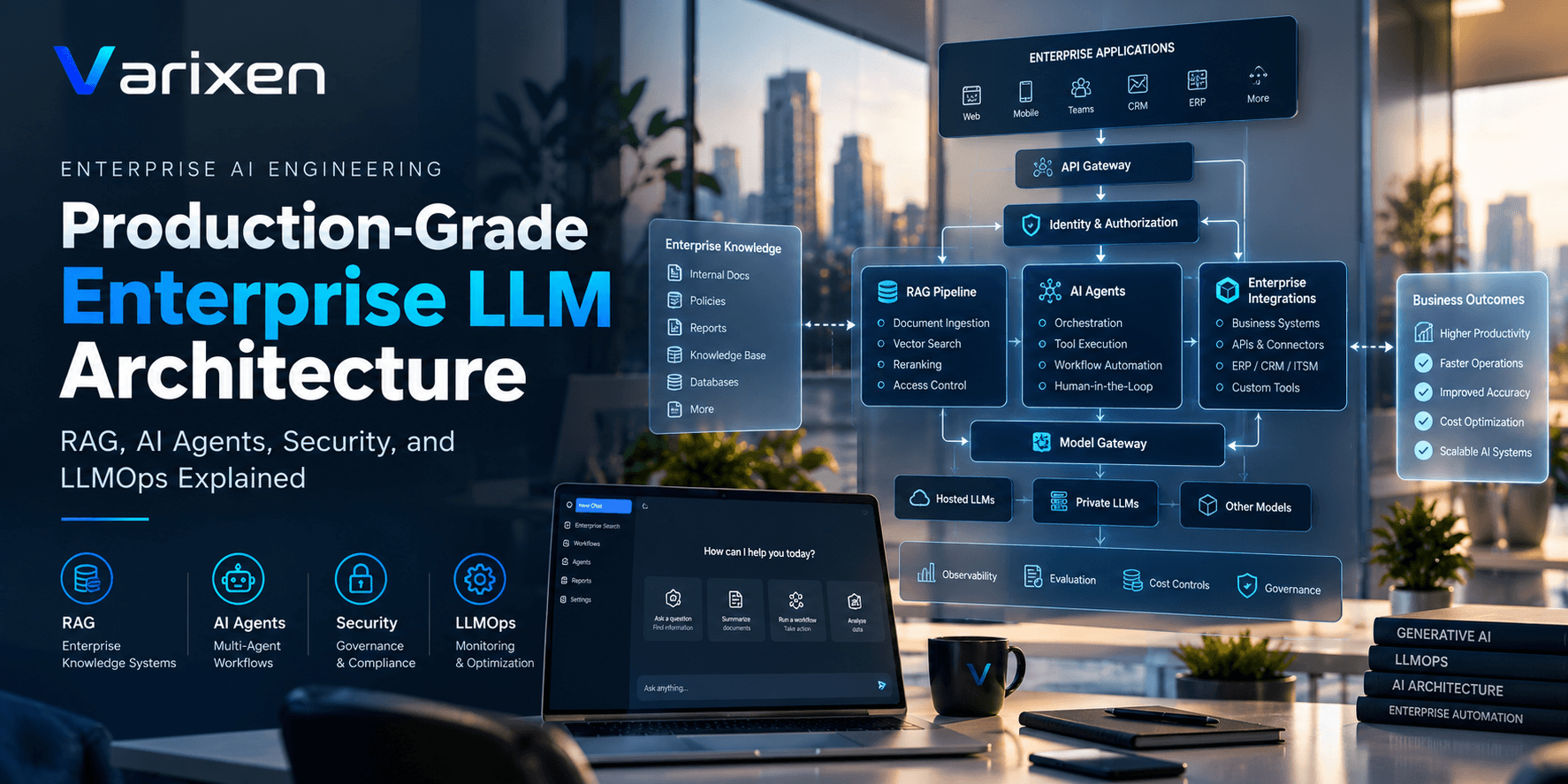
1. Understanding the Enterprise LLM Architecture Stack
A typical enterprise LLM application consists of several independently managed layers.
| / | \ |
| / | \ |
| \ | / |
| \ | / |
| / | \ |
| Cross-cutting: Observability | Evaluation | Security |
|---|---|---|
| LLMOps | Cost Controls | Governance |
The model is only one component.
The surrounding architecture determines whether the application can satisfy enterprise requirements.
Core architectural layers
| Layer | Primary responsibility |
|---|---|
| Application interface | User interaction and enterprise workflow integration |
| Identity and access | Authentication, authorization, tenant isolation |
| Orchestration | Routing, state management, prompt construction, execution control |
| Knowledge retrieval | Search, indexing, ranking, contextual grounding |
| Model gateway | Provider abstraction, model selection, quotas and usage tracking |
| Agent execution | Controlled tools, workflows and external actions |
| Evaluation | Quality, correctness, safety and regression testing |
| Observability | Tracing, latency, failures, token consumption and costs |
| Governance | Auditability, policy enforcement and data handling |
Separating these responsibilities reduces coupling and allows teams to evolve individual components without redesigning the entire system.
2. Designing an Enterprise RAG Pipeline
Retrieval-augmented generation enables an LLM to use external information without requiring that information to be embedded directly into the model's parameters.
For enterprise knowledge applications, RAG is often more practical than fine-tuning for continuously changing internal information.
However, production RAG requires considerably more than document embeddings and vector similarity search.
The ingestion pipeline
Enterprise Data Sources
    |
    v
Connectors and Change Detection
    |
    v
Parsing and Document Normalization
    |
    v
Chunking and Metadata Extraction
    |
    v
Access-Control Metadata
    |
    v
Embeddings + Search Indexes
    |
    v
Versioned Knowledge Repository
The ingestion layer should preserve document identifiers, source references, timestamps, versions, and access permissions.
For example, a financial services organization may have internal policies, regulatory documentation, contracts, and operational procedures.
Those documents cannot simply be indexed into a shared collection without considering authorization.
A critical design rule: retrieval must respect the requesting user's effective permissions.
Access checks should be enforced against trusted identity and authorization systems, not inferred by the LLM.
The retrieval pipeline
A robust query path might look like:
User Query
    |
Query Understanding
    |
Authorization-Aware Filtering
    |
Hybrid Retrieval
    |
Reranking
    |
Context Assembly
    |
LLM Generation
    |
Grounding and Output Validation
    |
Response + Source Citations
Hybrid retrieval combines semantic search with keyword-based methods such as BM25.
This can improve retrieval when queries contain exact identifiers, product codes, technical terminology, or phrases that embedding similarity alone may not reliably match.
Reranking then evaluates candidate passages against the user's query before they enter the model context.
The system should also handle insufficient evidence.
If relevant authorized information cannot be retrieved, the application should communicate that limitation rather than fabricate an answer.
What should be measured?
Production RAG systems should evaluate retrieval and generation separately.
Useful metrics include:
- Recall@k: Whether relevant information appears among retrieved results.
- Context precision: How much retrieved context is relevant.
- Faithfulness: Whether generated claims are supported by retrieved evidence.
- Answer correctness: Whether the response addresses the question accurately.
- Citation accuracy: Whether references support the claims attributed to them.
- Retrieval latency: How quickly the system obtains relevant context.
An apparently fluent answer is not sufficient evidence that the retrieval architecture is working correctly.
3. When Should Enterprises Use AI Agents?
Not every enterprise LLM application needs an autonomous agent.
For a straightforward knowledge-search application, a deterministic RAG workflow may be easier to secure, evaluate, and operate.
Agentic AI becomes useful when the application must select actions, interact with tools, manage multi-step execution, or respond dynamically to intermediate results.
Consider an enterprise procurement workflow.
An incoming request may require the system to:
- 1Classify the request.
- 2Extract structured requirements.
- 3Retrieve supplier information.
- 4Validate policy compliance.
- 5Identify missing information.
- 6Prepare a draft procurement record.
- 7Request approval before submitting a transaction.
Some steps are deterministic. Others require contextual reasoning.
The architecture should distinguish between them.
Recommended agent execution pattern
Request
   |
Intent Classification
   |
Policy and Permission Checks
   |
Workflow Orchestrator
   |
   +-- Retrieval Tool
   |
   +-- Validation Tool
   |
   +-- Enterprise API Tool
   |
   +-- Human Approval
   |
Execution Result
   |
Audit Log + State Update
The LLM can assist with planning and selecting permitted actions, but authorization and execution policy should remain outside the model.
Why uncontrolled agents fail
An agent that can freely call tools creates operational risks.
It may repeat a failed operation, execute a destructive action, expose sensitive data, or enter a costly execution loop.
Production agent systems therefore need:
Bounded execution: Limit steps, runtime, retries, and resource consumption.
Tool permissions: Grant only the capabilities required for the workflow.
Human approval: Require explicit authorization for sensitive or irreversible actions.
Idempotency: Prevent duplicate transactions when operations are retried.
State persistence: Preserve workflow progress across failures and restarts.
Audit trails: Record what actions were requested, approved, and executed.
Multi-agent architectures should be adopted when distinct roles or parallel workflows provide measurable benefits—not simply because multiple agents appear more sophisticated.
4. Security and Governance Must Be Architectural Controls
Enterprise AI introduces attack surfaces beyond those of conventional software.
For example, a malicious instruction embedded inside a retrieved document may attempt to redirect an agent or cause it to reveal information.
This is a prompt-injection attack.
The correct defense is not to assume that a stronger system prompt will prevent every attack.
Instead, applications should enforce trust boundaries.
Essential security controls
| Risk | Architectural control |
|---|---|
| Unauthorized document retrieval | Identity-aware access filtering |
| Prompt injection | Treat retrieved content as untrusted; restrict tool capabilities |
| Sensitive data leakage | Data classification, redaction and access controls |
| Unauthorized agent actions | Policy enforcement and approval gates |
| Cross-tenant exposure | Tenant isolation across storage and retrieval |
| Excessive resource consumption | Rate limits, quotas and execution budgets |
| Untraceable decisions | Structured logs and auditable execution records |
Enterprise integrations should use short-lived credentials or managed identities where supported.
Secrets should not be placed in prompts or exposed to model-generated tool arguments unnecessarily.
Security testing must include both conventional application vulnerabilities and AI-specific failure modes.
Frameworks such as the OWASP Top 10 for LLM Applications and NIST AI Risk Management Framework provide useful references for security and governance programs.
5. LLMOps: Operating AI as a Production Service
Traditional DevOps focuses on software delivery, infrastructure reliability, and operational automation.
LLMOps extends these practices to systems whose behavior depends on prompts, retrieved context, model versions, tools, and nondeterministic outputs.
A conventional application can pass unit tests while its LLM-generated answers become less reliable after a model or retrieval change.
That makes continuous evaluation essential.
A practical LLMOps lifecycle
Dataset and Evaluation Cases
           |
Prompt / Retrieval / Model Changes
           |
Automated Evaluation
           |
Security and Policy Checks
           |
Staging Deployment
           |
Canary or Controlled Rollout
           |
Production Monitoring
           |
Regression Analysis
           |
Continuous Improvement
Each release should track relevant configuration versions, including model identifiers, prompts, retrieval settings, and tool schemas.
Production observability
An enterprise LLM system should expose more than HTTP status codes.
Engineering teams should monitor:
| Metric | Why it matters |
|---|---|
| End-to-end latency | User experience and SLA performance |
| Time to first token | Responsiveness of streaming applications |
| Tokens per request | Usage efficiency |
| Cost per successful task | Business economics |
| Retrieval quality | Knowledge-system effectiveness |
| Tool execution failures | Agent reliability |
| Grounding failures | Answer trustworthiness |
| Human escalation rate | Automation effectiveness |
| Model/provider errors | Service availability |
| Policy violations | Security and governance |
Distributed tracing can connect an incoming request to retrieval operations, model calls, and downstream enterprise APIs.
Sensitive prompt content and personal data should be redacted or excluded from telemetry according to organizational policy.
6. Model Routing and AI FinOps
One of the most common architectural mistakes is routing every request to the most capable—and often most expensive—available model.
Different tasks require different levels of reasoning.
For example:
- Email classification may work with a small specialized model.
- Document extraction may require structured-output capabilities.
- Enterprise knowledge questions may require retrieval and a general-purpose LLM.
- Complex analysis may justify a more capable reasoning model.
A model gateway can route workloads based on capability, latency, privacy requirements, availability, and cost.
However, routing decisions must be validated against real evaluation datasets.
A cheaper model is not necessarily cheaper overall if its failure rate increases retries or human intervention.
Measure cost per successful outcome
A useful operational metric is:
Cost per successful task = Total AI workflow cost ÷ Number of successfully completed tasks
Workflow cost may include model inference, retrieval infrastructure, external services, retries, and human review.
This metric is more meaningful than token cost alone when evaluating enterprise automation economics.
Other optimization techniques include context reduction, caching where appropriate, batching, retrieval tuning, and selecting models based on task complexity.
7. Designing for Reliability and Scale
Production AI applications must tolerate variable inference latency, provider outages, concurrent requests, and long-running workflows.
Synchronous HTTP requests are suitable for short operations.
But workflows involving multiple model calls, document processing, and external systems may require asynchronous execution.
Example architecture
Client Application
       |
    API Layer
       |
 Request Validation
       |
  Workflow Store
       |
 Durable Task Queue
       |
  Worker Services
       |
 RAG / LLM / Agent Tools
       |
 Results + State Updates
       |
 Notification / Polling / Streaming
A durable queue helps decouple request intake from long-running processing.
Workers can scale independently, and workflow state can survive application restarts.
Critical design considerations include retry policies, exponential backoff, concurrency limits, dead-letter handling, idempotency keys, cancellation, and recovery procedures.
For enterprise applications, reliability is not merely a question of model uptime.
It depends on the entire execution chain.
8. Example: Enterprise Knowledge and Workflow Assistant
Consider a hypothetical organization building an internal AI assistant for IT operations.
Employees need answers from internal documentation and the ability to initiate approved service workflows.
The application might use:
Frontend: Next.js or React for the employee interface.
Backend: Python FastAPI or Node.js for APIs and orchestration.
Retrieval: PostgreSQL with pgvector, or another suitable search platform.
Model integration: A gateway supporting approved enterprise model providers.
Workflow execution: Controlled tool integrations with ITSM and identity systems.
Observability: OpenTelemetry-compatible tracing, metrics, and centralized logging.
Security: SSO, role-based authorization, document-level access enforcement, and audit logging.
An employee asks:
“What is the process for requesting access to the finance reporting system?”
The application authenticates the employee, retrieves authorized policy documentation, and returns a grounded response with citations.
If the employee requests access, the system invokes an approved workflow.
The LLM may prepare the request, but the actual permission change remains subject to organizational approval rules.
This illustrates the distinction between a chatbot and an enterprise AI application.
The chatbot generates answers.
The enterprise application manages a governed business process.
9. A Practical Production Readiness Checklist
Before launching an enterprise LLM application, engineering teams should be able to answer the following questions.
| Area | Production readiness question |
|---|---|
| Architecture | Are components modular and independently maintainable? |
| Retrieval | Is retrieval quality evaluated against representative queries? |
| Access control | Are document and tool permissions enforced outside the model? |
| Evaluation | Are quality and regression tests part of deployment? |
| Security | Have prompt injection and data leakage risks been tested? |
| Reliability | Can workflows recover from timeouts and partial failures? |
| Observability | Can engineers trace a request across every major component? |
| Cost | Is cost per successful task measured? |
| Governance | Are changes, actions and approvals auditable? |
| Operations | Are ownership, incident response and rollback procedures defined? |
A production release should also have explicit acceptance thresholds based on the application's risk profile and business requirements.
There is no universal accuracy, latency, or automation-rate target suitable for every enterprise AI use case.
Conclusion: The Model Is Not the Product
Enterprise LLM development is moving beyond experimentation.
Organizations increasingly need AI systems that can retrieve trusted information, execute controlled workflows, integrate with existing applications, and operate within defined security and financial constraints.
Achieving that requires more than selecting a foundation model.
It requires disciplined software architecture, retrieval engineering, agent orchestration, LLMOps, security, observability, and continuous evaluation.
The real engineering challenge is not making an LLM generate an impressive response. It is making the complete AI system dependable enough for real business operations.
At Varixen, our Enterprise AI Engineering focus includes RAG, agentic AI, intelligent automation, enterprise integration, LLMOps, and production-grade architecture.
For organizations planning an enterprise AI initiative, the most valuable starting point is a clear understanding of the business workflow, operating constraints, and measurable outcomes the system must deliver.
Explore Varixen's enterprise AI capabilities: https://www.varixen.com