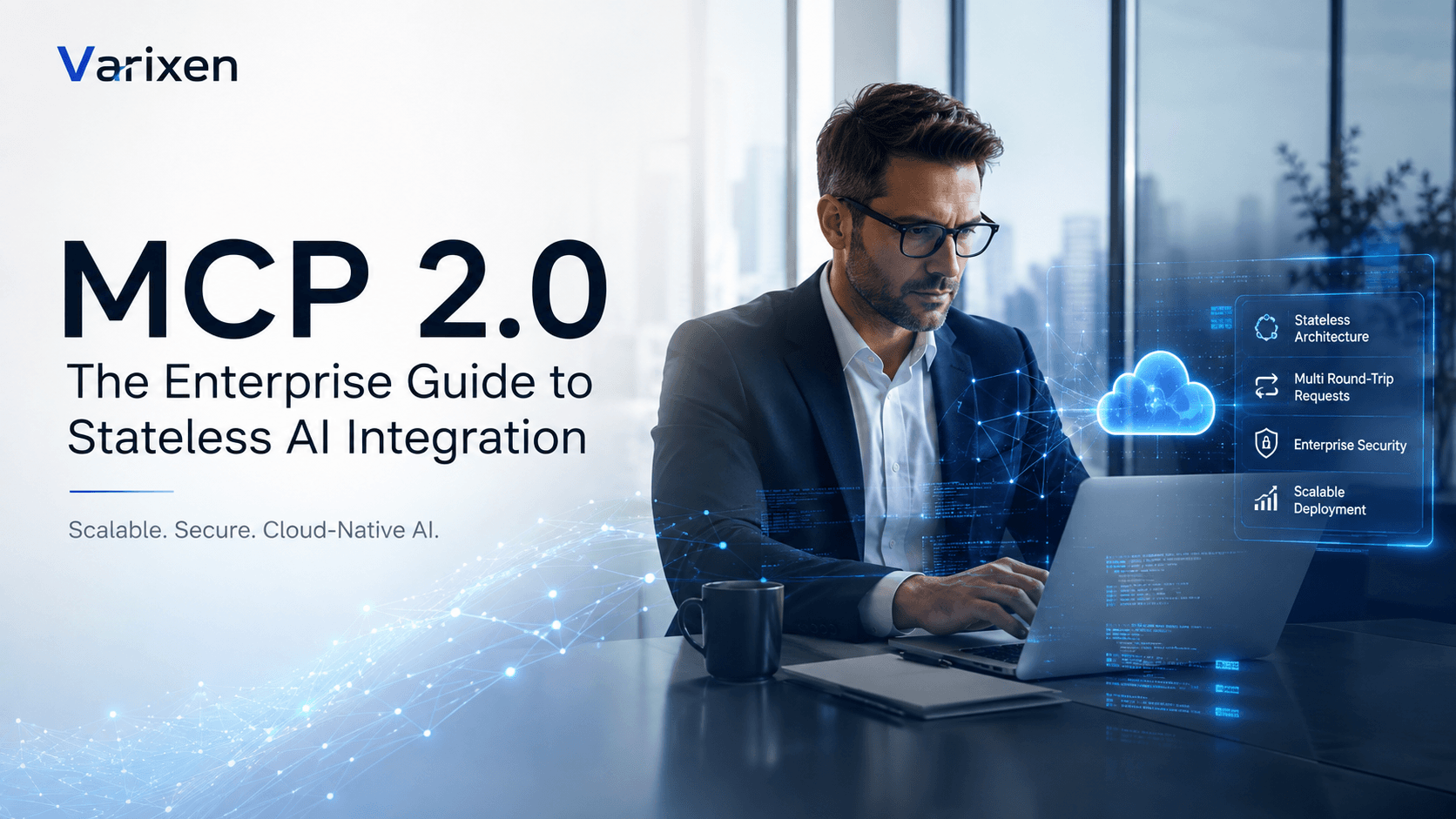
MCP 2.0 Explained: The Enterprise Guide to Stateless AI Integration, Scalable Agent Architectures, and the Future of Model Context Protocol
How the new Model Context Protocol architecture enables scalable, secure, cloud-native AI systems for enterprise production workloads.
Varixen Editorial Team
Enterprise Architecture & AI Advisory
Executive Summary
Enterprise AI adoption has shifted from experimentation to mission-critical production deployments. As organizations scale AI assistants, autonomous agents, enterprise search, intelligent workflows, and LLM-powered applications, one challenge has consistently emerged: building a standardized communication layer that is scalable, secure, interoperable, and cloud-native.
The latest Model Context Protocol specification—commonly referred to as MCP 2.0—addresses these challenges through a fundamental architectural redesign. Unlike earlier session-based implementations, MCP 2.0 embraces stateless HTTP communication, enterprise authorization standards, standardized extensions, improved routing, cache-aware discovery, and production-grade scalability.
For enterprise leaders, this evolution enables AI platforms that integrate seamlessly with existing API gateways, load balancers, security infrastructure, and cloud-native deployment models. Rather than merely enhancing developer experience, MCP 2.0 establishes a foundation for resilient, observable, and governable AI ecosystems capable of supporting millions of requests across distributed environments.
This article explores the architectural changes introduced in MCP 2.0, their business implications, implementation guidance, enterprise reference architectures, migration strategies, and real-world use cases based on the official MCP specification summarized in Varixen's internal reference guide.
Table of Contents
- 1Introduction
- 2Understanding MCP 2.0
- 3Current Industry Challenges
- 4Why This Problem Matters
- 5Technical Deep Dive
- 6Enterprise Architecture
- 7Real-World Enterprise Case Study
- 8Business Benefits
- 9Implementation Roadmap
- 10Common Mistakes
- 11Enterprise Best Practices
- 12Future Trends
- 13Key Takeaways
- 14Frequently Asked Questions
- 15Conclusion
- 16About Varixen
- 17Call To Action
- 18Internal Linking Suggestions
- 19External References
- 20Image Recommendations
- 21SEO Quality Checklist
Introduction
Modern enterprises rarely rely on a single AI model or isolated automation workflow. Instead, they operate complex ecosystems comprising foundation models, internal APIs, enterprise databases, document repositories, workflow engines, vector databases, identity providers, and business applications.
Historically, integrating these heterogeneous systems required bespoke connectors, proprietary SDKs, or tightly coupled middleware, leading to increased maintenance costs and limited interoperability.
Model Context Protocol (MCP) was introduced to standardize interactions between AI applications and external tools. According to the internal MCP 2.0 guide, the 2026-07-28 specification marks the most significant protocol revision since its inception, introducing a shift from stateful, session-based communication to a stateless request/response model over standard HTTP.
This architectural evolution enables horizontal scalability behind conventional load balancers, simplifies gateway integration, introduces Multi Round-Trip Requests (MRTR), formalizes extensions such as Tasks and Enterprise Managed Authorization, and strengthens OAuth/OpenID Connect alignment.
Current Industry Challenges
Enterprise AI teams frequently encounter challenges including:
- Scaling session-based AI integrations across distributed infrastructure.
- Managing sticky sessions and state synchronization in load-balanced environments.
- Integrating AI systems with existing API gateways, WAFs, and enterprise security controls.
- Supporting long-running agent workflows without maintaining persistent connections.
- Standardizing authorization across multiple identity providers.
- Ensuring consistent interoperability across diverse SDKs and programming languages.
- Balancing performance with governance through caching and protocol optimization.
These issues can increase infrastructure complexity, operational costs, and deployment risk, particularly as AI workloads transition from pilot projects to production platforms.
Why This Problem Matters
The architectural decisions underlying AI integration protocols have direct business implications:
- Revenue Growth: Faster deployment of AI-enabled products accelerates time-to-market.
- Operational Efficiency: Stateless communication simplifies scaling and reduces infrastructure overhead.
- Scalability: Horizontal scaling supports high-volume AI interactions without session affinity.
- Security: Enhanced authorization practices mitigate identity-related vulnerabilities.
- Governance: Standardized extensions and routing improve observability and policy enforcement.
By addressing these concerns, MCP 2.0 enables organizations to build AI platforms that are resilient, compliant, and aligned with modern cloud-native principles.
Technical Deep Dive
The internal MCP 2.0 guide highlights several core architectural advancements:
Stateless Protocol Core
MCP 2.0 eliminates the initialize/initialized handshake and session identifiers. Each request is self-contained, allowing any server instance to process it independently.
Multi Round-Trip Requests (MRTR)
Instead of maintaining a held-open bidirectional stream for user interactions, servers can return an input_required response. Clients gather the requested information and resubmit the original call with the necessary inputs, preserving statelessness while supporting interactive workflows.
Header-Based Routing
Mandatory HTTP headers such as Mcp-Method and Mcp-Name enable gateways to route, authorize, and meter traffic without parsing JSON payloads. This simplifies integration with existing API gateways and web application firewalls.
Cacheable Resource Discovery
Responses for tools/list, prompts/list, resources/list, and resources/read include cache metadata (ttlMs and cacheScope), allowing clients to reduce redundant requests and improve latency.
Extensions Framework
MCP 2.0 formalizes an extensibility model that includes Tasks, MCP Apps, and Enterprise Managed Authorization, enabling protocol evolution without modifying the core specification.
Enhanced Authorization
The specification aligns with OAuth 2.0 and OpenID Connect best practices, including issuer validation (RFC 9207), issuer-bound client credentials, and migration away from Dynamic Client Registration toward Client ID Metadata Documents.
Enterprise Architecture
Reference Architecture
An enterprise MCP 2.0 deployment may include:
- AI clients (web, mobile, IDEs)
- MCP-enabled applications
- API Gateway / WAF
- MCP servers
- Enterprise identity provider
- AI models and inference services
- Business APIs
- Vector databases
- Document repositories
- Monitoring and observability platforms
- Cloud load balancers
- Kubernetes clusters
- Long-running task orchestration services
Data Flow
- 1Client issues a stateless HTTP request.
- 2Gateway routes traffic using protocol headers.
- 3Identity services authenticate and authorize the request.
- 4MCP server invokes tools or AI models.
- 5External systems return results.
- 6Response is delivered to the client.
- 7Long-running operations leverage the Tasks extension for polling and notifications.
Real-World Case Study
Problem
A multinational financial services organization sought to deploy AI-powered operational assistants across multiple regions. The legacy session-based integration model complicated horizontal scaling and required session affinity across load-balanced infrastructure.
Solution
The organization migrated to MCP 2.0, adopting stateless communication, MRTR for interactive approvals, standardized authorization, and header-based gateway routing.
Implementation
- Upgraded Tier 1 SDKs.
- Replaced session management with stateless requests.
- Configured gateway routing using MCP headers.
- Integrated OAuth issuer validation.
- Implemented Tasks extension for background processing.
Business Results
| Metric | Outcome |
|---|---|
| Infrastructure scalability | Improved through horizontal scaling |
| Operational complexity | Reduced by eliminating session affinity |
| Security posture | Strengthened with enhanced authorization validation |
| Developer productivity | Increased through standardized protocol behavior |
Lessons Learned
- Design for statelessness from the outset.
- Integrate governance and security into protocol adoption.
- Leverage standardized extensions rather than custom implementations.
Business Benefits
| Benefit | Business Impact | Expected ROI |
|---|---|---|
| Stateless Architecture | Lower infrastructure complexity | High |
| Header-Based Routing | Simplified gateway integration | High |
| Cacheable Discovery | Reduced latency and network overhead | Medium |
| Standardized Extensions | Improved interoperability | High |
| Enhanced Authorization | Reduced security risk | High |
| Horizontal Scaling | Better resource utilization | High |
Implementation Roadmap
Phase 1 – Assessment
Evaluate existing MCP deployments, session management, and infrastructure dependencies.
Phase 2 – Planning
Define migration architecture, authorization model, and gateway configuration.
Phase 3 – Pilot
Deploy MCP 2.0 in a controlled production environment.
Phase 4 – Production Rollout
Expand adoption across enterprise AI services, monitoring performance and governance.
Phase 5 – Optimization
Refine caching, observability, scaling policies, and extension usage.
Common Mistakes
- Retaining hidden transport-level session state.
- Ignoring gateway routing capabilities.
- Delaying authorization modernization.
- Neglecting cache metadata.
- Overlooking migration guidance for deprecated features.
Best Practices
- Adopt stateless design principles.
- Utilize official Tier 1 SDKs.
- Integrate enterprise identity providers.
- Implement comprehensive observability.
- Use standardized protocol extensions.
- Follow official migration guidance for deprecated components.
Future Trends
- Wider adoption of enterprise AI interoperability standards.
- Increased use of agentic AI and multi-agent orchestration.
- Greater emphasis on governance and policy-driven AI integration.
- Expansion of cloud-native AI architectures leveraging stateless protocols.
- Continued evolution of protocol extensions for specialized enterprise workloads.
Key Takeaways
- MCP 2.0 introduces a stateless request/response architecture.
- MRTR enables interactive workflows without persistent connections.
- Header-based routing simplifies enterprise gateway integration.
- Formal extensions enhance protocol flexibility.
- Enhanced authorization improves enterprise security.
- Horizontal scalability supports production-grade AI deployments.
Frequently Asked Questions
- 1What is MCP 2.0?
- 2How does MCP 2.0 differ from earlier versions?
- 3Why is stateless architecture important?
- 4What are Multi Round-Trip Requests?
- 5How does header-based routing benefit enterprises?
- 6What authorization improvements are included?
- 7How should organizations approach migration?
- 8Which enterprise workloads benefit most from MCP 2.0?
Conclusion
MCP 2.0 represents a significant milestone in the maturation of enterprise AI infrastructure. By embracing stateless communication, standardized extensions, modern authorization, and cloud-native architectural principles, organizations can build scalable, secure, and interoperable AI ecosystems capable of supporting the next generation of intelligent applications. The changes outlined in the official specification provide a practical foundation for enterprises seeking to operationalize AI at scale while reducing complexity and improving governance.
About Varixen
Varixen is an Enterprise AI and Software Engineering company that helps organizations accelerate digital transformation through Artificial Intelligence, Agentic AI, Cloud Engineering, Automation, Data Engineering, Enterprise Software Development, and intelligent business solutions. By combining deep technical expertise with enterprise architecture best practices, Varixen supports businesses in designing, implementing, and scaling modern AI platforms.
Call To Action
If your organization is evaluating enterprise AI platforms or planning large-scale AI integrations, contact Varixen to schedule a consultation. Our experts can help assess your architecture, design secure AI ecosystems, and accelerate your digital transformation journey.
Internal Linking Suggestions
- 1Building Enterprise AI Agents with MCP
- 2Designing Multi-Agent Systems for Large Enterprises
- 3Enterprise AI Governance Best Practices
- 4Cloud-Native Architectures for Generative AI
- 5Securing Enterprise LLM Applications
External References
- Model Context Protocol Specification
- Microsoft Learn
- AWS Architecture Center
- Google Cloud Architecture Framework
- NVIDIA AI Documentation
- IBM AI Documentation
- NIST AI Risk Management Framework
- McKinsey Technology Insights
- Deloitte AI Institute
To download the detailed guide, Visit Varixen: https://www.linkedin.com/feed/update/urn:li:activity:7493228837544296449