The Future of Enterprise AI in 2026: From AI Assistants to Autonomous Business Systems
How executive leadership is moving beyond chatbot copilots to deploy self-healing, multi-agent AI operating systems that execute complex enterprise workflows at scale.
Varixen AI Advisory & Engineering Practice
Enterprise Autonomous Systems Team
1. Introduction: Why Enterprise AI Has Moved Beyond Experimentation
The enterprise technology landscape in 2026 has crossed a definitive threshold. For the past three years, boardrooms and executive suites treated Generative AI primarily as a productivity tool—experimenting with standalone chatbots, code autocomplete plugins, and draft text generators.
However, 2026 marks the official sunset of the proof-of-concept (PoC) era. Chief Executive Officers (CEOs), Chief Technology Officers (CTOs), and Chief Information Officers (CIOs) are no longer satisfied with vanity metrics like "time saved drafting emails" or "internal query counts." CFOs are actively demanding hard unit-economic returns, strict operational SLA guarantees, and direct bottom-line impact.
The fundamental shift occurring across global enterprises can be summarized in a single transformation:
The transition from passive AI assistants (Copilots) to active, event-driven Autonomous Business Systems (Agentic AI).
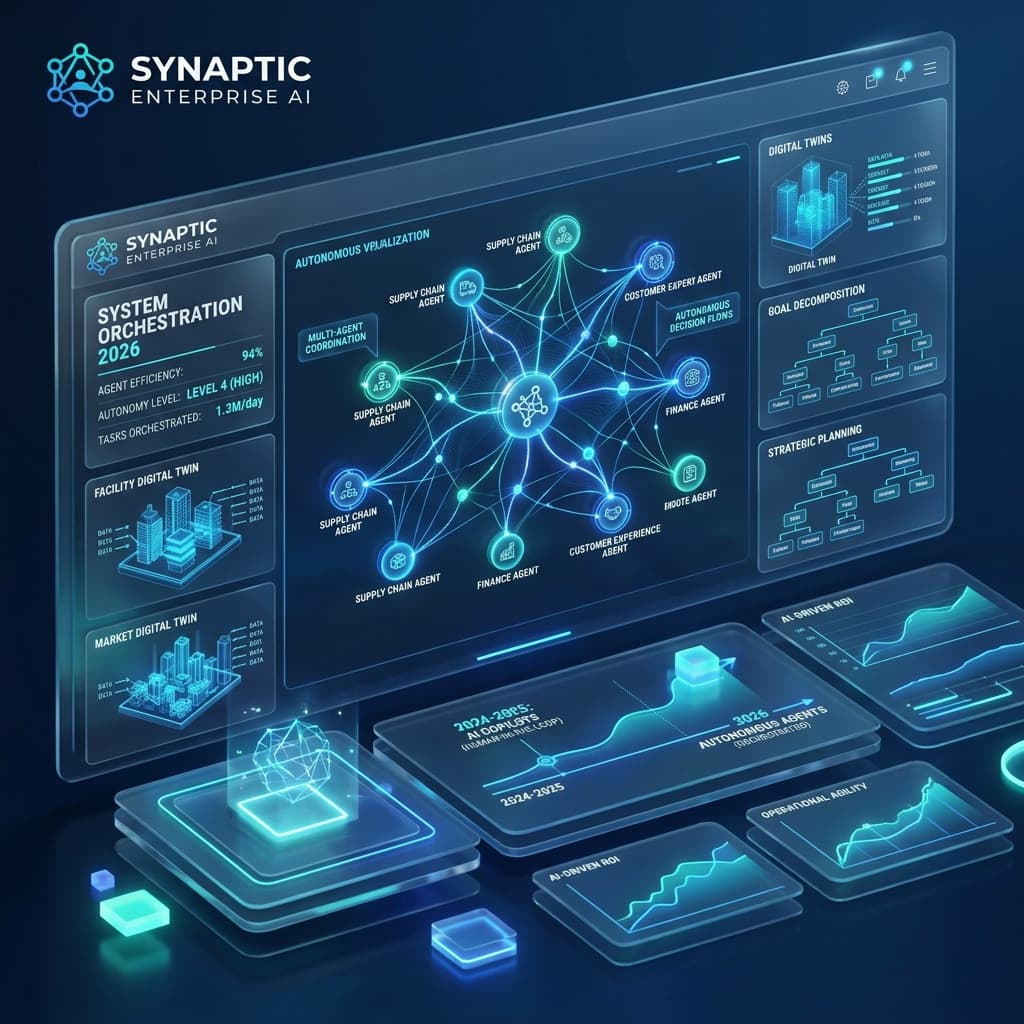
Rather than waiting for a human employee to type a prompt, modern Enterprise AI systems autonomously monitor business events, orchestrate multi-step cross-functional workflows, make context-aware decisions within enterprise guardrails, and execute transactions directly inside core systems of record (SAP, Salesforce, Workday, and custom databases).
[2023 - 2024: Conversational Copilots]
   Human Prompt ──► LLM API ──► Text Output ──► Human Manual Action

   [2025 - 2026+: Autonomous Enterprise Systems]
   Business Event ──► AI Agent Swarm ──► Semantic RAG + Graph ──► Enterprise API Execution
Why 2026 Is the Turning Point for Enterprise AI
- 1Model Economics & Efficiency Gains: Sub-second inference latency, specialized Small Language Models (SLMs), and dramatic cost drops per million tokens have made multi-agent continuous reasoning financially viable at scale.
- 2Multi-Agent Orchestration Maturity: Production-grade agent frameworks now support deterministic state management, automatic drift recovery, and zero-downtime task handoffs.
- 3Enterprise Vector & Knowledge Graph Scale: Vector databases and Graph RAG architectures have evolved to handle petabyte-scale structured and unstructured enterprise data with enterprise-grade access control.
- 4Confidential Computing & Sovereign Enclaves: Isolated VPC enclaves and confidential cloud computing enable organizations to process sensitive corporate IP without third-party data leakage risks.
- 5Regulatory & Compliance Governance Standards: Regulatory frameworks like the EU AI Act and ISO 42001 provide clear operational boundaries for safe, auditable autonomous decision-making.
2. What Is Enterprise AI? Defining the Next Generation of Business Computing
To navigate the 2026 AI landscape, executive leaders must distinguish between generic consumer AI tools and true Enterprise AI Architecture.
Enterprise AI is the integration of foundation models, specialized machine learning algorithms, vector retrieval pipelines, security guardrails, and legacy enterprise software connections into a unified, secure infrastructure that automates complex business processes with full auditability.
The 4 Generational Eras of Business Software
| Dimension | Era 1: Traditional Software | Era 2: Intelligent Software | Era 3: AI-First Systems | Era 4: Autonomous Workflows |
|---|---|---|---|---|
| Core Paradigm | Deterministic rule-based scripts | Statistical ML & predictive models | Generative LLMs & Copilots | Multi-agent autonomous networks |
| User Interaction | Forms, buttons, & rigid UIs | Dashboards & risk scores | Chat interfaces & prompts | Event-driven background execution |
| Data Processing | Structured SQL tables | Historical datasets & tabular ML | Unstructured text & vector RAG | Multimodal context (Text, Graph, Audio, APIs) |
| Decision Authority | 100% Manual human entry | Human advisory recommendation | Human-in-the-loop review | Autonomous execution with policy guardrails |
| Operational Impact | Task digitization | Forecasting & anomaly detection | Employee drafting assistance | End-to-end business process transformation |
High-Level Enterprise AI System Architecture
Below is the foundational architectural blueprint powering autonomous enterprise deployments in 2026:
┌─────────────────────────────────────────────────────────────────────────┐
│                      ENTERPRISE USER & EVENT LAYERS                     │
│  [Web Apps]   [Mobile Interfaces]   [Webhooks/Kafka]   [Email & Slack]   │
└────────────────────────────────────┬────────────────────────────────────┘
                                     │
┌────────────────────────────────────▼────────────────────────────────────┐
│                    ENTERPRISE AI GATEWAY & SECURITY                     │
│  - Identity & Access (RBAC/ABAC)         - Token Rate Limiting          │
│  - Prompt Injection Firewall              - Audit & Telemetry Logging    │
└────────────────────────────────────┬────────────────────────────────────┘
                                     │
┌────────────────────────────────────▼────────────────────────────────────┐
│                AGENT ORCHESTRATION & REASONING ENGINE                   │
│  - Task Planner Agent      - Execution Agent     - Compliance Guardrail  │
│  - State Checkpointing     - Tool Calling Bus    - Self-Healing Loop     │
└───────────────────┬─────────────────────────────────┬───────────────────┘
                    │                                 │
┌───────────────────▼───────────────┐     ┌───────────▼───────────────────┐
│     RETRIEVAL & MEMORY LAYER      │     │    FOUNDATION & SPECIALIST    │
│ - Vector Database (Qdrant/Milvus) │     │         MODEL LAYER           │
│ - Knowledge Graph (Neo4j)         │     │ - Frontier LLMs (Claude/GPT)  │
│ - Semantic Cache (Redis Enclave)  │     │ - Sovereign SLMs (vLLM Enclave)│
└───────────────────┬───────────────┘     └───────────┬───────────────────┘
                    │                                 │
┌───────────────────▼─────────────────────────────────▼───────────────────┐
│                    SYSTEMS OF RECORD INTEGRATION                        │
│  [SAP / ERP]   [Salesforce / CRM]   [Workday / HRMS]   [Data Lakes/S3]  │
└─────────────────────────────────────────────────────────────────────────┘
Learn more about how Varixen designs custom enterprise architectures: Explore Varixen Enterprise AI Solutions
3. The Evolution of AI: The 8-Stage Timeline to Autonomous Enterprises
Understanding where your organization sits on the AI maturity spectrum is essential for building a multi-year technology roadmap. Enterprise AI has progressed through eight distinct evolutionary milestones:
[1. Rule-Based Automation] ──► [2. Machine Learning] ──► [3. Deep Learning] ──► [4. Generative AI]
                                                                                      │
[8. Autonomous Enterprises] ◄── [7. Multi-Agent Systems] ◄── [6. AI Agents] ◄── [5. AI Copilots]- 1Rule-Based Automation (2010–2015): Basic Robotic Process Automation (RPA) and hardcoded
if-thenscripts. Brittle, expensive to maintain, and broke whenever UI layouts changed. - 2Machine Learning (2015–2018): Supervised learning for predictive maintenance, fraud detection, and customer churn scoring using structured tabular data.
- 3Deep Learning & Vision (2018–2021): Convolutional Neural Networks (CNNs) and BERT models for optical character recognition (OCR), document classification, and medical imaging.
- 4Generative AI & Foundation Models (2022–2023): Mass adoption of Large Language Models capable of zero-shot text generation, summarization, and natural language understanding.
- 5AI Copilots (2023–2024): Embedded sidebars in IDEs, CRM tools, and office suites, assisting individual employees with drafting, coding, and search.
- 6AI Agents (2024–2025): Single-agent setups capable of multi-step task execution, web search, tool calling, and structured database queries.
- 7Multi-Agent Systems (2025–2026): Collaborating swarms of domain-specialized agents (e.g., Finance Agent + Legal Compliance Agent + SAP Execution Agent) working together under an orchestration manager.
- 8Autonomous Enterprises (2026+): Self-optimizing business operations where cross-departmental agent networks manage routine operational transactions end-to-end, escalating only high-risk anomalies to human executives.
4. The Biggest Problems Enterprises Still Face in 2026
Despite historic investments in digital transformation, large organizations continue to suffer from chronic operational friction points:
1. Manual Approval Cycles & Operational Bottlenecks Complex business processes (e.g., capital expenditure requests, vendor approvals, contract amendments) routinely stall in multi-layer email chains and manual review queues—costing global enterprises weeks of unnecessary delay.
2. Unstructured Document Overload Up to 80% of enterprise data remains trapped in unstructured formats: multi-page PDF contracts, scanned invoices, regulatory filings, engineering blueprints, and customer communications. Traditional software cannot process this data without manual human intervention.
3. Deep Knowledge Silos Across Fragmented Systems Institutional knowledge is fragmented across SharePoint, Confluence, Slack, Jira, Salesforce, and legacy databases. Employees waste up to 2.5 hours per day searching for authoritative information or re-creating existing work.
4. Procurement Delays & Vendor Evaluation Risk Evaluating vendor RFPs involves cross-referencing security compliance, financial stability, technical specifications, and legal pricing terms. Manual evaluation of dozens of complex vendor responses delays critical operational timelines.
5. Legacy Systems & Technical Infrastructure Debt Decades-old core ERPs, mainframes, and on-premises databases lack modern REST APIs or microservices architectures, making integration with modern cloud applications difficult and slow.
6. Scaling Operational Costs Linearly In traditional business models, expanding revenue requires scaling operational headcount linearly. As labor costs rise, margin compression forces executives to seek non-linear operational leverage.
5. How Enterprise AI Solves These Problems Across Core Business Functions
Enterprise AI does not replace core systems; it creates an intelligent cognitive layer on top of your existing software stack. Here is how modern organizations deploy AI across core business functions:
┌─────────────────────────────────────────────────────────────────────────────┐
│                      CROSS-FUNCTIONAL ENTERPRISE AI IMPACT                  │
├───────────────────┬─────────────────────────────────────────────────────────┤
│ Business Function │ AI Transformation Scenario & Action Pattern             │
├───────────────────┼─────────────────────────────────────────────────────────┤
│ Procurement       │ Autonomous RFP evaluation, vendor risk scoring, and     │
│                   │ contract clause extraction.                             │
├───────────────────┼─────────────────────────────────────────────────────────┤
│ Human Resources   │ Zero-touch onboarding, automated candidate matching,    │
│                   │ and 24/7 benefits policy resolution.                    │
├───────────────────┼─────────────────────────────────────────────────────────┤
│ Finance & Audit   │ Real-time invoice matching, anomaly audit detection,    │
│                   │ and continuous GAAP/IFRS compliance monitoring.         │
├───────────────────┼─────────────────────────────────────────────────────────┤
│ Manufacturing     │ Visual quality inspection, supply chain rerouting, and  │
│                   │ predictive equipment maintenance via digital twins.    │
├───────────────────┼─────────────────────────────────────────────────────────┤
│ Healthcare        │ Clinical trial protocol matching, HIPAA document         │
│                   │ abstraction, and prior-authorization processing.        │
├───────────────────┼─────────────────────────────────────────────────────────┤
│ Customer Support  │ Autonomous multi-channel ticketing, sentiment-aware     │
│                   │ escalation, and instant RMA processing.                 │
├───────────────────┼─────────────────────────────────────────────────────────┤
│ IT & Engineering  │ Self-healing infrastructure, security log anomaly       │
│                   │ triage, and automated legacy code modernization.        │
└───────────────────┴─────────────────────────────────────────────────────────┘
Deep Dive: Departmental Applications
- Procurement & Supply Chain: Autonomous agent swarms parse incoming vendor proposals, compare technical specs against internal standards, verify compliance, and output structured scoring matrices in hours instead of weeks.
- Finance & Accounting: Continuous AI audit engines stream incoming ledger entries, cross-referencing POs, receipts, and bank statements to flag duplicate invoices or compliance anomalies prior to payment execution.
- IT & Cybersecurity: AI security agents monitor SIEM log streams in real-time, detecting multi-stage zero-day attack vectors, automatically isolating compromised endpoints, and generating incident remediation reports.
Discover how Varixen transforms specific organizational departments: Explore Varixen Departmental AI Solutions
6. Flagship Case Study: Global Manufacturing Enterprise Transformation
To understand the real-world operational and financial impact of Enterprise AI, consider a representative transformation executed for a multinational manufacturing organization:
### Client Profile: Global Industrial Equipment Manufacturer > - Scale: Operations in 14 countries, 30,000+ employees, $4.2B annual revenue. > - Operational Friction: Evaluated over 300 vendor RFPs annually across complex mechanical components, raw materials, and logistics services. > - Baseline Process: Manual 3-week evaluation cycle per procurement round involving cross-functional reviews from engineering, legal, security, and finance teams. Total cost: $4.5M in annual administrative overhead.
[BEFORE VARIXEN]
Incoming Vendor RFPs ──► 3 Weeks Manual Review ──► High Cost ($4.5M/yr) ──► Missed Savings
[AFTER VARIXEN]
Incoming Vendor RFPs ──► Varixen Agentic Engine ──► 3.5 Days Scored Output ──► $1.8M Saved
`
The Varixen Solution
Varixen architected and deployed an Agentic Procurement Intelligence Engine:
- 1Multimodal Ingestion Pipeline: Automated parsing of unstructured vendor PDF responses, financial tables, ISO certifications, and technical blue-prints into a secure vector and document graph database.
- 2Multi-Agent Evaluation Swarm:
- 3- Technical Agent: Scored vendor blue-print compliance against internal engineering tolerances.
- 4- Commercial & Risk Agent: Verified supplier financial health, pricing index benchmarks, and credit metrics.
- 5- ESG & Legal Agent: Audited carbon footprint disclosures, supply chain transparency, and contract indemnity terms.
- 3Human-in-the-Loop Approval Dashboard: Procurement leaders received an interactive comparison matrix with instant source-document attribution and automated negotiation recommendation scripts.
Quantifiable Results Achieved
- 80% Reduction in Evaluation Cycle Time: Slashed average RFP review time from 21 business days down to 3.5 days.
- $1.8 Million Negotiated Savings: Identified volume discount pricing opportunities and favorable terms across 45 primary vendor contracts in Year 1.
- 100% Audit Compliance: Eliminated human oversight errors in vendor risk evaluations, ensuring complete compliance with corporate ESG mandates.
7. AI Agents vs Traditional Automation (RPA): Detailed Comparison
Executive leaders often ask: "How do AI Agents differ from the Robotic Process Automation (RPA) tools we bought five years ago?"
The table below outlines the core architectural and operational distinctions:
| Evaluation Criteria | Traditional Automation (RPA) | Enterprise AI Agents (2026) |
|---|---|---|
| Decision-Making Engine | Hardcoded if/else conditional logic | Semantic reasoning & dynamic LLM/SLM planning |
| Adaptability to UI/API Changes | High failure rate; breaks if buttons move or APIs change | High resilience; self-heals by interpreting semantic context |
| Data Handling Capabilities | Structured data only (Excel, database fields) | Unstructured, semi-structured & multimodal data (PDFs, images, audio) |
| Handling Edge Cases | Throws unhandled exceptions; requires manual intervention | Autonomous problem-solving & alternative path routing |
| Learning & Self-Improvement | Static; requires human developers to rewrite scripts | Dynamic; learns from human feedback & operational telemetry |
| Orchestration Model | Linear single-threaded scripts | Asynchronous multi-agent swarms with consensus protocols |
| Time to Value & Maintenance | High maintenance overhead & brittle codebases | Rapid configuration; continuous adaptability to enterprise changes |
8. Enterprise AI Reference Architecture (The Technical Stack)
Building a secure, resilient, enterprise-grade AI stack requires a layered systems architecture. The key components include:
┌─────────────────────────────────────────────────────────────────────────┐
│ 1. ENTERPRISE GATEWAY & ACCESS CONTROL                                  │
│ - OAuth2 / OIDC Single Sign-On        - Fine-Grained RBAC & ABAC         │
│ - Prompt Scrubbing & Data Loss Guard   - SLA & Concurrency Throttling     │
└────────────────────┬────────────────────────────────────┘
                                     │
┌────────────────────▼────────────────────────────────────┐
│ 2. REASONING & MULTI-AGENT ORCHESTRATION                                │
│ - Task Planning & Decomposition       - State Checkpointing (Redis)      │
│ - Consensus & Evaluation Loops        - Human-in-the-Loop Escalation     │
└────────────────────┬────────────────────────────────────┘
                                     │
┌────────────────────▼────────────────────────────────────┐
│ 3. HYBRID RETRIEVAL & VECTOR MEMORY (RAG)                               │
│ - Vector Search Engine (Qdrant)       - Enterprise Knowledge Graph       │
│ - Semantic Cache & Deduplication      - Document Chunking & Hybrid Search│
└────────────────────┬────────────────────────────────────┘
                                     │
┌────────────────────▼────────────────────────────────────┐
│ 4. MODEL EXECUTION & PRIVACY ENCLAVE                                    │
│ - Private Sovereign Model Enclaves    - Managed Foundation Cloud APIs    │
│ - Model Guardrails & Hallucination Checks                               │
└─────────────────────────────────────────────────────────────────────────┘
Key Architectural Layers
- 1Enterprise AI Gateway: Acts as the central traffic control point. Manages API rate limits, filters prompt injection attacks, redacts PII data before payload delivery, and maintains complete SOC2 audit logs.
- 2Multi-Agent Orchestration Bus: Coordinates work among specialized AI agents. Ensures state persistence across long-running tasks, handles retries gracefully, and enforces execution timeouts.
- 3Hybrid Retrieval & Memory Layer (RAG + Knowledge Graph): Combines dense vector retrieval (for semantic similarity search) with Knowledge Graphs (for exact entity-relationship traversal). This hybrid approach reduces hallucinations by over 95% compared to raw LLMs.
- 4Model Execution & Privacy Enclave: Routes workload tasks between high-speed local GPU clusters (running quantized open-weights models like Llama 3 or Mistral for sensitive data) and managed cloud foundation models for open-ended complex reasoning.
9. Common Mistakes Companies Make (And How to Avoid Them)
When scaling Enterprise AI, technical leadership must navigate common execution traps:
┌─────────────────────────────────────────────────────────────────────────┐
│                      FIVE PITFALLS IN ENTERPRISE AI                     │
├───────────────────────────────────┬─────────────────────────────────────┤
│ Execution Trap                    │ Recommended Strategic Fix           │
├───────────────────────────────────┼─────────────────────────────────────┤
│ 1. Buying AI Tools Without a      │ Build a central Enterprise AI       │
│    Strategic Architecture         │ Gateway & unified RAG infrastructure│
├───────────────────────────────────┼─────────────────────────────────────┤
│ 2. Neglecting Data Quality &      │ Clean, catalog, and index data      │
│    Access Security                │ before launching production agents  │
├───────────────────────────────────┼─────────────────────────────────────┤
│ 3. Chasing AI Hype Instead of     │ Prioritize high-impact, high-volume │
│    Measurable Business ROI        │ operational bottlenecks             │
├───────────────────────────────────┼─────────────────────────────────────┤
│ 4. Absent Security, Compliance,   │ Deploy isolated VPC enclaves with   │
│    and Governance Frameworks      │ strict RBAC & full audit logging    │
├───────────────────────────────────┼─────────────────────────────────────┤
│ 5. Ignoring Human Adoption &      │ Implement intuitive UIs with clear  │
│    Change Management              │ human-in-the-loop review controls   │
└───────────────────────────────────┴─────────────────────────────────────┘
1. Buying AI Tools Without a Unified Strategy Deploying isolated point solutions across departments leads to vendor sprawl, duplicate licensing costs, and fragmented data silos. Executive leaders must establish a centralized Enterprise AI Platform Strategy.
2. Neglecting Enterprise Data Quality & Governance An AI agent's output quality is constrained by the data feeds powering its context. Deploying RAG on un-curated, out-of-date SharePoint files will generate hallucinated enterprise outputs. Clean and index your data before scaling.
3. Chasing Hype Instead of Measurable Business ROI Avoid building complex AI tools for low-value edge cases. Focus initial capital investments on high-frequency, high-cost operational bottlenecks with clear baseline metrics.
4. Lacking Security, Compliance, and Governance Safeguards Exposing internal corporate documents to public third-party LLMs introduces severe data leakage risks. Enforce isolated cloud VPC enclaves, encrypted vector storage, and granular RBAC.
5. Overlooking Organizational Change Management Technology is only half the adoption equation. Employees must be trained on how to work alongside AI agents, interpret confidence scores, and leverage automated recommendations effectively.
10. Implementation Roadmap: A Practical 6-Phase Blueprint
Transforming an enterprise into an AI-driven organization requires a structured implementation methodology. Varixen recommends a 6-phase operational roadmap:
[Phase 1: Bottleneck Discovery] ──► [Phase 2: ROI Prioritization] ──► [Phase 3: Data Prep]
                                                                            │
[Phase 6: Enterprise Scaling]  ◄── [Phase 5: ROI Tuning]    ◄── [Phase 4: MVP Build]
Phase 1: Bottleneck Discovery & Process Mining (Weeks 1–3) - Conduct cross-departmental workshops with engineering, finance, legal, and operational leaders. - Quantify manual labor hours, cycle times, error rates, and existing software friction points.
Phase 2: Use Case Prioritization & ROI Matrix (Weeks 3–4) - Map identified use cases onto an Impact vs. Technical Feasibility Matrix. - Select 1 to 2 flagship use cases offering high operational ROI and manageable implementation complexity.
Phase 3: Data Pipeline & Security Infrastructure Preparation (Weeks 5–9) - Establish secure cloud VPC enclaves, vector database clusters, and RBAC authentication connectors. - Clean, de-duplicate, and embed primary enterprise document repositories.
Phase 4: MVP Build & Controlled Pilot Deployment (Weeks 10–16) - Develop specialized multi-agent workflows and human-in-the-loop approval interfaces. - Deploy the pilot system to a controlled group of power users; log real-world user feedback and latency metrics.
Phase 5: ROI Measurement & Performance Tuning (Weeks 17–20) - Measure pilot performance against baseline KPIs (e.g., cycle time reduction, error rate, cost per transaction). - Fine-tune prompt templates, model routing parameters, and vector retrieval strategies.
Phase 6: Enterprise-Wide Scaling & Governance Standardisation (Ongoing) - Expand successful agent frameworks to adjacent business units. - Establish a central Enterprise AI Center of Excellence (CoE) to govern ongoing AI deployments.
11. 11 Enterprise AI Trends to Watch in 2026 and Beyond
As enterprise AI infrastructure rapidly matures, executive leaders must keep a close watch on eleven key trends shaping enterprise software:
- 1Agentic AI & Autonomous Workflows: Software shifting from passive dashboards to self-executing agent networks.
- 2Enterprise AI Operating Systems (AI OS): Unified orchestration layers managing model selection, vector context, tool calling, and governance across all corporate applications.
- 3Multi-Agent Team Collaboration: Specialized agents collaborating using structured protocol frameworks (e.g., Consensus Voting, Plan-Execute-Reflect loops).
- 4Real-Time Operational Digital Twins: Live AI representations of supply chains, factories, and organizational workflows that simulate decision impacts before physical execution.
- 5Low-Latency Edge AI: Running compact 3B–8B parameter models directly on edge devices, IoT gateways, and local workstations for sub-20ms inference and complete offline operation.
- 6On-Premises & Sovereign VPC Large Language Models: Complete ownership of model weights deployed within private cloud enclaves, ensuring absolute data privacy.
- 7Automated Continuous Compliance Auditing: AI governance engines that monitor every system transaction in real time against SOC2, HIPAA, and GDPR standards.
- 8Robotics & Computer Vision Integration: Bridging digital intelligence with physical operations in manufacturing, logistics, and warehouse environments.
- 9Multimodal Enterprise AI: Unified models processing structured text, complex blue-prints, video streams, and audio recordings within a single context window.
- 10Autonomous Decision Support Systems: Executive decision cockpits that continuously analyze market signals, internal financials, and operational constraints to suggest strategic resource allocations.
- 11Self-Healing Software Infrastructure: AI agents that detect production application bugs, author code fixes, run regression test suites, and deploy patches autonomously.
12. Why Varixen is the Strategic AI Partner for Enterprise Leaders
At Varixen, we do not build generic chatbots or simple API wrappers. We partner with forward-thinking enterprise executives to design, engineer, and deploy secure, scalable, enterprise-grade AI solutions tailored to measurable business outcomes.
┌─────────────────────────────────────────────────────────────────────────┐
│                         THE VARIXEN DIFFERENCE                          │
├───────────────────────────────────┬─────────────────────────────────────┤
│ Architectural Excellence           │ Production-Grade Security           │
│ Multi-agent swarms, hybrid RAG,   │ SOC2, HIPAA, ISO 42001 compliance   │
│ sub-200ms latency topology.       │ with zero third-party data leakage. │
├───────────────────────────────────┼─────────────────────────────────────┤
│ Turnkey Integration               │ Guaranteed Business ROI             │
│ Connect seamlessly to SAP,        │ Hard unit-economic focus with       │
│ Salesforce, Workday, & mainframes.│ clear baseline KPI commitments.     │
└───────────────────────────────────┴─────────────────────────────────────┘
Our Core Capabilities
- Custom AI Platform Development: Designing tailored multi-agent orchestration platforms built around your proprietary enterprise data and workflows.
- Enterprise AI Strategy & Governance: Helping technology leaders map out high-ROI AI roadmaps, evaluation frameworks, and compliance guardrails.
- Legacy System AI Modernization: Wrapping intelligent cognitive interfaces around legacy ERPs and core databases without risky rip-and-replace software overhauls.
Explore Varixen's full suite of enterprise capabilities: Discover Varixen AI Services
13. Conclusion: The Imperative for Enterprise Leadership
The transition from AI tools to AI-Powered Autonomous Enterprises is no longer a distant theoretical vision—it is the operating reality of 2026.
Organizations that continue to rely on manual workflows, fragmented software tools, and un-governed AI experiments will find themselves at a growing competitive disadvantage against agile competitors who run intelligent, automated business operations.
The most effective way to start is not by attempting a massive, multi-year software overhaul across every department at once. Instead, identify a single high-impact, high-volume operational bottleneck, deploy a secure, agentic solution, validate the return on investment, and scale that architectural foundation across your organization.
Ready to Explore How Enterprise AI Can Transform Your Business?
Partner with Varixen to design, build, and deploy secure, scalable, enterprise-grade AI solutions engineered for measurable operational impact.
Schedule an Executive AI Architecture Consultation | Explore Our Enterprise AI Solutions