How Enterprise Leaders Are Approaching AI in 2026
From standalone PoCs to mission-critical multi-agent workflow automation with strict governance.
Varixen Engineering Team
AI Architecture & Strategy Practice
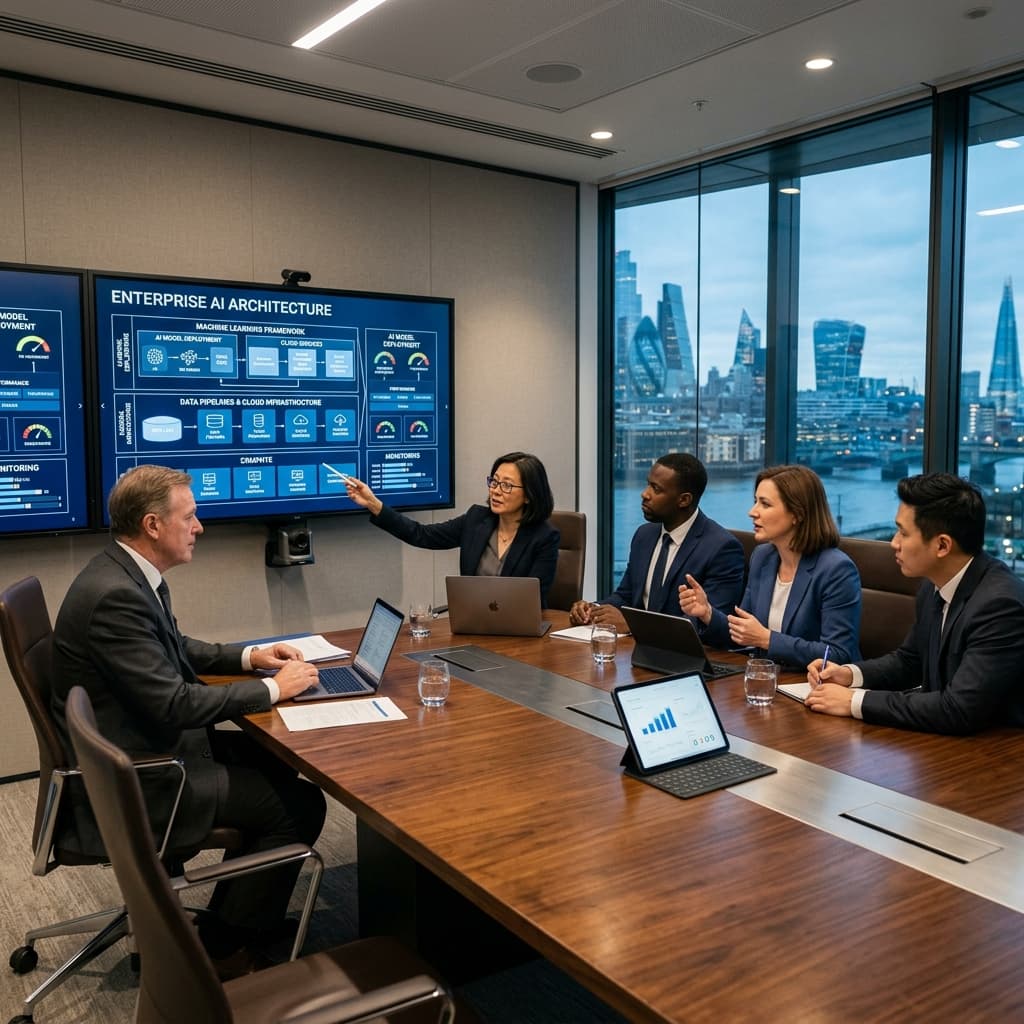
The Shift from Proof-of-Concept to Production Reality
In 2025 and 2026, enterprise technology leadership moved aggressively away from standalone GenAI demos and un-governed internal chatbots. Today, the mandate from boards and CFOs is unequivocal: produce measurable operational ROI or reallocate the budget.
Organization leaders realize that raw LLM wrappers without deep system integration produce vanity metrics rather than durable enterprise value. Success requires embedding intelligence directly into operational workflows—connecting real-time data pipelines to autonomous action engines.
Key Takeaways - PoC Phase is Over: 88% of enterprise AI budgets in 2026 are allocated to production infrastructure and system integration. - Data Quality is the Core Bottleneck: Models are only as effective as the real-time vector and relational context feeds powering them. - Multi-Agent Orchestration: Transitioning from single-prompt assistants to multi-step autonomous AI agents with strict security guardrails.
Architecting for Security, Governance, and SOC2 Compliance
Enterprise compliance teams are key stakeholders in AI adoption. Leading organizations enforce strict role-based access control (RBAC) and tenant isolation at every layer of their AI architecture.
Deploying models within isolated VPC enclaves (using AWS BAA or Azure Confidential Computing) ensures that sensitive IP and customer PII are never leaked or used to train third-party foundation models.
Explore how Varixen builds production-grade, SOC2-compliant AI infrastructure for global enterprises: Discover Varixen AI Development Services
The Multi-Agent Workflow Paradigm
Rather than relying on a single monolithic prompt, top engineering teams are building specialized multi-agent teams. For example, a customer inquiry is first triaged by a classifier agent, routed to a RAG retrieval agent for account context, passed to an execution agent for ERP action, and finally reviewed by a safety guardrail agent.
This modular design dramatically reduces hallucination risk while improving response latency to under 300 milliseconds.
Learn more about building 24/7 autonomous agent teams for your business: Explore Varixen Autonomous AI Agents