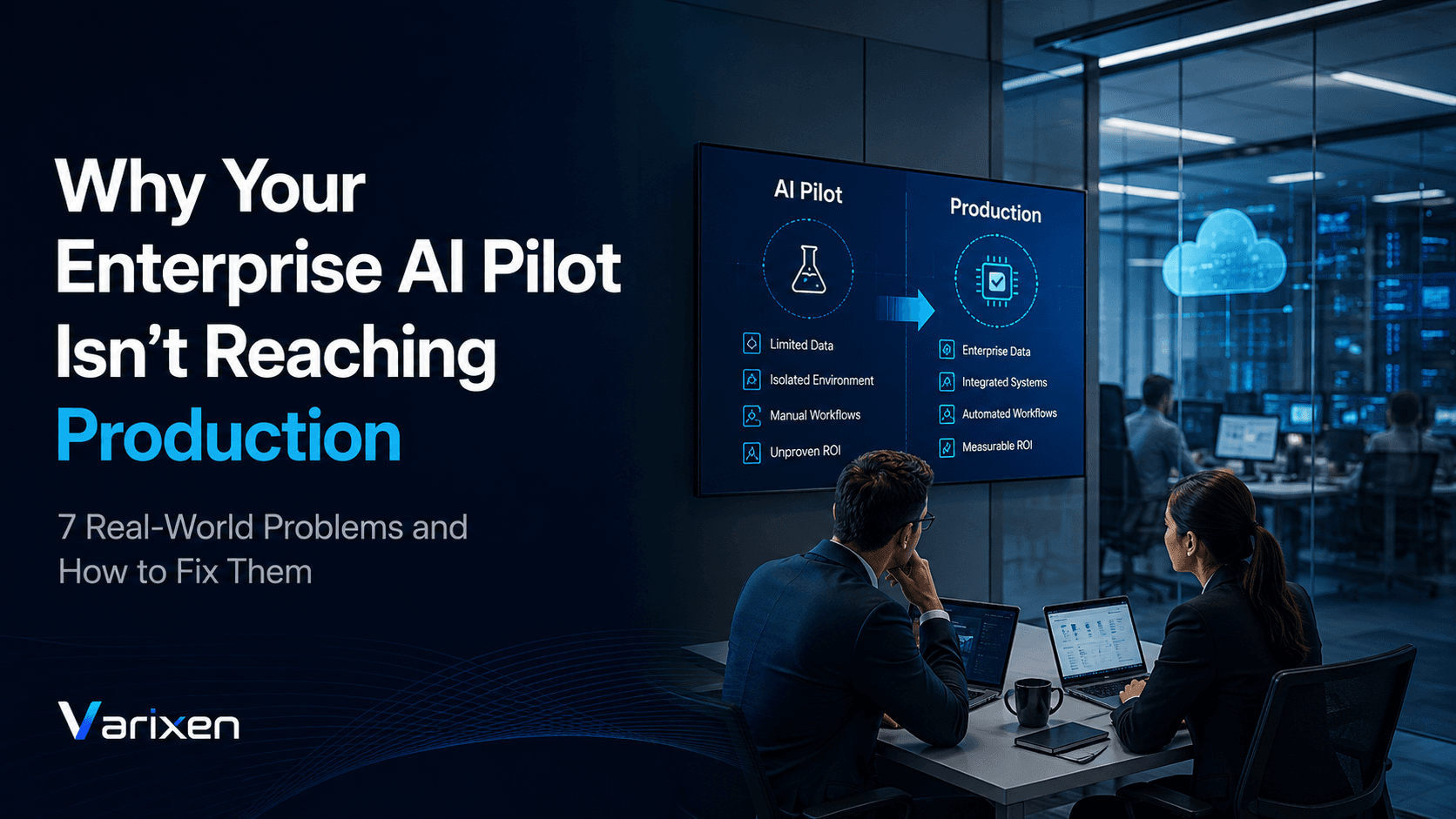
Why Your Enterprise AI Pilot Isn't Reaching Production: 7 Real-World Problems and How to Fix Them
From promising proof of concept to secure, scalable business system: the practical enterprise AI production playbook.
Varixen Editorial Team
Enterprise Architecture & AI Advisory
Executive Summary
The enterprise AI market is moving from experimentation toward production. Deloitte's 2026 research found that worker access to sanctioned AI tools increased by 50% in one year, while the number of companies with at least 40% of AI projects in production is expected to double within six months. Yet only 34% of organizations report deeply transforming their business with AI.
The gap is rarely caused by the AI model alone.
Production exposes problems that a proof of concept can hide: fragmented data, legacy integrations, security controls, unreliable outputs, infrastructure costs, unclear ownership, and weak business metrics.
The organizations that succeed treat AI as an enterprise engineering and transformation program, not simply as a model integration project.
Table of Contents
- 1Introduction
- 2Why AI Pilots Struggle in Production
- 3Why This Problem Matters
- 4Seven Real-World Production Problems
- 5Enterprise AI Production Architecture
- 6Illustrative Case Study
- 7Business Benefits
- 8Implementation Roadmap
- 9Common Mistakes
- 10Best Practices
- 11Future Trends
- 12Key Takeaways
- 13Frequently Asked Questions
- 14Conclusion
Introduction
An AI proof of concept can look deceptively simple.
A team connects an LLM to a handful of documents, builds a chatbot, demonstrates impressive answers, and reports that the pilot is successful.
Then someone asks:
"Can we deploy this across the organization?"
That question changes everything.
Production AI must work with real enterprise data, real users, real security policies, real transaction systems, real latency requirements, and real accountability.
A prototype can tolerate imperfections.
A production system cannot.
This is why the journey from AI pilot to production is becoming one of the most important enterprise technology challenges of 2026.
McKinsey's recent research identifies data readiness as a key constraint as organizations attempt to scale AI pilots. Enterprises increasingly need governed, reusable foundations that connect structured and unstructured data across systems and workflows.
The question is therefore no longer:
"Can we build an AI demo?"
It is:
"Can we engineer an AI system that reliably creates business value inside our existing enterprise?"
Current Industry Challenges
Enterprise AI adoption is accelerating, but operational readiness is not moving at the same speed.
Deloitte's 2026 research found that 42% of organizations consider their AI strategy highly prepared, while organizations feel less prepared in infrastructure, data, risk, and talent.
The problem becomes even more visible with autonomous AI. Nearly three-quarters of surveyed organizations expect to deploy agentic AI within two years, but only 21% report having mature governance for agentic AI.
For Indian enterprises, the transition is already particularly relevant. Deloitte's 2026 India findings report that 40% of respondents describe AI usage as significant or full, compared with approximately 28% globally, with strong adoption in product development, strategy and operations, marketing and sales, and supply chain.
The implication is clear:
The competitive advantage is shifting from experimenting with AI to engineering AI into the operating model.
Why This Problem Matters
An AI pilot that never reaches production creates more than a technology problem.
It creates an investment problem.
| Business Area | What Happens When AI Stalls |
|---|---|
| Revenue | Potential customer, sales, and product opportunities remain unrealized |
| Cost | Prototype and infrastructure spending produces limited operational return |
| Productivity | Employees continue performing the manual process |
| Scalability | A solution works for hundreds of records but not millions |
| Risk | Uncontrolled AI creates security, compliance, and operational exposure |
| Innovation | Teams accumulate pilots without building reusable capabilities |
The goal should not be to maximize the number of AI pilots.
The goal should be to create a repeatable path from:
Business Problem → Pilot → Production → Adoption → Measurable Outcome
Technical Deep Dive
The 7 Problems Blocking Enterprise AI Production
1. The AI Cannot Access the Right Enterprise Data
A prototype might operate on a curated dataset.
Production rarely does.
Enterprise information may be distributed across:
- ERP systems
- CRM platforms
- Data warehouses
- Data lakes
- SharePoint and document repositories
- Email
- APIs
- Operational databases
- PDFs
- IoT platforms
- Legacy applications
The solution is not simply adding more documents to an LLM.
A production architecture needs a governed data-access layer combining APIs, retrieval systems, metadata, permissions, document processing, and data pipelines.
Practical approach
Enterprise Systems
       ↓
Data Ingestion
       ↓
Validation + Classification
       ↓
Governed Data Layer
       ↓
RAG / Search / APIs
       ↓
AI Application
McKinsey's 2026 research emphasizes this exact issue: scaling AI requires structured and unstructured data to become a governed, reusable foundation rather than disconnected information sources.
2. The Prototype Data Is Clean; Production Data Is Not
AI systems often perform well during demonstrations because the data has already been selected and cleaned.
Real enterprise data contains:
- duplicates
- outdated records
- conflicting values
- missing fields
- inconsistent naming
- access restrictions
- unstructured documents
This creates an important principle:
AI quality is partly a data engineering problem.
Production systems need data validation, metadata, retrieval evaluation, document processing, access control, and continuous quality monitoring.
3. The AI Cannot Integrate With Existing Business Systems
An AI assistant that only answers questions has limited operational value.
The real value appears when it can safely interact with enterprise systems.
For example:
Employee Request
      ↓
AI Agent
      ↓
Business Rules
      ↓
Enterprise API
      ↓
ERP / CRM / Database
      ↓
Validation
      ↓
Human Approval
      ↓
Transaction
The AI should not directly manipulate critical databases.
Instead, enterprise APIs and controlled services should define what the AI can access and what actions it can perform.
This makes API design, microservices, authentication, authorization, event-driven architecture, and workflow orchestration central to production AI.
4. Security and Governance Stop the Deployment
Security teams are right to ask difficult questions:
- What data can the AI access?
- Which users can access it?
- Can an agent execute transactions?
- Can it expose confidential information?
- Can its actions be audited?
- What happens when the model produces an unsafe output?
NIST's AI Risk Management Framework provides a foundation for incorporating trustworthiness considerations into AI design, development, deployment, use, and evaluation. Its Generative AI Profile further addresses risks specific to generative AI systems.
A production AI architecture should therefore include:
Identity → Authorization → Policy Enforcement → Human Approval → Monitoring → Audit
For autonomous agents, governance becomes even more important. Deloitte reports that approximately 80% of surveyed organizations currently lack mature agent governance capabilities such as decision boundaries, real-time monitoring, and comprehensive audit trails.
5. AI Accuracy Drops in Production
A pilot might achieve excellent results on a small evaluation set.
Production introduces:
- new document types
- ambiguous questions
- changing business rules
- incomplete information
- unexpected user behavior
- model changes
- retrieval failures
The solution is not simply "use a better model."
Production AI requires an evaluation framework.
Measure:
- retrieval accuracy
- groundedness
- task completion
- hallucination rate
- response latency
- human override rate
- successful tool calls
- user acceptance
AI evaluation should become part of the software delivery lifecycle rather than a one-time pre-launch exercise.
6. Infrastructure and AI Costs Increase at Scale
A prototype may serve 50 employees.
Production may need to serve 50,000.
The architecture must account for:
- concurrency
- model selection
- caching
- queues
- API limits
- autoscaling
- observability
- disaster recovery
- latency
- infrastructure cost
Cloud architecture therefore becomes part of AI strategy.
Depending on the workload, enterprises may use AWS, Azure, or Google Cloud with containerized services, Kubernetes, managed databases, vector infrastructure, queues, monitoring, and CI/CD.
The objective is not to build the most complicated architecture.
It is to build the simplest architecture that can meet production requirements.
7. Nobody Can Prove the ROI
This is the final—and often most important—problem.
An enterprise shouldn't measure an AI project primarily by:
- number of prompts
- number of tokens
- model size
- API calls
Instead measure the business process.
For example:
Invoice automation
Before AI:
12 minutes per invoice
After automation:
4 minutes per invoice
Now the organization can calculate:
Time saved × transaction volume × labor cost
The same principle applies to:
- claims processing
- customer support
- procurement
- software development
- quality inspection
- maintenance
- supply chain operations
AI becomes strategically valuable when technical metrics connect to business metrics.
Enterprise Architecture
A practical enterprise AI production architecture can be organized into six layers:
┌──────────────────────────────────────────────┐
│              Business Applications           │
│ CRM • ERP • Portals • Mobile • Operations    │
└──────────────────────┬───────────────────────┘
                       ↓
┌──────────────────────────────────────────────┐
│              AI Application Layer             │
│ Assistants • Agents • RAG • Automation        │
└──────────────────────┬───────────────────────┘
                       ↓
┌──────────────────────────────────────────────┐
│            AI / Orchestration Layer          │
│ LLMs • Tools • Workflows • Guardrails        │
└──────────────────────┬───────────────────────┘
                       ↓
┌──────────────────────────────────────────────┐
│                 Data Layer                    │
│ APIs • Databases • Vector DB • Documents      │
└──────────────────────┬───────────────────────┘
                       ↓
┌──────────────────────────────────────────────┐
│          Cloud & Engineering Platform        │
│ AWS/Azure/GCP • Kubernetes • CI/CD            │
└──────────────────────┬───────────────────────┘
                       ↓
┌──────────────────────────────────────────────┐
│       Security • Governance • Observability  │
│ IAM • Policies • Audit • Evaluation • Alerts  │
└──────────────────────────────────────────────┘
Key architectural principle
Keep the model replaceable. Keep the enterprise architecture durable.
Models will change quickly.
Your data architecture, API contracts, security controls, evaluation framework, observability, and business workflows should not need to be rebuilt every time a new model becomes available.
Real-World Case Study
Illustrative Case: Manufacturing Operations AI
The following is an illustrative enterprise scenario, not a claim about a Varixen client.
Problem
A manufacturing organization operates several plants and has information distributed across ERP, manufacturing systems, maintenance records, and machine telemetry.
Operations managers spend significant time answering:
"Why did yesterday's production output fall?"
The company builds an AI assistant that can summarize production reports.
The pilot works.
But the production requirement is much broader:
Identify the problem, correlate operational data, explain the likely cause, and recommend the next action.
Solution
The organization designs an AI operations platform connecting:
- ERP data
- Production data
- Maintenance history
- Machine telemetry
- Document repositories
- Business rules
The AI system retrieves relevant information, correlates events, generates an explanation, and recommends an action.
Critical actions require human approval.
Implementation
Machine Data ──┐
ERP ───────────┤
MES ───────────┼──→ Data Platform
Maintenance ───┤          ↓
Documents ─────┘     AI / RAG Layer
                         ↓
                  Operations Agent
                         ↓
                 Business Validation
                         ↓
                  Human Approval
                         ↓
                  Action / Workflow
Business Results
For an actual implementation, the organization should establish a baseline and measure:
| KPI | Baseline | Target Direction |
|---|---|---|
| Production investigation time | 120 min | ↓ |
| Manual data gathering | 60 min | ↓ |
| Mean time to identify cause | 180 min | ↓ |
| AI recommendation acceptance | 0% | ↑ |
| Unplanned downtime | Baseline | ↓ |
| Operator productivity | Baseline | ↑ |
The important point is not a fabricated percentage improvement.
The business case should be established from measurable operational baselines before deployment.
NIST's 2026 smart-manufacturing roadmap similarly identifies industrial data complexity, heterogeneous systems, trustworthy operation, digital twins, robotics, sensing, and supply-chain optimization as important challenges and opportunities for industrial AI.
Lessons Learned
The AI model was only one component.
The production solution required:
Data Engineering + Software Engineering + AI + Cloud + Security + Workflow Automation + Operations
That is the reality of enterprise AI.
Business Benefits
| Benefit | Business Impact | Expected ROI |
|---|---|---|
| Process automation | Reduces repetitive human work | High when transaction volume is high |
| Faster decisions | Reduces time spent collecting and analyzing information | High for time-sensitive operations |
| Data accessibility | Makes fragmented enterprise knowledge easier to use | Medium–High |
| Reduced errors | Adds validation and consistency to repetitive workflows | Medium–High |
| Scalable operations | Handles growing workloads without proportional headcount growth | High |
| Better visibility | Gives leaders real-time operational intelligence | Depends on use case |
| Risk reduction | Improves access control, monitoring, and auditability | Often difficult to quantify but strategically significant |
ROI should always be calculated against a specific business process, not against AI usage alone.
Implementation Roadmap
Phase 1 — Assessment
Identify:
- Business problem
- Process owner
- Current cost
- Current cycle time
- Data sources
- Integration requirements
- Security requirements
Phase 2 — Architecture
Define:
- AI approach
- Data architecture
- APIs
- Cloud infrastructure
- Security model
- Evaluation strategy
- Success metrics
Phase 3 — Pilot
Build the smallest production-relevant version.
Do not build a disconnected demo.
Use representative data, realistic users, and realistic workflows.
Phase 4 — Production
Introduce:
- Authentication
- Authorization
- Monitoring
- Evaluation
- CI/CD
- Disaster recovery
- Audit logging
- Cost controls
- Human escalation
Phase 5 — Optimization
Measure business outcomes and continuously improve:
Model → Data → Workflow → User Experience → Cost → ROI
Common Mistakes
Building a demo instead of a production architecture
Fix: Design the pilot around the eventual production workflow.
Starting with the model instead of the business problem
Fix: Define the KPI first.
Ignoring enterprise data quality
Fix: Perform data-readiness assessment before scaling.
Connecting AI directly to critical databases
Fix: Use governed APIs and controlled services.
Adding security after development
Fix: Build identity, authorization, policies, and auditability into the architecture.
Measuring AI activity instead of business outcomes
Fix: Tie AI performance to operational KPIs.
Overengineering the first version
Fix: Start with the minimum architecture required for the risk and scale of the use case.
Best Practices
- 1Start with a measurable business problem.
- 2Design the production architecture before scaling the pilot.
- 3Treat enterprise data as a product, not merely an input.
- 4Keep AI models replaceable.
- 5Use APIs and controlled tools for enterprise actions.
- 6Build security and governance into the system from day one.
- 7Evaluate AI continuously in production.
- 8Introduce human approval for high-impact actions.
- 9Monitor latency, cost, quality, and business outcomes.
- 10Scale successful patterns across business functions rather than rebuilding every AI project from scratch.
Future Trends
The next stage of enterprise AI will move beyond isolated assistants.
Organizations are increasingly exploring:
- AI agents executing multi-step workflows
- Multi-agent systems
- AI-native software development
- Enterprise AI search
- AI-powered ERP workflows
- Physical AI and robotics
- Digital twins
- Real-time enterprise intelligence
- AI security and governance platforms
The direction is already visible. Deloitte's 2026 research reports rapid expected growth in agentic AI while governance remains immature, reinforcing the need to build control mechanisms alongside autonomous capabilities.
For industrial organizations, NIST's 2026 roadmap points toward convergence among AI, sensing, digital twins, robotics, autonomous systems, and supply-chain optimization.
The enterprise AI architecture of the future will therefore be less about one model and more about the interaction between:
Models + Data + Software + Agents + Cloud + Security + Business Processes
Key Takeaways
- An AI pilot succeeding does not mean the enterprise solution is production-ready.
- The biggest blockers are often data, integration, security, reliability, infrastructure, and ROI.
- Enterprise AI should be engineered as a business system, not deployed as an isolated model.
- APIs and governed workflows are critical when AI needs to interact with enterprise systems.
- Data readiness is becoming a foundational requirement for scaling AI.
- Agentic AI increases the importance of authorization, monitoring, governance, and auditability.
- Business KPIs—not token consumption—should determine whether an AI initiative is successful.
- The strongest AI programs connect technology architecture directly to operational outcomes.
Frequently Asked Questions
1. Why do enterprise AI pilots fail to reach production?
Most failures occur when pilots encounter real-world data complexity, legacy integrations, security requirements, reliability issues, operational scale, or unclear ROI.
2. How long should an enterprise AI pilot take?
There is no universal timeline. A narrowly defined use case can often be validated quickly, but production deployment requires additional work around integration, security, testing, governance, and operations.
3. Should enterprises build or buy AI solutions?
It depends on differentiation, existing systems, security requirements, available skills, and economics. Commodity capabilities are often better purchased, while strategically differentiated workflows may justify custom engineering.
4. Does enterprise AI always require fine-tuning?
No. Many enterprise applications can begin with retrieval-augmented generation, structured APIs, prompting, tool use, or workflow orchestration. Fine-tuning should be considered when there is a clear model-behavior requirement that other approaches cannot address effectively.
5. How should AI security be implemented?
Start with identity, least-privilege access, data protection, authorization, policy controls, monitoring, audit trails, evaluation, and human oversight for high-impact actions.
6. What is the most important AI production metric?
There is no single metric. The most important metric should relate to the business process being improved—for example, processing time, cost per transaction, error rate, revenue, downtime, or customer resolution time.
7. How can companies prepare their data for AI?
Inventory important data sources, improve quality, establish ownership and access policies, connect structured and unstructured data, and create governed retrieval and integration mechanisms.
8. What is the difference between an AI pilot and production AI?
A pilot demonstrates technical or business feasibility. Production AI must additionally satisfy requirements for reliability, security, scalability, observability, integration, governance, user adoption, and measurable business performance.
9. Should every enterprise use AI agents?
No. Agentic AI is appropriate when a process requires reasoning, tool use, or multi-step execution. Deterministic automation can remain the better option for simple, predictable workflows.
Conclusion
The hardest part of enterprise AI is rarely making the first model respond.
It is making the entire system work reliably inside the business.
Production AI requires more than an LLM. It requires trusted data, resilient software architecture, secure integrations, cloud infrastructure, evaluation, governance, observability, and a measurable business case.
Organizations that understand this can stop accumulating disconnected AI pilots and start building reusable AI capabilities across the enterprise.
The objective is not to deploy more AI.
It is to turn AI into reliable business infrastructure.
About Varixen
Varixen is an Enterprise AI and Software Engineering company helping organizations apply AI, automation, cloud engineering, data engineering, enterprise software, and intelligent technologies to practical business problems.
Its capabilities span enterprise AI and AI agents, intelligent automation, computer vision, manufacturing AI, data platforms, cloud engineering, enterprise software, AI security, and digital transformation.
The focus is on designing and engineering solutions that can move from business problem to production system, while considering architecture, security, integration, scalability, and measurable business outcomes.
Call To Action
Moving an AI Pilot Toward Production?
If your organization has an AI proof of concept but is facing challenges with data, enterprise integration, security, cloud infrastructure, automation, or measurable ROI, the next step is to assess the production path.
Explore how Varixen can help design and engineer your enterprise AI transformation.
Contact Varixen: https://www.varixen.com
Internal Linking Suggestions
- 1AI ROI: Stop Measuring Tokens and Start Measuring Business Outcomes
- 2Enterprise RAG Architecture: Building Production-Ready AI With Enterprise Data
- 3AI Agent Security: Designing Secure Autonomous Enterprise Systems
- 4Enterprise AI Data Strategy: Building the Data Foundation for AI
- 5From RPA to Agentic Automation: The Evolution of Enterprise Workflow Automation