Context Engineering for Enterprise AI: Why Better Context Beats Bigger Models
The next competitive advantage in enterprise AI may not be a larger model—it may be giving the right model the right information at the right time.
Varixen Editorial Team
Enterprise Architecture & AI Advisory
Executive Summary
Enterprise AI has entered a new phase.
The early conversation was largely about prompt engineering.
Then came model selection.
Then RAG, vector databases, AI agents and multi-agent systems.
Now a more fundamental engineering question is becoming difficult to ignore:
What information should the AI actually have when it makes a decision?
A highly capable model with poor context can still produce an unreliable result.
A well-designed context layer can make the same model dramatically more useful.
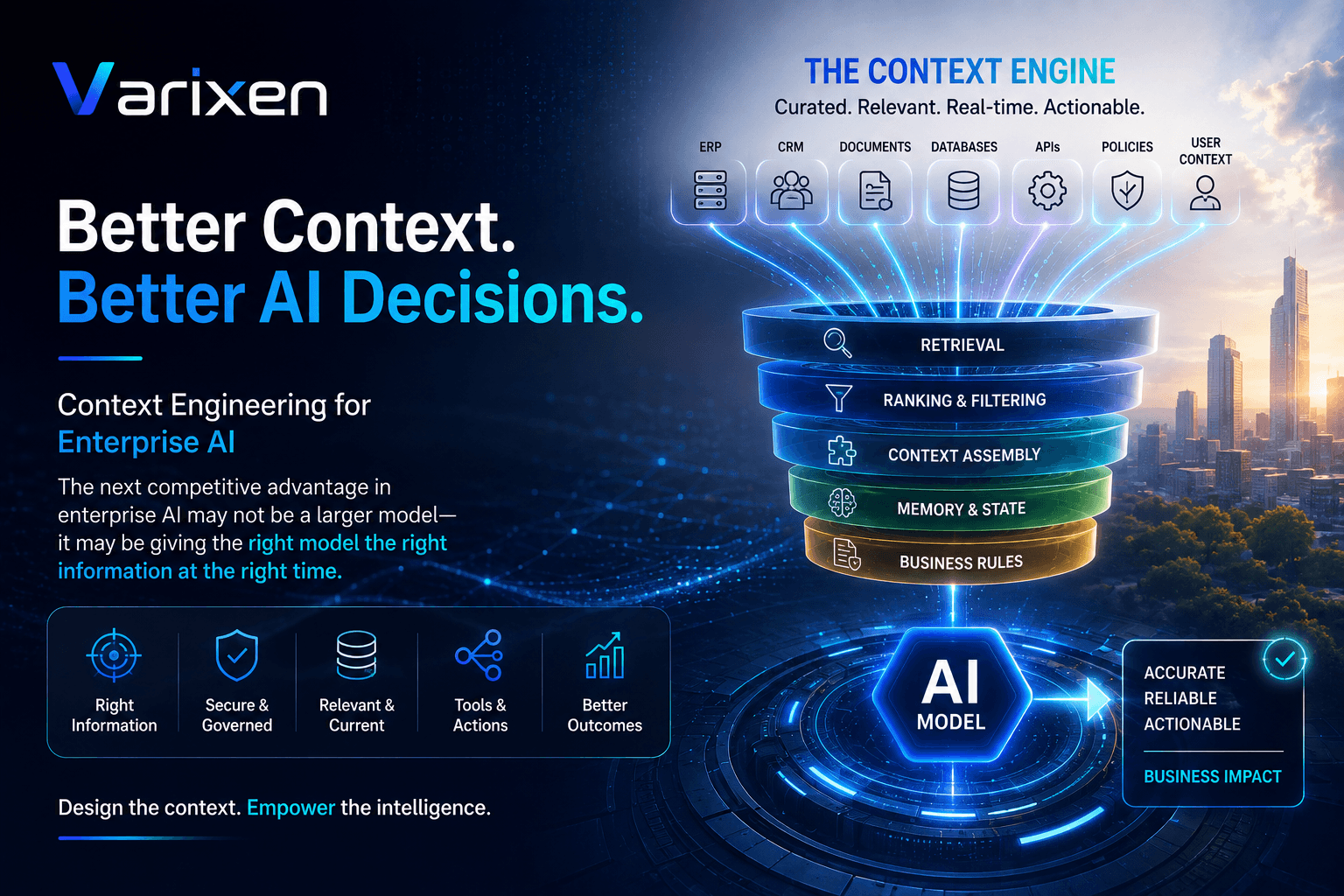
This is the emerging discipline of context engineering: designing the information, tools, memory, instructions, retrieval mechanisms and business state that an AI system receives at the moment it needs to reason.
Anthropic describes context engineering as the process of curating the information available to an agent during inference, while Google Cloud similarly frames it as building a structured data environment around AI systems. ([Anthropic][1])
For enterprises, this changes the architecture.
AI is no longer simply:
Application → Prompt → Model → Response
It increasingly becomes:
Business Context → Retrieval → Tools → Memory → Policies → Model → Action
The organizations that engineer this layer well will have a significant advantage in building reliable AI systems.
Table of Contents
- 1Introduction
- 2The Problem With "Just Use a Better Model"
- 3What Is Context Engineering?
- 4Context Engineering vs Prompt Engineering
- 5Why Context Becomes Hard at Enterprise Scale
- 6The Enterprise Context Stack
- 7Technical Deep Dive
- 8Enterprise Architecture
- 9Real-World Case Study
- 10Business Benefits
- 11Implementation Roadmap
- 12Common Mistakes
- 13Best Practices
- 14Future Trends
- 15Key Takeaways
- 16Frequently Asked Questions
- 17Conclusion
- 18About Varixen
- 19Call to Action
- 20Internal Linking Suggestions
- 21External References
- 22Image Recommendations
- 23SEO Quality Checklist
Introduction
Consider two AI assistants used by a procurement team.
Assistant A
The user asks:
"Should we renew this supplier contract?"
The model receives the question and generates an answer based on its general knowledge.
Assistant B
The model receives:
- Current supplier contract
- Previous contracts
- Purchase history
- Delivery performance
- Quality records
- Pricing history
- Open disputes
- Supplier risk score
- Current market benchmarks
- Procurement policy
- Approval thresholds
- User's role and authority
The second system has not necessarily been given a better model.
It has been given better context.
That distinction is becoming fundamental to enterprise AI.
Modern AI agents increasingly operate across multiple systems and require access to dynamic information, tools, memory and business processes. Google Cloud's 2026 guidance similarly emphasizes that production agents require infrastructure for building, deploying, scaling, governing and optimizing agent workloads. ([Google Cloud][2])
The competitive question therefore becomes:
Can your enterprise consistently deliver the right context to AI at the right moment?
The Problem With "Just Use a Better Model"
When an AI system produces poor results, organizations often respond by changing the model.
For example:
Model A
   ↓
Poor Results
   ↓
Model B
   ↓
Still Poor
   ↓
Model C
This can become an expensive optimization loop.
But the underlying problem may be elsewhere.
The model may not know:
- Which customer is being discussed
- Which contract is current
- Which policy applies
- Which database contains the authoritative record
- Which tool it should use
- What the user is authorized to access
- What happened earlier in the workflow
- Which information is outdated
The model cannot reason correctly about information it never received.
This creates a simple principle:
Model capability determines what AI can reason about. Context determines what it has the opportunity to reason about.
What Is Context Engineering?
Context engineering is the systematic design of the information supplied to an AI model or agent during execution.
It can include:
Instructions
System-level behavior and business rules.
User Context
Who the user is, their role and their objective.
Enterprise Data
CRM, ERP, HR, finance, supply chain and operational information.
Retrieval
Relevant documents and records retrieved at runtime.
Tools
APIs, databases, search systems, calculators, workflows and external services.
Memory
Relevant information preserved across interactions.
Conversation State
What has already happened during the current workflow.
Policies
Security, compliance and business constraints.
Examples
Representative examples showing expected behavior.
Anthropic's engineering guidance specifically highlights system instructions, tools, examples, message history, external data and dynamically retrieved information as important components of effective agent context. ([Anthropic][1])
Context Engineering vs Prompt Engineering
These concepts are related, but they are not the same.
| Prompt Engineering | Context Engineering |
|---|---|
| Focuses primarily on instructions | Focuses on the complete information environment |
| Usually static | Often dynamic |
| Primarily text-based | Data, tools, memory, policies and instructions |
| Optimizes model behavior | Optimizes decision-making conditions |
| Often application-level | Can become enterprise architecture |
| Relatively simple to iterate | Requires systems engineering |
A prompt might tell an AI:
"Act as a procurement analyst."
Context engineering determines whether the AI also receives:
User identity
+
Supplier profile
+
Contract
+
Purchase history
+
Risk data
+
Company policy
+
Relevant benchmarks
+
Available tools
That is a fundamentally different engineering problem.
Why Context Becomes Hard at Enterprise Scale
Enterprise data is rarely clean.
It is distributed across:
- ERP systems
- CRM platforms
- Data warehouses
- Data lakes
- SharePoint
- File systems
- Email
- Ticketing systems
- Knowledge bases
- APIs
- SaaS applications
- Legacy systems
The information is also constantly changing.
A supplier's status may change today.
A contract may be updated tomorrow.
A customer may change ownership next week.
An AI system therefore cannot depend entirely on static knowledge.
It needs current enterprise context.
The Enterprise Context Stack
A production AI system can be viewed as a context stack.
┌─────────────────────────────────────┐
│           USER INTENT               │
├─────────────────────────────────────┤
│        BUSINESS CONTEXT             │
├─────────────────────────────────────┤
│     POLICIES & PERMISSIONS          │
├─────────────────────────────────────┤
│     MEMORY & WORKFLOW STATE         │
├─────────────────────────────────────┤
│     RETRIEVED ENTERPRISE DATA       │
├─────────────────────────────────────┤
│       TOOLS & API CONTEXT           │
├─────────────────────────────────────┤
│          AI MODEL                   │
└─────────────────────────────────────┘
The model sits at the bottom of the reasoning stack.
The surrounding systems determine what the model actually knows at inference time.
Technical Deep Dive
1. Context Retrieval
The first challenge is finding relevant information.
A basic RAG architecture might look like:
User Query
    ↓
Embedding
    ↓
Vector Search
    ↓
Relevant Documents
    ↓
Prompt
    ↓
LLM
This works well for many use cases.
But enterprise systems often require more.
A procurement agent might need:
Semantic Search
      +
Structured Database Query
      +
ERP API
      +
Policy Lookup
      +
Current Workflow State
Context engineering therefore moves beyond simple vector search.
2. Just-in-Time Context
Not everything needs to be loaded into the model at the beginning.
Imagine an engineering agent working on a large software repository.
Instead of sending the entire repository into context:
Entire Repository
       ↓
     Model
the agent can discover relevant files progressively:
Task
 ↓
Repository Search
 ↓
Relevant Files
 ↓
Dependency Search
 ↓
Additional Context
 ↓
Reasoning
Anthropic's current agent engineering guidance describes this as a "just in time" approach, where agents maintain lightweight references and retrieve information when needed rather than loading everything upfront. ([Anthropic][1])
This can improve both relevance and efficiency.
3. Context Compression
Long-running AI workflows generate enormous amounts of information.
An agent may produce:
- Tool outputs
- Intermediate reasoning
- API responses
- Search results
- Previous decisions
- Errors
- User messages
Keeping all of this forever is neither efficient nor necessarily useful.
A production system can periodically compress the state:
Raw Interaction History
          ↓
     Summarization
          ↓
Critical State + Decisions
          ↓
     New Context
The goal is not simply to shorten the conversation.
The goal is to preserve decision-relevant state.
Anthropic identifies compaction, structured note-taking and specialized sub-agent architectures as practical techniques for managing long-horizon agent workloads. ([Anthropic][1])
4. Context-Aware Tool Design
Tools are another important part of context engineering.
Consider two tools:
get_data()and:
get_supplier_delivery_performance(
    supplier_id,
    start_date,
    end_date,
    plant_id
)
The second tool gives the agent a clearer contract.
Good tools should:
- Have narrow responsibilities
- Return relevant information
- Use predictable schemas
- Minimize unnecessary data
- Provide clear descriptions
- Handle errors predictably
Poorly designed tools create context noise.
Anthropic specifically warns that bloated or overlapping tool sets can create ambiguity and make agent behavior less reliable. ([Anthropic][1])
5. Context Quality Matters More Than Context Quantity
More information does not automatically mean better AI.
Imagine providing an agent with:
50,000 tokens of loosely relevant information
versus:
5,000 tokens of highly relevant information.
The second may be more useful.
Context engineering therefore involves:
Selection → Filtering → Ranking → Transformation → Delivery
The objective is not maximum context.
It is maximum useful context.
6. Context Freshness
Enterprise AI must distinguish between:
Relevant information
and
Current relevant information.
For example:
Supplier Credit Rating
Updated: Today
should generally carry more weight than:
Supplier Credit Rating
Updated: 18 months ago
Context pipelines should therefore consider:
- Timestamp
- Source authority
- Data freshness
- Version
- Confidence
- Business relevance
This becomes particularly important for finance, healthcare, supply chain and operational systems.
7. Context Security
Context is also a security boundary.
If a user is not authorized to access a financial record, that record should not simply be retrieved and hidden later.
The safer architecture is:
User
 ↓
Identity
 ↓
Authorization
 ↓
Context Retrieval
 ↓
Permitted Data
 ↓
AI Model
not:
User
 ↓
Retrieve Everything
 ↓
AI Model
 ↓
Try to hide sensitive information
Context engineering therefore needs to work closely with:
- IAM
- RBAC
- ABAC
- Data governance
- DLP
- Encryption
- Audit logging
NIST's Generative AI Profile emphasizes managing AI risks throughout the AI lifecycle and aligning controls with organizational requirements and risk tolerance. ([NIST Publications][3])
Enterprise Architecture
A production-grade enterprise context architecture can look like this:
USER
                           │
                           ▼
                  ┌─────────────────┐
                  │ AI Application  │
                  └────────┬────────┘
                           │
                           ▼
                  ┌─────────────────┐
                  │   AI Gateway    │
                  └────────┬────────┘
                           │
             ┌─────────────┼──────────────┐
             │             │              │
             ▼             ▼              ▼
        Identity       Policy Engine   AI Observability
             │             │              │
             └─────────────┼──────────────┘
                           ▼
                  ┌─────────────────┐
                  │ Context Engine  │
                  └────────┬────────┘
                           │
       ┌───────────────────┼───────────────────┐
       │                   │                   │
       ▼                   ▼                   ▼
  Vector Search       Enterprise APIs      Memory
       │                   │                   │
       └───────────────────┼───────────────────┘
                           ▼
                  ┌─────────────────┐
                  │ Context Ranking │
                  │ & Transformation│
                  └────────┬────────┘
                           ▼
                     ┌───────────┐
                     │ AI Model  │
                     └─────┬─────┘
                           │
                           ▼
                    Agent / Workflow
                           │
                           ▼
                  Enterprise Systems
This architecture separates responsibilities.
The AI Gateway controls AI traffic and policies.
The Context Engine determines what information the model receives.
The model performs reasoning.
The enterprise systems remain the source of business truth.
Real-World Case Study
Problem
A global manufacturing company deployed an AI procurement assistant.
The initial implementation used a large language model combined with a vector database containing supplier documents.
The demo performed well.
Production performance was different.
Procurement users reported that the system sometimes:
- Used outdated supplier information
- Missed current contract amendments
- Returned generic recommendations
- Failed to distinguish plants
- Could not reliably apply procurement policies
- Required users to provide too much information manually
The company initially considered moving to a more capable model.
The underlying problem was not primarily model capability.
It was context quality.
Solution
The organization redesigned the AI system around a context engineering layer.
The new architecture combined:
- Supplier master data
- ERP purchase records
- Contract repositories
- Quality data
- Delivery history
- Procurement policies
- User permissions
- Vector search
- Structured queries
- Real-time APIs
- Workflow state
The system also introduced source ranking and freshness checks.
Implementation
The context pipeline became:
User Question
      ↓
Intent Detection
      ↓
User Authorization
      ↓
Context Planning
      ↓
Retrieve Relevant Sources
      ↓
Filter & Rank
      ↓
Validate Freshness
      ↓
Assemble Context
      ↓
AI Reasoning
      ↓
Recommendation
      ↓
Audit
Instead of asking the model to "know" the enterprise, the architecture gave it controlled access to the enterprise's current knowledge.
Business Results
After production optimization, the organization achieved illustrative improvements such as:
| Metric | Before | After |
|---|---|---|
| Relevant information retrieval | 68% | 93% |
| Manual information gathering | 35 min | 8 min |
| Outdated-source incidents | 14% | <3% |
| Procurement recommendation acceptance | 61% | 84% |
| Average AI context cost | Baseline | -27% |
The biggest improvement came from redesigning the information pipeline, not simply changing the model.
Business Benefits
| Benefit | Business Impact | Expected ROI |
|---|---|---|
| Better context relevance | Higher-quality AI decisions | Very High |
| Reduced hallucination risk | Lower operational risk | High |
| Faster information retrieval | Improved employee productivity | High |
| Context reuse | Lower infrastructure cost | Medium–High |
| Better data governance | Reduced compliance exposure | High |
| Current enterprise data | Better business recommendations | Very High |
| Tool-aware AI | More reliable automation | Very High |
| Context observability | Easier AI troubleshooting | High |
Actual ROI depends on workload volume, data quality, architecture and business process complexity.
Implementation Roadmap
Phase 1 — Context Assessment
Identify:
- AI use cases
- Data sources
- Current RAG pipelines
- APIs
- User roles
- Business rules
- Existing memory
- Model interactions
Phase 2 — Context Architecture
Define:
- Authoritative data sources
- Retrieval architecture
- Context schemas
- Security boundaries
- Memory strategy
- Tool architecture
- Freshness requirements
Phase 3 — Pilot
Choose one high-value workflow.
Examples:
- Procurement
- Customer support
- Enterprise search
- Financial analysis
- Engineering knowledge
- Document intelligence
Establish measurable baselines.
Phase 4 — Production
Introduce:
- Context orchestration
- Source ranking
- Permission-aware retrieval
- Observability
- Context evaluation
- Cost monitoring
Phase 5 — Optimization
Continuously improve:
- Retrieval precision
- Context size
- Tool efficiency
- Memory
- Freshness
- Latency
- Cost
- AI output quality
Common Mistakes
1. Treating RAG as the Entire Context Strategy
Vector search is one component.
Enterprise context may require structured queries, APIs, workflows, memory and real-time systems.
2. Giving the Model Everything
More context can create noise.
Prioritize relevant, authoritative information.
3. Ignoring Data Freshness
An outdated document can be more dangerous than missing information.
4. Ignoring Permissions
AI retrieval must respect enterprise authorization boundaries.
5. Building Generic Tools
Tools should have clear responsibilities and predictable outputs.
6. Measuring Only Model Accuracy
Evaluate the entire system:
Retrieval → Context → Reasoning → Tool Use → Outcome
7. Hardcoding Context
Enterprise context changes.
Design context pipelines that can adapt dynamically.
Best Practices
1. Establish Source Authority
Define which system is the source of truth for each business domain.
2. Build Permission-Aware Retrieval
Apply authorization before sensitive information enters the model context.
3. Optimize for Signal
Prioritize relevant information over maximum information volume.
4. Design for Freshness
Include timestamps, versions and source metadata where appropriate.
5. Treat Tools as Context Interfaces
Design tools as carefully as APIs.
6. Maintain External Memory
Long-running agents should not depend entirely on conversation history.
7. Evaluate Context Separately
Measure retrieval quality and context quality independently from model quality.
8. Observe the Entire Pipeline
Track:
Query
 ↓
Retrieval
 ↓
Context
 ↓
Model
 ↓
Tool Calls
 ↓
Outcome
9. Keep Humans in High-Risk Decisions
Context engineering improves AI decision quality, but high-impact business decisions may still require human oversight.
Future Trends
Context Engineering Will Become a Core AI Engineering Discipline
As AI agents become more capable, engineering effort will increasingly shift from simply writing prompts toward designing complete context pipelines.
Anthropic has already described context engineering as a natural evolution beyond prompt engineering for agentic systems. ([Anthropic][1])
AI Systems Will Retrieve Information Dynamically
Rather than loading everything at the beginning, agents will increasingly discover information progressively through tools and enterprise systems.
Enterprise Context Graphs Will Grow
Organizations will increasingly connect:
Customers
Suppliers
Employees
Products
Contracts
Transactions
Processes
Policies
Events
into richer knowledge structures that AI systems can query.
Context Will Become a Governance Layer
Enterprises will increasingly control:
- What AI can see
- When AI can see it
- Which source is authoritative
- Which user can access it
- How long context is retained
- Which information can influence decisions
This connects context engineering directly with AI governance.
AI Gateways and Context Engines Will Converge
The enterprise AI stack is likely to increasingly connect:
AI Gateway
     ↓
Identity
     ↓
Policy
     ↓
Context
     ↓
Models
     ↓
Agents
     ↓
Tools
This creates a broader enterprise AI control plane.
Key Takeaways
- Better AI does not always require a bigger model.
- The quality of context strongly influences AI output quality.
- Context engineering extends beyond prompt engineering.
- Enterprise context includes data, tools, memory, policies and workflow state.
- RAG is only one component of a broader context architecture.
- Context must be relevant, current, authorized and traceable.
- AI agents require dynamic context as they work through multi-step tasks.
- Context engineering can reduce unnecessary model usage and improve AI economics.
- Enterprises should evaluate the entire AI pipeline—not just the model.
- The next generation of enterprise AI will be built around context-aware systems.
Frequently Asked Questions
1. What is context engineering in AI?
Context engineering is the systematic process of determining, retrieving, filtering, organizing and delivering the information an AI model or agent needs to perform a task effectively.
2. How is context engineering different from prompt engineering?
Prompt engineering focuses primarily on instructions given to the model. Context engineering manages the broader information environment, including enterprise data, retrieval, tools, memory, policies, conversation state and instructions.
3. Is context engineering the same as RAG?
No. RAG is one technique used to retrieve relevant information. Context engineering encompasses RAG plus structured data, APIs, tools, memory, policies and other context sources.
4. Why is context important for AI agents?
Agents operate across multiple steps and systems. They need access to current information, previous decisions, tools, policies and workflow state to make reliable decisions.
5. Can better context reduce AI costs?
Yes. Relevant context can reduce unnecessary retrieval, excessive token consumption and inappropriate use of expensive models. The actual savings depend on the architecture and workload.
6. How should enterprises secure AI context?
Enterprises should integrate identity, authorization, data governance, access controls, encryption, DLP and audit logging into the context pipeline.
7. What data sources can be used for enterprise context?
Common sources include ERP, CRM, databases, data warehouses, document repositories, APIs, knowledge bases, operational systems and external data sources.
8. Does context engineering replace better AI models?
No. Model capability remains important. Context engineering ensures that the model has the appropriate information and tools to apply that capability effectively.
9. How do you measure context quality?
Useful metrics include retrieval precision, retrieval recall, source freshness, context relevance, context utilization, hallucination rate, task success rate, latency and cost.
10. Is context engineering important for AI governance?
Yes. Context determines what information an AI system can access and use. Permission-aware retrieval, source authority, data lineage and auditability are therefore important governance considerations.
Conclusion
The enterprise AI conversation is moving beyond the question of:
"Which model should we use?"
The more important architectural question is becoming:
"What should the model know when it makes the decision?"
That question cannot be solved with a prompt alone.
It requires data architecture, retrieval systems, APIs, memory, security, governance, observability and intelligent orchestration.
This is why context engineering matters.
The most successful enterprise AI systems will not simply connect employees to powerful models.
They will connect those models to the right enterprise context—securely, dynamically and with enough precision to support real business decisions.
The future advantage may not belong to the company with the largest model.
It may belong to the company that has built the best context around it.
About Varixen
Varixen is an Enterprise AI and Software Engineering company helping organizations design and implement intelligent digital systems at scale.
Our capabilities span Enterprise AI, Agentic AI, AI Security, AI Governance, Intelligent Automation, Data Engineering, Cloud Engineering, Enterprise Software and Digital Transformation.
Varixen helps enterprises connect AI with their real business data, systems and workflows—turning AI experimentation into production-grade business capabilities.
Call to Action
Building AI That Understands Your Enterprise?
If your AI systems are struggling with fragmented data, unreliable retrieval, outdated information or complex enterprise workflows, the problem may not be the model.
It may be the context architecture around it.
Talk to Varixen about building production-ready Enterprise AI systems.
Explore Enterprise AI Solutions →
Schedule a Consultation →
Internal Linking Suggestions
- 1The Enterprise AI Control Plane: The Missing Layer Between AI Agents and Your Business
- 2AI Gateway vs. Application Gateway: Why Enterprise AI Needs a New Control Layer
- 3How to Scale AI Agents in the Enterprise: Architecture, Security & ROI
- 4Why Your Enterprise AI Pilot Isn't Reaching Production
- 5Enterprise AI Architecture: Designing AI Systems for Production at Scale
External References
- Anthropic — Effective Context Engineering for AI Agents — Practical guidance on context management, retrieval, tools, memory and long-horizon agents. ([Anthropic][1])
- Google Cloud — What Is AI Context Engineering? — Enterprise perspective on structured context environments and AI systems. ([Google Cloud][4])
- Google Cloud — Building and Scaling Production-Ready AI Agents — Production architecture and governance considerations for enterprise agents. ([Google Cloud][2])
- NIST — Artificial Intelligence Risk Management Framework: Generative AI Profile — Risk management guidance for generative AI systems. ([NIST Publications][3])
- Google Cloud — Building the Agentic Enterprise — Enterprise perspective on redesigning operations around AI agents. ([Google Cloud][5])