
Computer Vision for Manufacturing: Building Intelligent Quality Inspection Systems at Enterprise Scale
How enterprise manufacturers are transforming quality, productivity, and operational excellence through AI-powered computer vision.
Varixen Editorial Team
Enterprise Architecture & AI Advisory
Executive Summary
Manufacturers are under continuous pressure to improve quality, reduce production costs, increase throughput, and meet increasingly stringent customer expectations. Traditional inspection methods—often dependent on manual sampling or rule-based automation—struggle to keep pace with modern production environments.
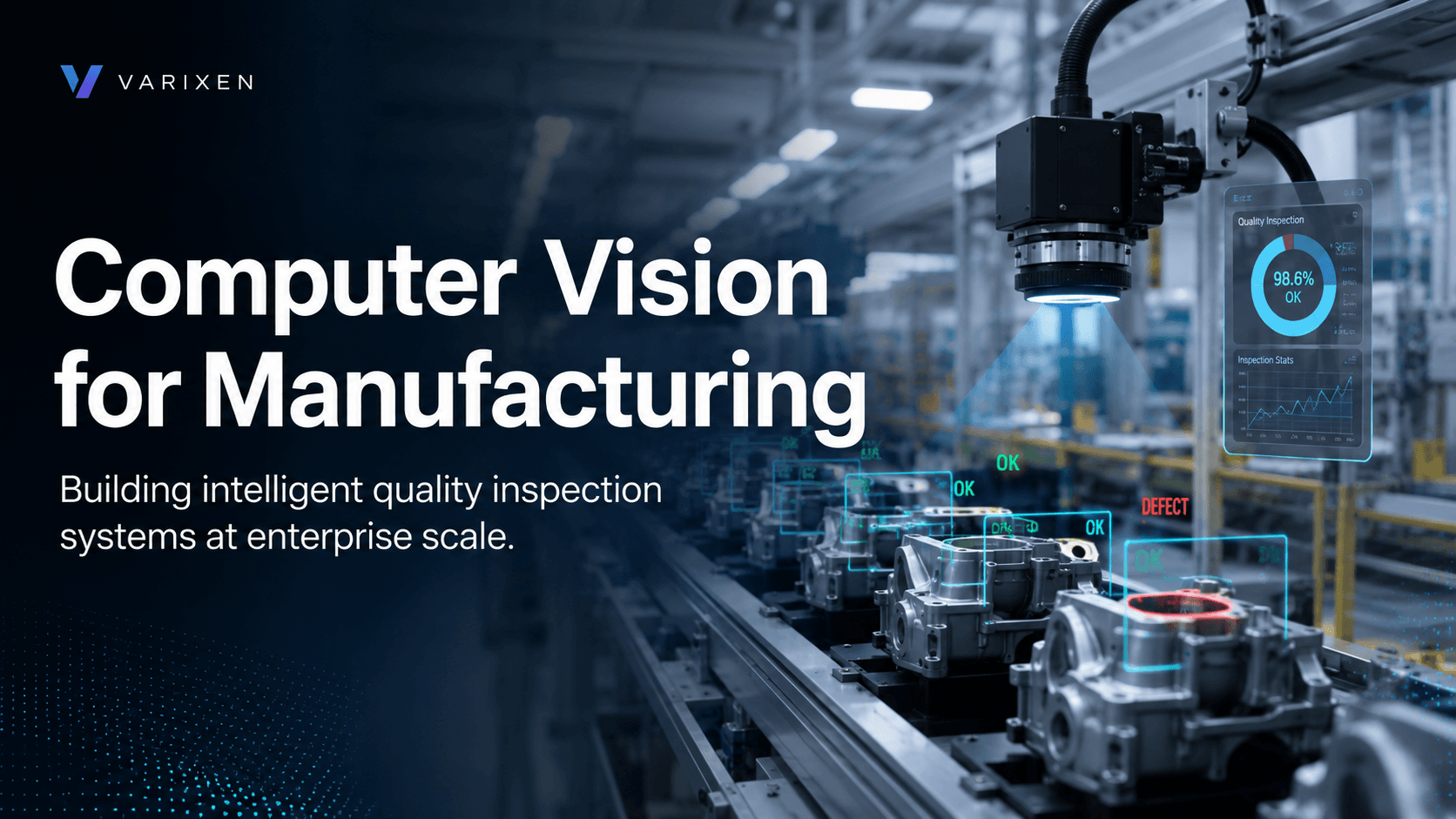
Computer Vision Manufacturing combines AI, deep learning, industrial imaging, edge computing, cloud platforms, and real-time analytics to automate visual inspection across manufacturing operations. Modern vision systems identify defects, monitor production lines, verify assembly correctness, perform dimensional measurements, read labels, detect anomalies, and generate continuous quality intelligence.
Beyond replacing manual inspection, enterprise computer vision creates measurable business value by reducing defects, minimizing waste, improving Overall Equipment Effectiveness (OEE), enabling predictive quality management, and providing data-driven insights that support continuous operational improvement.
Table of Contents
- 1Introduction
- 2Current Industry Challenges
- 3Why This Problem Matters
- 4Technical Deep Dive
- 5Vision Inspection Pipeline
- 6Enterprise Architecture
- 7Real-World Case Study
- 8Business Benefits
- 9Implementation Roadmap
- 10Common Mistakes
- 11Best Practices
- 12Future Trends
- 13Key Takeaways
- 14Frequently Asked Questions
- 15Conclusion
- 16About Varixen
- 17Call To Action
- 18Internal Linking Suggestions
- 19External References
- 20Image Recommendations
- 21SEO Quality Checklist
Introduction
Manufacturing quality has evolved significantly over the past decade. Global supply chains, increasing customization, stricter compliance requirements, and labor shortages have created new operational challenges. Manufacturers now require inspection systems capable of operating continuously while maintaining exceptional accuracy.
Computer Vision Manufacturing addresses these challenges by enabling intelligent visual understanding of manufacturing processes. Instead of relying solely on fixed rules, modern AI models learn from thousands—or millions—of production images to recognize subtle defects and continuously improve over time.
Applications include:
- Surface defect detection
- Weld inspection
- PCB inspection
- Assembly verification
- Packaging inspection
- OCR for serial numbers
- Barcode validation
- Label verification
- Paint quality inspection
- Pharmaceutical packaging validation
- Food quality assessment
- Automotive component inspection
These capabilities are becoming foundational to Industry 4.0 initiatives.
Current Industry Challenges
Modern manufacturing organizations commonly face the following issues:
Manual Inspection Limitations
Human inspectors experience fatigue, inconsistency, and reduced accuracy over long production shifts. Even experienced operators may overlook subtle defects under high production speeds.
Increasing Production Complexity
Product variants continue to grow, making static rule-based inspection systems difficult to maintain.
High Cost of Defects
Undetected defects can result in:
- Warranty claims
- Product recalls
- Customer dissatisfaction
- Brand damage
- Compliance penalties
Labor Shortages
Many manufacturers struggle to recruit and retain experienced quality inspectors.
Data Silos
Inspection data often remains isolated from MES, ERP, and analytics systems, limiting opportunities for process optimization.
Limited Traceability
Manufacturers increasingly require image-level traceability for compliance, audits, and root-cause investigations.
Why This Problem Matters
Quality directly affects profitability.
| Business Driver | Enterprise Impact |
|---|---|
| Reduced defects | Lower warranty costs |
| Faster inspection | Higher throughput |
| Early defect detection | Reduced scrap |
| Consistent quality | Stronger customer satisfaction |
| Production analytics | Continuous improvement |
| Automated reporting | Better compliance |
Organizations deploying enterprise vision systems often observe improvements in first-pass yield, production efficiency, and operational visibility while reducing inspection-related labor costs.
Technical Deep Dive
Computer Vision Manufacturing consists of multiple interconnected components.
Image Acquisition
Industrial cameras capture images from production lines using:
- Area scan cameras
- Line scan cameras
- High-speed cameras
- Thermal cameras
- 3D cameras
- Multispectral cameras
Lighting systems are equally important and may include:
- Dome lighting
- Ring lighting
- Structured lighting
- Backlighting
- Coaxial lighting
Image Preprocessing
Before inference, images undergo preprocessing such as:
- Noise reduction
- Lens distortion correction
- Contrast enhancement
- Color normalization
- Image alignment
- Perspective correction
- Region of interest extraction
AI Model Inference
Deep learning models analyze processed images.
Common model types include:
- CNNs
- Vision Transformers (ViT)
- YOLO
- Faster R-CNN
- Mask R-CNN
- EfficientDet
- Segment Anything models
- Semantic segmentation networks
Tasks include:
- Classification
- Object detection
- Instance segmentation
- Anomaly detection
- OCR
- Pose estimation
Decision Engine
Business rules evaluate AI outputs.
Examples include:
- Reject defective items
- Trigger alarms
- Stop production
- Generate maintenance tickets
- Notify operators
- Update ERP systems
Continuous Learning
Enterprise deployments establish MLOps pipelines for:
- Dataset management
- Annotation
- Model retraining
- Performance monitoring
- Drift detection
- Model versioning
Vision Inspection Pipeline
Industrial Camera
        │
        ▼
Image Acquisition
        │
        ▼
Image Preprocessing
        │
        ▼
AI Vision Model
        │
        ▼
Defect Classification
        │
 ┌──────┴────────┐
 │               │
Pass          Defect
 │               │
 │         Alert + Reject
 │               │
 └──────┬────────┘
        ▼
MES / ERP / Dashboard
        ▼
Analytics & Continuous Learning
Enterprise Architecture
A production-grade architecture typically includes:
Edge Layer
- Industrial cameras
- PLC integration
- Edge GPU devices
- Local inference
- Sensor integration
AI Layer
- Model serving
- Inference APIs
- Defect classification
- OCR services
- Segmentation services
Integration Layer
- REST APIs
- OPC UA
- MQTT
- Kafka
- Enterprise Service Bus
Enterprise Applications
- MES
- ERP
- QMS
- SCM
- Warehouse Management
Cloud Infrastructure
- Kubernetes clusters
- Object storage
- Model registry
- Data lake
- Monitoring platform
Databases
- Time-series database
- Relational database
- Vector database for image embeddings
- Data warehouse
Security
- Zero Trust networking
- Identity and Access Management
- Encryption in transit and at rest
- Secure edge devices
- Audit logging
- Model governance
Real-World Case Study
Problem
A global automotive component manufacturer experienced inconsistent manual inspection across three production plants. Small surface defects frequently escaped detection, resulting in customer complaints and costly warranty replacements.
Solution
The organization deployed an enterprise Computer Vision Manufacturing platform incorporating high-resolution industrial cameras, edge AI inference, centralized model management, and integration with its Manufacturing Execution System (MES).
Implementation
- Installed industrial imaging stations at each inspection point.
- Collected and annotated historical production images.
- Trained deep learning models for defect classification and anomaly detection.
- Deployed inference at the edge to meet sub-second latency requirements.
- Integrated inspection outcomes with ERP and quality dashboards.
- Established automated model monitoring and periodic retraining.
Business Results
| KPI | Before | After |
|---|---|---|
| Inspection accuracy | 92% | 99.3% |
| False rejects | 7% | 1.5% |
| Manual inspection effort | 100% | 30% |
| Defect escape rate | 2.8% | 0.4% |
| Quality reporting time | 2 days | Real-time |
Lessons Learned
- Image quality has a greater impact than model complexity.
- Early stakeholder involvement accelerates adoption.
- Pilot projects should target high-value inspection points.
- Continuous model improvement is essential as products evolve.
Business Benefits
| Benefit | Business Impact | Expected ROI |
|---|---|---|
| Automated inspection | Lower labor costs | High |
| Improved quality | Reduced warranty claims | High |
| Faster throughput | Increased production capacity | High |
| Predictive quality | Fewer production interruptions | Medium-High |
| Digital traceability | Better compliance | Medium |
| Real-time analytics | Faster operational decisions | High |
| Scrap reduction | Lower material waste | High |
| Enterprise visibility | Improved operational governance | Medium |
Implementation Roadmap
Phase 1 — Assessment
- Identify inspection bottlenecks.
- Evaluate production processes.
- Assess data availability.
- Define success metrics.
Phase 2 — Planning
- Select use cases.
- Choose hardware.
- Design architecture.
- Estimate ROI.
Phase 3 — Pilot
- Collect production images.
- Train AI models.
- Validate accuracy.
- Measure business outcomes.
Phase 4 — Production
- Scale across production lines.
- Integrate MES and ERP.
- Deploy monitoring.
- Train operational teams.
Phase 5 — Optimization
- Retrain models.
- Expand use cases.
- Optimize inference performance.
- Measure continuous improvements.
Common Mistakes
- 1Starting AI projects without sufficient image data.
- 2Ignoring lighting conditions.
- 3Selecting cameras based solely on cost.
- 4Neglecting edge computing latency requirements.
- 5Treating AI deployment as a one-time project.
- 6Failing to integrate with enterprise systems.
- 7Ignoring governance and cybersecurity.
- 8Measuring only model accuracy instead of business outcomes.
- 9Overlooking operator training.
- 10Underestimating data labeling effort.
Best Practices
- Begin with high-value inspection scenarios.
- Standardize image acquisition.
- Maintain labeled datasets.
- Monitor model drift continuously.
- Deploy inference close to production equipment.
- Integrate with MES, ERP, and QMS.
- Implement secure MLOps pipelines.
- Track business KPIs alongside AI metrics.
- Establish governance for AI lifecycle management.
- Continuously improve models using production feedback.
Future Trends
The future of Computer Vision Manufacturing will increasingly include:
- Vision-language models for industrial understanding
- Foundation models adapted for manufacturing
- Self-supervised industrial learning
- Synthetic data generation for rare defects
- Digital twins integrated with visual inspection
- Collaborative robotics with embedded vision
- Explainable AI for regulated manufacturing
- Edge AI accelerators with lower power consumption
- Autonomous factories driven by multi-agent AI systems
- Unified quality intelligence across global production networks
Key Takeaways
- Computer Vision Manufacturing is becoming a strategic enterprise capability.
- AI-powered inspection improves consistency beyond manual methods.
- Edge AI enables low-latency production decisions.
- Enterprise integration is as important as model accuracy.
- Continuous learning delivers sustained performance improvements.
- Quality intelligence supports broader digital transformation initiatives.
- MLOps is essential for long-term operational success.
- Successful implementations align technology investments with measurable business outcomes.
Frequently Asked Questions
1. What is Computer Vision Manufacturing?
It is the application of AI and machine vision technologies to automate visual inspection, defect detection, process monitoring, and quality assurance in manufacturing environments.
2. Which industries benefit most?
Automotive, electronics, pharmaceuticals, food and beverage, aerospace, logistics, medical devices, heavy machinery, and consumer goods.
3. Can computer vision replace all manual inspection?
Not entirely. Many enterprises adopt a hybrid model where AI performs primary inspection while human experts review exceptions or highly complex cases.
4. Why is edge computing important?
Running inference close to production equipment minimizes latency, reduces bandwidth usage, and improves operational resilience during network interruptions.
5. What data is required to train inspection models?
High-quality labeled images representing both normal production and a diverse range of defect types under realistic operating conditions.
6. How should manufacturers measure success?
Track operational KPIs such as defect escape rate, first-pass yield, false reject rate, inspection throughput, downtime, scrap reduction, and return on investment.
7. How do these systems integrate with existing enterprise software?
Through APIs, industrial protocols (such as OPC UA and MQTT), and connectors to MES, ERP, QMS, and analytics platforms.
8. What are the biggest implementation risks?
Poor image acquisition, insufficient training data, lack of stakeholder alignment, weak governance, and failure to plan for ongoing model maintenance.
Conclusion
Computer Vision Manufacturing is no longer limited to isolated automation projects; it has become a foundational capability for modern industrial enterprises. By combining advanced imaging, AI-driven analysis, edge computing, and enterprise integration, manufacturers can significantly improve product quality, operational efficiency, and decision-making.
Organizations that approach vision AI as an enterprise transformation initiative—supported by robust data pipelines, scalable architectures, and disciplined MLOps practices—are better positioned to achieve sustainable competitive advantage. As manufacturing continues to evolve toward autonomous operations, computer vision will remain a critical enabler of intelligent, resilient, and data-driven production.
About Varixen
Varixen is an Enterprise AI and Software Engineering company that helps organizations accelerate digital transformation through Artificial Intelligence, Agentic AI, Computer Vision, Intelligent Automation, Cloud Engineering, Data Engineering, Enterprise Software Development, and modern digital platforms. By combining enterprise architecture expertise with production-ready AI solutions, Varixen supports organizations in building scalable, secure, and measurable technology capabilities that deliver long-term business value.
Call To Action
Ready to explore how Computer Vision Manufacturing can transform your production operations?
- Contact Varixen to discuss your manufacturing challenges.
- Schedule an enterprise AI consultation tailored to your quality and operational goals.
- Request a Vision AI demonstration to see how intelligent inspection, defect detection, and real-time manufacturing analytics can be applied to your environment.
Internal Linking Suggestions
- 1Agentic AI in Smart Manufacturing
- 2Predictive Maintenance with Industrial AI
- 3Intelligent Document Processing for Manufacturing Operations
- 4Building Enterprise Digital Twins for Industry 4.0
- 5AI Governance and Security for Industrial AI Platforms
External References
- Microsoft Learn — AI, Azure AI Vision, and Manufacturing guidance
- AWS Machine Learning and Manufacturing solutions
- Google Cloud Manufacturing and Vertex AI documentation
- NVIDIA Metropolis and Industrial AI resources
- IBM Maximo and AI for Manufacturing resources
- NIST AI Risk Management Framework
- McKinsey Technology publications on Industry 4.0 and manufacturing productivity
- Deloitte Insights on Smart Manufacturing and Digital Operations