The AI Transformation Paradox: Why Technology Adoption Isn't Creating Enterprise Transformation
Why enterprise AI transformation requires more than deploying models, copilots, and agents—and how leaders can redesign work, operating models, governance, and technology around intelligent systems.
Varixen Editorial Team
Enterprise Architecture & AI Advisory
Executive Summary
The enterprise AI conversation has changed.
A few years ago, leadership teams were asking whether artificial intelligence was ready for business. Today, the question is increasingly different: why are organizations deploying AI without seeing proportional transformation?
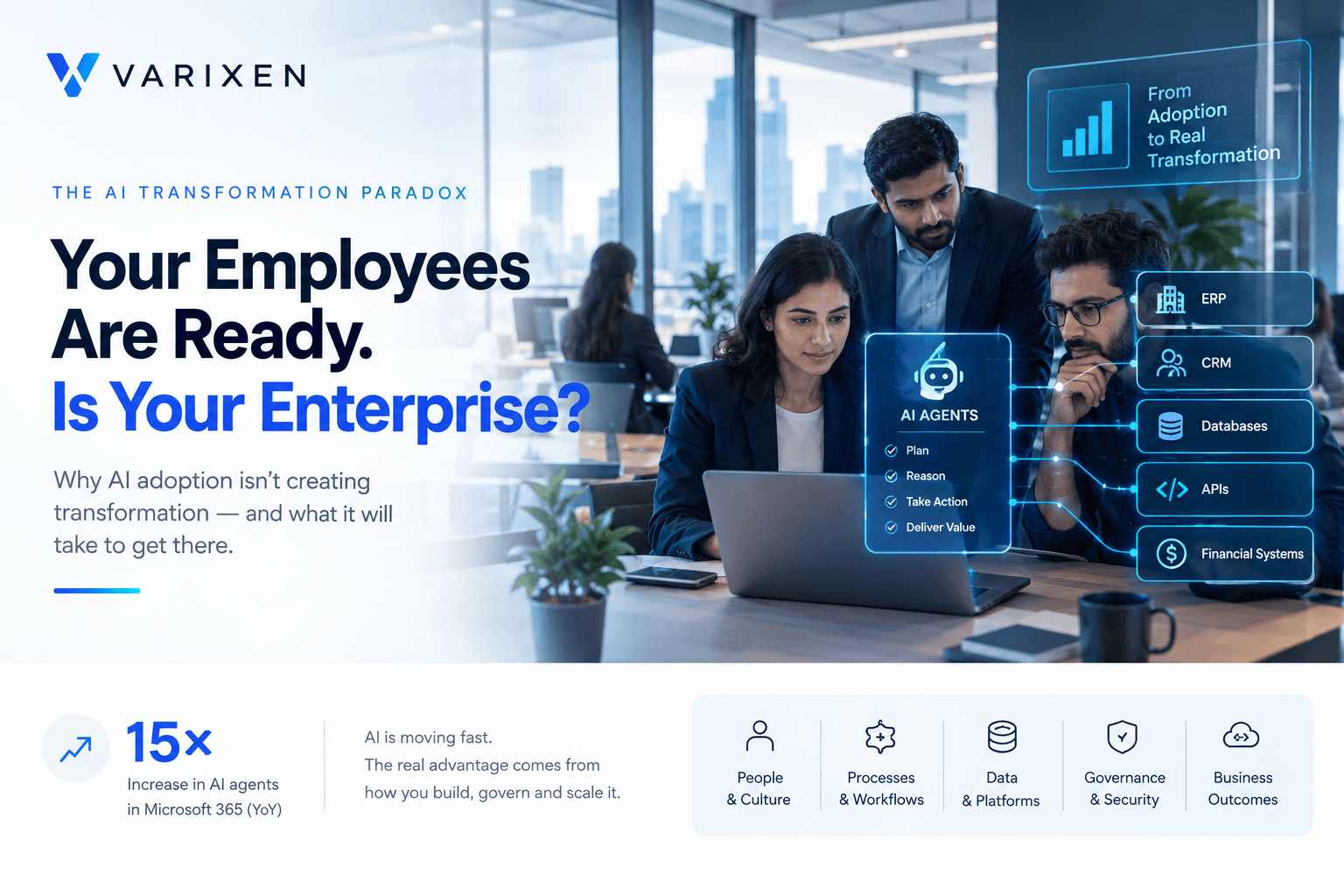
Microsoft's 2026 Work Trend Index highlights the emerging gap. Organizational factors—including culture, manager support, and talent practices—were associated with more than twice the reported AI impact of individual factors. Microsoft also reports that agents in the Microsoft 365 ecosystem increased 15× year over year and 18× in large enterprises.
At the same time, Deloitte's 2026 State of AI in the Enterprise research reports that worker access to AI increased 50% in 2025, while only 34% of organizations said they were truly reimagining the business with AI.
This creates the AI Transformation Paradox:
Employees are becoming AI-enabled faster than enterprises are becoming AI-native.
The consequence is a growing divide between AI adoption and AI transformation.
Organizations can deploy copilots, build RAG applications, introduce AI assistants, and experiment with autonomous agents while continuing to operate fundamentally unchanged.
The next phase of enterprise AI therefore requires a broader transformation across five dimensions:
- 1People — how employees work with AI.
- 2Processes — how workflows are redesigned.
- 3Platforms — how data, applications, models, and agents connect.
- 4Governance — how AI is controlled, measured, and trusted.
- 5Economics — how AI investments translate into measurable business outcomes.
The organizations that master these five dimensions will move beyond AI experimentation toward an intelligence-driven operating model.
Table of Contents
- 1Introduction
- 2AI Adoption Is Not AI Transformation
- 3The AI Transformation Paradox
- 4Why Enterprises Are Getting Stuck
- 5Legacy Workflows: The Hidden Constraint
- 6Organizational Silos
- 7Data Fragmentation
- 8Employee Adoption vs. Enterprise Adoption
- 9AI Governance Cannot Be an Afterthought
- 10Redesigning Work for Human + AI Collaboration
- 11Building the AI-Native Operating Model
- 12Measuring Enterprise AI ROI
- 13Reskilling for the AI Workforce
- 14Enterprise Architecture for AI Transformation
- 15Real-World Case Study
- 16Business Benefits
- 17Enterprise AI Transformation Roadmap
- 18Common Mistakes
- 19Best Practices
- 20Future Trends
- 21Key Takeaways
- 22Frequently Asked Questions
- 23Conclusion
- 24About Varixen
- 25Call to Action
- 26Internal Linking Suggestions
- 27External References
- 28Image Recommendations
- 29SEO Quality Checklist
Introduction
Artificial intelligence is becoming embedded in everyday enterprise work.
Employees use AI to draft documents, analyze data, summarize meetings, write software, research markets, prepare presentations, respond to customers, and automate repetitive tasks.
Engineering teams use AI coding assistants.
Sales teams use AI for prospect research.
Finance teams use AI for analysis.
Procurement teams use AI to evaluate suppliers and RFPs.
Operations teams use AI for forecasting and workflow automation.
Manufacturers are deploying computer vision, predictive maintenance, robotics, and intelligent quality inspection.
The technology is no longer theoretical.
Yet a fundamental problem remains:
Most organizations have not redesigned the enterprise around these capabilities.
A company can give 20,000 employees access to an AI assistant without changing a single core workflow.
It can deploy an enterprise chatbot without fixing fragmented knowledge.
It can build an AI agent without redesigning the approval process that prevents the agent from taking meaningful action.
It can automate document processing while leaving employees responsible for manually moving information between five systems.
That is adoption.
It is not transformation.
McKinsey's 2026 research similarly points to a gap between AI experimentation and enterprise-scale impact. One recent McKinsey survey found that almost 90% of organizations report at least experimenting with AI, while only 7% report scaling it across the enterprise.
The challenge is therefore moving from AI as a tool to AI as part of the operating model.
AI Adoption Is Not AI Transformation
The distinction is fundamental.
AI adoption
AI adoption asks:
Where can we use AI?
Examples:
- Give employees an AI assistant.
- Add a chatbot to the website.
- Deploy an AI coding assistant.
- Build a document summarizer.
- Create a RAG application.
- Experiment with an AI agent.
AI transformation
AI transformation asks:
How should the business operate differently because AI exists?
That question is considerably harder.
It requires organizations to reconsider:
- Processes
- Roles
- Decision rights
- Technology architecture
- Data flows
- Governance
- Performance metrics
- Workforce capabilities
- Customer interactions
- Operating costs
The difference can be illustrated simply:
AI Adoption
     │
     ▼
Deploy AI Tools
     │
     ▼
Employees Use AI
     │
     ▼
Incremental Productivity
versus:
AI Transformation
        │
        ▼
Redesign Business Processes
        │
        ▼
Rebuild Data & Technology Foundations
        │
        ▼
Redesign Human + AI Roles
        │
        ▼
Embed Governance
        │
        ▼
Automate Decisions & Workflows
        │
        ▼
Measure Business Outcomes
        │
        ▼
Continuous Enterprise Optimization
The second model creates structural change.
The AI Transformation Paradox
The paradox is becoming increasingly visible.
Employees are often more willing to experiment with AI than organizations are willing to redesign around it.
Microsoft's 2026 Work Trend Index reports that 65% of AI users fear falling behind if they do not adopt AI quickly, while 45% say it feels safer to continue with current goals than redesign work. Only 13% reported feeling rewarded for reinvention.
This creates an organizational contradiction.
Leadership says:
"We need to become AI-first."
The employee hears:
"Use AI to do your existing job faster."
The organization continues measuring:
- tickets closed
- reports generated
- calls completed
- hours worked
- projects delivered
But the underlying workflow remains unchanged.
The employee becomes more productive.
The enterprise does not necessarily become fundamentally different.
That distinction matters.
Why Enterprises Are Getting Stuck
There are several recurring reasons.
1. AI Is Being Added to Existing Processes
Many organizations approach AI as another software feature.
For example:
Existing Process
      ↓
Manual Review
      ↓
Human Decision
      ↓
Manual Approval
      ↓
ERP Update
AI is simply inserted into one step:
Existing Process
      ↓
AI Summarization
      ↓
Manual Review
      ↓
Human Decision
      ↓
Manual Approval
      ↓
ERP Update
The organization has added AI.
It has not redesigned the process.
A transformed workflow might instead become:
Business Event
      ↓
AI Agent
      ↓
Retrieve Enterprise Context
      ↓
Analyze
      ↓
Recommend Action
      ↓
Policy Check
      ↓
Human Approval When Required
      ↓
Execute Through API
      ↓
Audit
      ↓
Continuous Learning
That is a fundamentally different operating model.
Legacy Workflows: The Hidden Constraint
Legacy systems are not necessarily the biggest problem.
Legacy workflows are.
A modern AI model cannot automatically eliminate a process that requires:
- five approvals
- three spreadsheets
- two email chains
- manual data entry
- disconnected systems
- undocumented business rules
Consider procurement.
A conventional procurement workflow might look like:
- 1Business requests purchase.
- 2Procurement creates RFP.
- 3Vendors submit proposals.
- 4Teams manually compare responses.
- 5Finance reviews pricing.
- 6Legal reviews terms.
- 7Procurement negotiates.
- 8Purchase order is created.
An AI-enabled organization shouldn't simply automate step four.
It should ask:
Which parts of this workflow actually require human judgment?
AI can potentially:
- extract requirements
- normalize vendor responses
- compare commercial terms
- identify deviations
- flag contractual risks
- analyze historical supplier performance
- recommend negotiation priorities
- prepare negotiation briefs
- initiate downstream workflows
The human then focuses on:
- strategic supplier relationships
- risk decisions
- negotiation
- exceptions
- business trade-offs
That is workflow transformation.
Organizational Silos
AI transformation exposes organizational fragmentation.
Consider a customer onboarding process.
Sales owns the CRM.
Finance owns billing.
Operations owns fulfillment.
Legal owns contracts.
IT owns applications.
Security owns access.
Data teams own analytics.
Each department may have its own systems, policies, and objectives.
An AI agent cannot create enterprise value simply by being intelligent if it cannot cross those boundaries.
This is why enterprise AI requires cross-functional architecture.
The goal isn't merely to deploy AI models.
It is to connect:
People + Data + Applications + Processes + AI + Governance
into a coherent operating system.
McKinsey's 2026 Global Tech Agenda describes a similar shift toward product and platform operating models, with leading organizations building an "intelligence layer" combining data, AI models, and decision systems.
Data Fragmentation
AI transformation ultimately depends on information.
Yet enterprise information is frequently distributed across:
- ERP systems
- CRM platforms
- Data warehouses
- Data lakes
- SharePoint
- Email
- PDFs
- Databases
- SaaS applications
- Operational systems
- Documents
- APIs
A powerful model cannot compensate for inaccessible or poorly governed enterprise data.
This is why AI transformation should begin with a data accessibility strategy, not simply a model selection exercise.
Organizations need to determine:
- What data exists?
- Who owns it?
- Who can access it?
- How current is it?
- Is it trustworthy?
- Can AI retrieve it?
- Can AI act on it?
- How is access audited?
The answer forms the foundation for enterprise RAG, AI agents, analytics, automation, and decision intelligence.
Employee Adoption vs. Enterprise Adoption
Employee adoption is necessary—but insufficient.
A developer using GitHub Copilot is individual AI adoption.
An engineering organization redesigning its software lifecycle around AI-assisted requirements, architecture, coding, testing, security, deployment, and observability is enterprise transformation.
Similarly:
Employee using ChatGPT → AI adoption
Finance department redesigning analysis and forecasting workflows around AI → AI transformation
Employee using an AI assistant → AI adoption
Customer service organization redesigning support around AI agents and human escalation → AI transformation
The question should therefore move from:
"How many employees are using AI?"
to:
"How many business processes have been redesigned around AI?"
That is a much stronger transformation metric.
AI Governance Cannot Be an Afterthought
As AI moves deeper into business operations, governance becomes an operating requirement.
This becomes especially important when AI can:
- access confidential information
- make recommendations
- execute transactions
- interact with customers
- modify records
- call enterprise APIs
- make autonomous decisions
Governance should therefore cover the complete AI lifecycle.
NIST's AI Risk Management Framework provides a structured approach for organizations to manage AI risks and promote trustworthy AI, while its Generative AI Profile addresses risks and mitigation actions across the generative AI lifecycle.
Enterprise AI governance should address:
Identity
Who is the AI system?
Authorization
What can it access?
Policy
What is it allowed to do?
Human Oversight
When must a human approve an action?
Security
How is the system protected?
Observability
Can the organization understand what happened?
Auditability
Can decisions and actions be reconstructed?
Evaluation
Is the system performing reliably?
Accountability
Who owns the outcome?
Governance should not become a committee that slows transformation.
It should become part of the architecture.
Redesigning Work for Human + AI Collaboration
The future of work is not necessarily:
Humans vs. AI
It is increasingly:
Humans + AI + Agents
The key question is determining which responsibilities belong to each.
Humans should generally own
- Strategic decisions
- Ethical judgments
- High-risk approvals
- Relationship management
- Ambiguous decisions
- Organizational leadership
AI should increasingly handle
- Repetitive analysis
- Information retrieval
- Classification
- Summarization
- Pattern detection
- Data preparation
- Routine recommendations
AI agents can increasingly execute
- Multi-step workflows
- API interactions
- Information gathering
- Workflow routing
- Operational actions
- Exception handling within defined policies
This creates a new operating model:
Human Strategy
      │
      ▼
AI-Assisted Decisions
      │
      ▼
Agentic Execution
      │
      ▼
Automated Monitoring
      │
      ▼
Human Oversight
The objective isn't maximum autonomy.
It is appropriate autonomy.
Building the AI-Native Operating Model
An AI-native enterprise doesn't simply have more AI applications.
It has different mechanisms for getting work done.
A practical enterprise AI operating model should contain six layers.
1. Strategy Layer
Define:
- Business objectives
- AI priorities
- Transformation goals
- Investment areas
- Risk tolerance
2. Process Layer
Map:
- Current workflows
- Bottlenecks
- Decision points
- Manual activities
- Automation opportunities
3. Intelligence Layer
Provide:
- Foundation models
- Enterprise RAG
- AI agents
- Predictive models
- Computer vision
- Decision systems
4. Data Layer
Provide:
- Governed enterprise data
- Knowledge repositories
- Data pipelines
- Vector databases
- Analytics platforms
- Data quality controls
5. Platform Layer
Provide:
- APIs
- Model gateways
- Agent orchestration
- Kubernetes
- Cloud infrastructure
- Observability
- Security
6. Governance Layer
Control:
- Identity
- Permissions
- Policies
- Model evaluation
- Risk
- Compliance
- Auditability
Together these layers create an enterprise AI foundation.
Measuring Enterprise AI ROI
One of the biggest transformation mistakes is measuring AI activity instead of business outcomes.
Weak metrics include:
- Number of prompts
- Number of AI users
- Number of models deployed
- Number of AI applications
- Number of chatbot conversations
These metrics demonstrate adoption.
They don't necessarily demonstrate value.
Better metrics include:
| Business Metric | Example |
|---|---|
| Cost reduction | Cost per transaction |
| Productivity | Hours saved per workflow |
| Revenue | AI-attributed revenue |
| Quality | Defect reduction |
| Speed | Cycle-time reduction |
| Customer experience | Resolution time |
| Risk | Error or compliance reduction |
| Operations | Throughput improvement |
| Decision quality | Forecast accuracy |
| Workforce leverage | Revenue per employee |
Deloitte's 2026 research reports productivity and efficiency as leading realized benefits of enterprise AI, with 66% of organizations reporting gains; other reported benefits include improved insights and decision-making, reduced costs, and improved customer relationships.
The strongest AI business case therefore connects:
AI Capability → Process Change → Operational Metric → Financial Outcome
Reskilling for the AI Workforce
AI transformation doesn't eliminate the importance of people.
It changes where human expertise creates value.
Employees need new capabilities in:
- AI literacy
- Critical thinking
- AI output evaluation
- Workflow design
- Data interpretation
- Automation
- AI governance
- Domain-specific AI usage
Microsoft reports that human skills such as quality control of AI output and critical thinking remain among the most important capabilities for AI-enabled work.
But training alone isn't enough.
An organization can train 10,000 employees on prompt engineering and still fail to transform.
The more important question is:
What should employees do differently after the training?
Training must therefore be connected to redesigned workflows.
Enterprise Architecture for AI Transformation
AI transformation also creates architectural consequences.
A modern enterprise AI architecture should typically connect:
┌──────────────────────┐
                    │    Business Goals    │
                    └──────────┬───────────┘
                               │
                    ┌──────────▼───────────┐
                    │   AI Orchestration   │
                    │ Agents / Workflows   │
                    └──────────┬───────────┘
                               │
             ┌─────────────────┼─────────────────┐
             │                 │                 │
       ┌─────▼─────┐     ┌─────▼─────┐    ┌─────▼─────┐
       │ Enterprise│     │ AI Models │    │ Business  │
       │   Data    │     │ & RAG     │    │   APIs    │
       └─────┬─────┘     └─────┬─────┘    └─────┬─────┘
             │                 │                 │
             └─────────────────┼─────────────────┘
                               │
                    ┌──────────▼───────────┐
                    │ Governance & Security│
                    └──────────┬───────────┘
                               │
                    ┌──────────▼───────────┐
                    │ Business Outcomes    │
                    └──────────────────────┘
This architecture needs:
- Enterprise identity
- API management
- Agent orchestration
- Data governance
- Model management
- Vector search
- Observability
- Security
- Human approval mechanisms
- Audit trails
- Cost monitoring
The goal is not to create one giant AI platform.
It is to create reusable enterprise capabilities that allow AI applications and agents to be built safely and efficiently.
Real-World Case Study
Problem
Consider a global manufacturing company operating across multiple regions.
The company has implemented:
- AI-powered demand forecasting
- Computer vision inspection
- Procurement analytics
- Employee copilots
- Customer service automation
Individually, the projects perform well.
However, the company still experiences:
- Long procurement cycles
- Manual quality reporting
- Fragmented operational data
- Repeated data entry
- Slow exception handling
- Limited visibility across plants
The company has adopted AI.
It has not transformed its operating model.
Solution
The organization establishes an enterprise AI transformation program focused on workflows rather than individual tools.
It identifies five high-value processes:
- 1Procurement
- 2Quality inspection
- 3Maintenance
- 4Supply-chain planning
- 5Customer service
Instead of creating isolated AI applications, the organization establishes common capabilities for:
- Enterprise data access
- AI model management
- Agent orchestration
- Identity and authorization
- Workflow automation
- Observability
- Governance
Implementation
The company redesigns each process.
Procurement
AI analyzes RFP responses, identifies deviations, and prepares negotiation intelligence.
Quality
Computer vision identifies defects and automatically creates quality events.
Maintenance
Predictive models identify equipment anomalies and trigger maintenance workflows.
Supply Chain
AI combines demand, inventory, supplier, and logistics data to recommend actions.
Customer Service
AI agents resolve routine requests while escalating complex cases to human teams.
Business Results
After establishing measurable baselines, the company targets:
- Reduced process cycle times
- Lower manual processing
- Reduced quality escapes
- Faster supplier evaluation
- Improved equipment availability
- Higher employee productivity
The important outcome is not the number of AI models deployed.
It is the transformation of how the organization operates.
Lessons Learned
1. Start with workflows, not models.
2. Build reusable AI capabilities.
3. Treat governance as architecture.
4. Measure financial and operational outcomes.
5. Redesign employee roles alongside technology.
6. Scale successful patterns instead of creating isolated pilots.
Business Benefits
| Benefit | Business Impact | Typical Measurement |
|---|---|---|
| Workflow automation | Lower operating costs | Cost per transaction |
| Faster decisions | Reduced cycle time | Decision latency |
| Employee augmentation | Higher productivity | Hours saved |
| Better intelligence | Improved decisions | Forecast/decision accuracy |
| Process standardization | Lower operational variance | Process compliance |
| AI-assisted customer service | Faster resolution | Resolution time |
| Predictive operations | Reduced downtime | Availability/OEE |
| Intelligent procurement | Better commercial outcomes | Savings / cycle time |
| Improved governance | Lower AI risk | Policy compliance |
| Enterprise scalability | Faster AI deployment | Time to production |
ROI should always be validated against the organization's actual baseline rather than assumed as a universal percentage.
Enterprise AI Transformation Roadmap
Phase 1 — Executive Alignment
Define:
- Business objectives
- Transformation priorities
- Executive ownership
- Risk appetite
- Success metrics
Output: AI transformation strategy.
Phase 2 — Enterprise Assessment
Evaluate:
- Existing AI initiatives
- Data architecture
- Technology landscape
- Business processes
- Workforce capabilities
- Governance maturity
Output: AI readiness assessment.
Phase 3 — Prioritize Value Pools
Identify workflows based on:
Business Impact × AI Feasibility × Data Readiness × Risk
Prioritize high-value opportunities.
Output: AI transformation portfolio.
Phase 4 — Redesign Workflows
Map the current process.
Then redesign it around:
- AI assistance
- Automation
- Agentic execution
- Human decision points
Output: Future-state operating model.
Phase 5 — Build the AI Foundation
Implement:
- Data foundations
- AI platform
- Model gateway
- RAG
- Agent orchestration
- Security
- Governance
- Observability
Output: Reusable enterprise AI platform.
Phase 6 — Production Deployment
Move priority use cases into production.
Establish:
- Monitoring
- Evaluation
- Incident management
- Cost controls
- Model lifecycle management
Output: Production AI systems.
Phase 7 — Scale and Optimize
Expand successful patterns across:
- Departments
- Business units
- Regions
- Products
- Processes
Continuously measure business outcomes.
Output: AI-native operating model.
Common Mistakes
1. Measuring AI adoption instead of business impact
Thousands of employees using AI doesn't automatically mean transformation.
Better approach: Measure process and financial outcomes.
2. Building isolated AI pilots
Each department creates its own chatbot, RAG system, or agent.
Better approach: Build reusable enterprise capabilities.
3. Ignoring workflow redesign
AI is added to a broken process.
Better approach: Redesign the process before automating it.
4. Treating governance as paperwork
Governance becomes a committee that reviews AI projects after development.
Better approach: Embed governance directly into architecture.
5. Focusing only on models
Organizations spend excessive time comparing models while ignoring data, processes, integration, and adoption.
Better approach: Treat the model as one component of the system.
6. Training without redesigning roles
Employees receive AI training but continue operating under old performance expectations.
Better approach: Connect reskilling to redesigned work.
7. Expecting immediate enterprise-wide transformation
Large organizations cannot redesign everything simultaneously.
Better approach: Start with measurable value pools and scale proven patterns.
Best Practices
Start With Business Problems
Do not begin with:
"Where can we use GPT?"
Begin with:
"Where are we losing time, money, quality, or decision speed?"
Build Reusable Capabilities
Create shared capabilities for:
- Identity
- Data
- Models
- Agents
- APIs
- Governance
- Observability
Design Human Oversight
Not every AI decision requires human approval.
Not every decision should be autonomous.
Define explicit autonomy boundaries.
Treat Data as Infrastructure
Enterprise AI cannot scale on fragmented, inaccessible data.
Establish AI Governance Early
Security, risk, privacy, compliance, and auditability should be incorporated from the beginning.
Measure Value Continuously
Every production AI initiative should have:
- Baseline
- Target
- Measurement methodology
- Financial interpretation
- Owner
Create Executive Ownership
AI transformation should not belong exclusively to IT.
Business, technology, operations, finance, risk, and HR must participate.
Future Trends
1. From Copilots to Digital Labor
AI will increasingly move from assisting employees toward executing defined categories of work.
2. Multi-Agent Enterprise Workflows
Organizations will deploy multiple specialized agents coordinating across business processes.
3. AI-Native Operating Models
Companies will increasingly redesign roles and processes around human and machine collaboration.
4. AI Governance as Infrastructure
Policy enforcement, identity, evaluation, and auditability will become embedded into AI platforms.
5. AI Economics
Enterprises will increasingly measure AI using cost-per-outcome rather than cost-per-token or number of users.
6. Physical AI
AI will increasingly connect software intelligence with robotics, industrial equipment, warehouses, and manufacturing environments.
Deloitte's 2026 research reports that 58% of organizations already report at least limited use of physical AI, with that figure expected to rise significantly over the following two years.
7. Intelligence-Driven Enterprises
The longer-term shift is from companies that use AI to companies whose operating models are fundamentally built around intelligence.
That is the real destination.
Key Takeaways
- AI adoption is not the same as AI transformation.
- Employees can become AI-enabled while the enterprise remains structurally unchanged.
- The biggest transformation opportunities often exist in workflows, not individual AI applications.
- Data fragmentation can limit AI impact even when models are highly capable.
- Enterprise AI requires security, governance, identity, observability, and accountability.
- Human + AI operating models should define where autonomy begins and ends.
- AI ROI should be measured through business outcomes rather than usage statistics.
- Reskilling must be connected to redesigned work.
- Successful enterprises will build reusable AI capabilities rather than disconnected pilots.
- The next competitive advantage will come from how organizations operate with AI, not simply whether they use it.
Frequently Asked Questions
1. What is the difference between AI adoption and AI transformation?
AI adoption means implementing AI tools or applications. AI transformation involves redesigning business processes, operating models, technology, workforce practices, and governance around AI.
2. Why are many enterprise AI projects failing to create significant value?
Common reasons include fragmented data, weak integration, insufficient workflow redesign, unclear ownership, poor governance, and measuring adoption rather than business outcomes.
3. Does AI transformation mean replacing employees?
Not necessarily. Many enterprise use cases are better understood as human augmentation and workflow redesign. AI can handle repetitive work while employees focus on judgment, relationships, strategy, and exception handling.
4. Should every enterprise deploy AI agents?
No. Agentic AI is appropriate when a workflow involves multiple steps, tools, decisions, and actions that can be governed effectively. Simpler use cases may be better served by conventional automation or AI assistance.
5. How should CEOs measure AI transformation?
CEOs should connect AI initiatives to measurable outcomes such as revenue, cost reduction, productivity, cycle time, quality, customer experience, risk reduction, and decision quality.
6. What role does AI governance play?
Governance establishes how AI is approved, accessed, monitored, evaluated, secured, and audited. It should be integrated into the technology architecture rather than treated as an administrative process.
7. How important is enterprise data?
Extremely important. AI systems require reliable access to relevant business information. Poor data quality, fragmentation, and access restrictions can significantly reduce the value of AI applications.
8. Should companies build their own AI platform?
Not always. The right decision depends on scale, security requirements, existing infrastructure, use cases, and organizational capabilities. Enterprises should prioritize reusable capabilities while avoiding unnecessary platform complexity.
9. What should an organization do before launching an AI transformation program?
Establish executive objectives, identify high-value workflows, assess data and technology readiness, define governance requirements, and create measurable business baselines.
10. How long does enterprise AI transformation take?
There is no universal timeline. Individual workflows can be transformed in months, while organization-wide operating-model transformation is an ongoing multi-year journey. The objective should be incremental, measurable value rather than a single "AI transformation" launch date.
Conclusion
The next phase of enterprise AI will not be won by organizations that simply deploy the most models, copilots, or agents.
It will be won by organizations that redesign how work gets done.
The AI Transformation Paradox exists because technology is advancing faster than organizational change. Employees can adopt AI within days, while enterprise processes, governance structures, data architectures, incentives, and operating models can take years to evolve.
That gap is now becoming a strategic issue.
The answer is not to slow AI adoption.
It is to accelerate organizational transformation alongside it.
The enterprise of the future will not simply have AI tools embedded across departments. It will have an operating model in which people, AI systems, agents, data, applications, and automation work together under clearly defined governance.
For CEOs and technology leaders, the strategic question is therefore no longer:
"Are we using AI?"
It is:
"What should our organization look like now that AI exists?"
That is where real AI transformation begins.
About Varixen
Varixen is an Enterprise AI and Software Engineering company helping organizations build intelligent, secure, and scalable digital capabilities.
Our work spans Enterprise AI, Agentic AI, AI Agents, Generative AI, AI Governance, AI Security, Computer Vision, Intelligent Automation, Data Engineering, Cloud Engineering, Enterprise Software, and Digital Transformation.
We help organizations move from AI experimentation to production by connecting business strategy with modern architecture, data, automation, and measurable operational outcomes.
Call to Action
Is your organization adopting AI—or actually transforming around it?
Varixen helps enterprises assess AI readiness, identify high-value transformation opportunities, redesign workflows, establish AI governance, and build production-grade AI and automation platforms.
Explore how your organization can move from AI adoption to measurable enterprise transformation.
Talk to Varixen about your AI transformation roadmap.
Internal Linking Suggestions
- 1From AI Pilots to Production: The Enterprise Architecture Behind Scalable Agentic AI
- 2Rethinking Enterprise Architecture for the Agentic AI Era
- 3The Enterprise AI Operating System: Building the Intelligence Layer for Modern Businesses
- 4AI Governance in the Enterprise: Building Secure and Responsible AI at Scale
- 5The New Economics of Enterprise AI: Designing Cloud Infrastructure for AI at Scale
External References
- 1Microsoft — 2026 Work Trend Index
- 2Microsoft's 2026 research covering organizational AI impact, human agency, AI adoption, and the growth of enterprise agents.
- 2Deloitte — State of AI in the Enterprise 2026
- 2Research covering AI adoption, scaling, workforce readiness, business impact, governance, agentic AI, and physical AI.
- 3Deloitte — Enterprise AI Trends 2026
- 2Analysis of work redesign, governance, and AI ROI as organizations move from adoption toward transformation.
- 4McKinsey — Global Tech Agenda 2026
- 2Research on AI, data, operating models, technology strategy, and the emerging enterprise intelligence layer.
- 5McKinsey — Rewired: Practical People Lessons for Scaling AI Adoption
- 2Analysis of why workflow redesign, operating models, leadership, and organizational culture are increasingly important to scaling AI.
- 6McKinsey — The Operating Model Advantage
- 2Research examining why AI value increasingly depends on redesigning how work is performed and decisions are made.
- 7NIST — AI Risk Management Framework
- 2Authoritative framework for managing AI risks and incorporating trustworthy AI practices into design, development, deployment, and evaluation.
- 8NIST — Generative AI Profile
- 2Guidance for identifying and managing risks associated with generative AI throughout the AI lifecycle.