From AI Proof of Concept to Production: A Practical Enterprise AI Architecture Guide
A practical architecture framework for turning promising AI experiments into secure, scalable, observable, and production-ready enterprise systems.
Varixen Editorial Team
Enterprise Architecture & AI Advisory
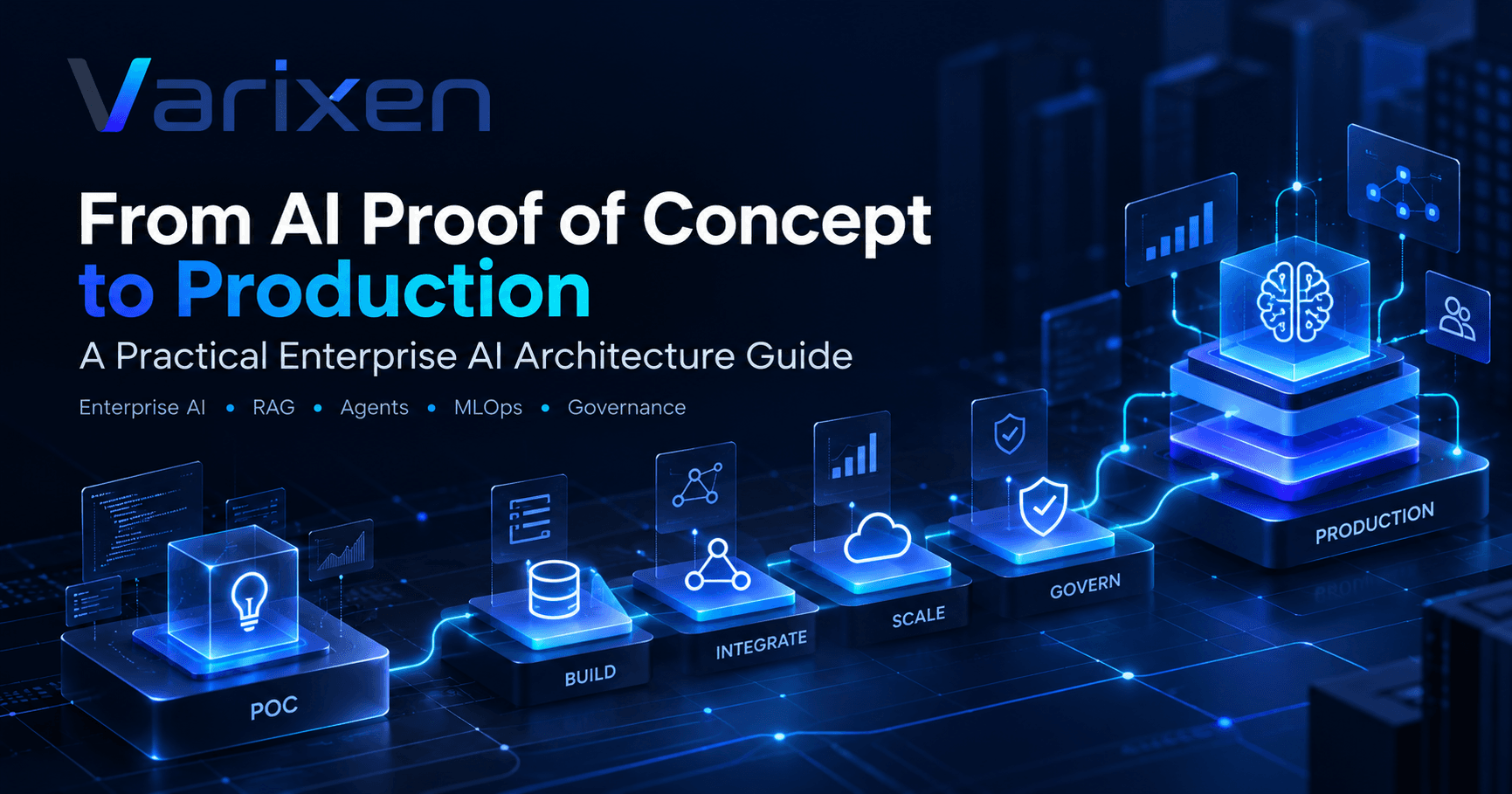
From AI Proof of Concept to Production: A Practical Enterprise AI Architecture Guide
Building an AI proof of concept has become relatively easy.
A small team can connect a foundation model to a dataset, create a conversational interface, build a predictive model, or automate a workflow in days or weeks.
The difficult part begins afterward.
An AI system that works during a controlled demonstration must eventually operate with real users, production data, enterprise authentication, unpredictable workloads, existing software systems, security requirements, failure conditions, compliance controls, and measurable business expectations.
That transition—from AI experiment to production business system—is where architecture becomes critical.
Production AI is not simply a model running behind an API.
It is an engineered system combining:
- business workflows
- enterprise data
- AI models
- retrieval systems
- APIs and integrations
- security controls
- orchestration
- observability
- infrastructure
- governance
- human oversight
- continuous evaluation
This guide explains how enterprises can architect that transition systematically.
Why AI Proofs of Concept Often Fail in Production
A proof of concept typically answers one question:
Can the technology perform this task?
Production introduces a much larger set of questions:
- Can it perform reliably thousands of times?
- Can it access enterprise data securely?
- What happens when a model produces an incorrect answer?
- How is sensitive information protected?
- Can employees access only information they are authorized to see?
- What happens when an external model provider becomes unavailable?
- How do we evaluate model quality after deployment?
- How does the AI interact with ERP, CRM, databases and internal applications?
- Can every important action be audited?
- What happens when usage increases 20x?
- Can the system be maintained as models and business processes change?
The architecture must answer all of these questions.
This is why enterprise AI development increasingly resembles distributed software and platform engineering rather than isolated machine-learning experimentation.
Varixen's AI Development Services approach treats AI as part of a broader production system encompassing data engineering, model design, API orchestration, governance and continuous operations.
The Production Enterprise AI Architecture
A useful way to think about production AI is as a layered architecture.
┌─────────────────────────────────────────────┐
│           BUSINESS APPLICATIONS             │
│ Web • Mobile • CRM • ERP • Internal Tools   │
└──────────────────────┬──────────────────────┘
                       │
┌──────────────────────▼──────────────────────┐
│             AI APPLICATION LAYER            │
│ Copilots • Agents • Search • Predictions    │
└──────────────────────┬──────────────────────┘
                       │
┌──────────────────────▼──────────────────────┐
│          ORCHESTRATION & GUARDRAILS         │
│ Routing • Tools • Policies • HITL • State   │
└─────────────┬─────────────────┬─────────────┘
              │                 │
┌─────────────▼──────┐  ┌──────▼─────────────┐
│ RETRIEVAL / MEMORY │  │    MODEL LAYER     │
│ RAG • Vector DB    │  │ LLM • ML • Vision  │
│ Search • Graph     │  │ Predictive Models  │
└─────────────┬──────┘  └──────┬─────────────┘
              │                 │
┌─────────────▼─────────────────▼─────────────┐
│                DATA LAYER                   │
│ Documents • DBs • APIs • Events • Streams  │
└──────────────────────┬──────────────────────┘
                       │
┌──────────────────────▼──────────────────────┐
│       PLATFORM, SECURITY & OBSERVABILITY    │
│ IAM • Logs • CI/CD • Monitoring • MLOps    │
└─────────────────────────────────────────────┘
Each layer solves a different production problem.
1. Start With the Business Workflow, Not the AI Model
One of the most common mistakes in enterprise AI projects is beginning with:
"Which LLM should we use?"
A better starting point is:
What business decision or workflow are we improving?
Consider an accounts payable workflow.
The business process may involve:
- 1Receiving an invoice.
- 2Extracting invoice data.
- 3Identifying the supplier.
- 4Matching it against a purchase order.
- 5Detecting exceptions.
- 6Routing the invoice for approval.
- 7Updating the ERP.
- 8Maintaining an audit trail.
The AI model may participate in only two or three of those steps.
The rest requires workflow orchestration, application logic, integrations, validation and governance.
The same principle applies to customer support, procurement, healthcare operations, manufacturing, legal review and internal knowledge systems.
AI should become a capability inside a business process, not an isolated application disconnected from it.
2. Build a Reliable Enterprise Data Layer
Production AI quality depends heavily on the information available to it.
That information may come from:
- relational databases
- data warehouses
- ERP platforms
- CRM systems
- SharePoint
- Google Drive
- internal APIs
- PDFs and Word documents
- support tickets
- emails
- event streams
- images
- sensor data
- operational databases
A production architecture therefore needs a controlled data-access layer.
Enterprise Systems
       │
       ├── ERP
       ├── CRM
       ├── Documents
       ├── Databases
       ├── APIs
       └── Event Streams
              │
              ▼
      Data Processing Layer
              │
      ┌───────┼────────┐
      ▼       ▼        ▼
 Structured  Vector   Feature/
   Data       Store    Model Data
The objective is not merely to collect data.
The architecture should define:
- data ownership
- access permissions
- freshness
- lineage
- validation
- retention
- encryption
- transformation
- schema management
Without these foundations, sophisticated AI models can still generate unreliable results.
3. Separate AI Models From Business Logic
A production application should rarely allow an LLM or ML model to control the entire workflow directly.
Instead, isolate model intelligence from deterministic business logic.
For example:
User Request
     │
     ▼
Application API
     │
     ▼
Policy / Validation Layer
     │
     ▼
AI Model
     │
     ▼
Structured Response
     │
     ▼
Business Rules
     │
     ├── Approve automatically
     ├── Escalate
     ├── Request human review
     └── Reject
This separation provides several advantages.
Predictability
Critical business rules remain deterministic.
Model portability
Models can be replaced without rewriting the complete application.
Security
The model receives only the information required for its task.
Testability
Application logic and model behaviour can be evaluated independently.
Auditability
The enterprise can identify exactly which component made a particular decision.
This becomes especially important when AI participates in financial, healthcare, legal or operational workflows.
4. Use RAG When Enterprise Knowledge Matters
A foundation model knows what it learned during training.
It does not automatically know:
- your latest contracts
- internal operating procedures
- product documentation
- customer records
- company policies
- current inventory
- project documentation
- private knowledge bases
For these scenarios, enterprises often introduce Retrieval-Augmented Generation (RAG).
A simplified RAG architecture looks like this:
Enterprise Documents
        │
        ▼
Document Parsing
        │
        ▼
Chunking + Metadata
        │
        ▼
Embedding Generation
        │
        ▼
Vector / Search Index
        │
        ▼
User Query
        │
        ▼
Hybrid Retrieval
        │
        ▼
Re-ranking
        │
        ▼
Relevant Context
        │
        ▼
LLM
        │
        ▼
Grounded Response + Sources
The value of RAG is not simply "giving documents to ChatGPT."
Production implementations must consider:
- document parsing quality
- semantic chunking
- metadata
- embedding models
- vector databases
- keyword search
- hybrid retrieval
- re-ranking
- access control
- source citations
- freshness
- evaluation
For knowledge-intensive enterprise applications, these design decisions can matter as much as the choice of foundation model.
Varixen's RAG Development & Knowledge Systems capability covers architectures combining vector retrieval, semantic indexing, re-ranking and enterprise knowledge systems.
5. Introduce Agentic AI Only Where Actions Are Required
RAG retrieves information.
AI agents can go further and act upon information.
An AI agent may:
- query a database
- call an API
- create a ticket
- update a CRM
- generate a report
- retrieve documents
- execute business rules
- send a workflow for approval
- coordinate multiple specialized agents
A simplified agent architecture might look like:
Business Goal
     │
     ▼
Agent Orchestrator
     │
     ├── Planning
     ├── Memory / State
     ├── Tool Selection
     ├── Policy Validation
     └── Error Recovery
             │
             ▼
     Enterprise Tools
     ├── CRM
     ├── ERP
     ├── Database
     ├── Email
     ├── Search
     └── Internal APIs
However, autonomy introduces risk.
An agent that can read information is fundamentally different from one capable of:
- modifying customer records
- approving financial transactions
- sending communications
- provisioning infrastructure
- executing code
The architecture should therefore define explicit permission boundaries and human approval gates.
For workflows that require tool usage and multi-step decision execution, see Varixen's Autonomous AI Agents engineering capability.
6. Design Human-in-the-Loop Controls
Not every AI decision should be autonomous.
A useful production pattern is confidence-based routing.
AI Output
    │
    ▼
Confidence / Policy Check
    │
    ├── High confidence + low risk
    │        └── Execute automatically
    │
    ├── Medium confidence
    │        └── Human verification
    │
    └── High-risk action
             └── Mandatory approval
Human-in-the-loop systems are especially useful when workflows involve:
- financial decisions
- regulatory compliance
- legal interpretation
- medical information
- customer commitments
- security changes
- irreversible transactions
The objective is not to reduce automation.
It is to create controlled automation where machine speed and human accountability complement each other.
7. Build an AI Gateway Instead of Connecting Everything Directly to Models
As enterprise AI adoption expands, multiple applications may begin communicating with multiple models.
Without an abstraction layer, architecture can quickly become difficult to manage.
Application A ──┐
Application B ──┼──► AI Gateway ──► Model A
Application C ──┤                  ► Model B
Agent System  ──┘                  ► Model C
An AI gateway can centralize:
- authentication
- model routing
- rate limiting
- cost controls
- prompt policies
- request logging
- PII filtering
- fallback models
- caching
- latency tracking
- token consumption
- safety controls
This also reduces model-provider lock-in.
Instead of embedding provider-specific code throughout the enterprise, applications communicate with a controlled internal interface.
8. Engineer for Model Failure
Traditional software engineers learn to expect network failures, database failures and dependency failures.
AI engineering requires another assumption:
The model itself can fail semantically even when the API returns HTTP 200.
A successful API response does not guarantee a correct answer.
Production architectures therefore need multiple types of fallback.
Infrastructure fallback
If Model A becomes unavailable:
Primary Model
     │ failure
     ▼
Secondary Model
Quality fallback
If model confidence falls below an acceptable threshold:
AI Result
    │
confidence < threshold
    ▼
Human Review
Retrieval fallback
If enterprise evidence cannot be located:
Query
  │
  ▼
Retrieval
  │
No reliable evidence
  ▼
Return "insufficient information"
Workflow fallback
If an agent fails during a multi-step execution:
Checkpoint
   │
Failure
   │
Retry
   │
Alternative tool
   │
Human escalation
Failure handling should be designed into the architecture rather than added after deployment.
9. Observability Must Include AI Behaviour
Traditional application monitoring asks:
- Is the API available?
- What is the latency?
- Are there errors?
- Is CPU utilization high?
AI systems require additional questions:
- Which model produced the response?
- Which prompt version was used?
- Which documents were retrieved?
- How many tokens were consumed?
- What did the inference cost?
- Did the response pass evaluation?
- Was sensitive information detected?
- Did a user reject the answer?
- Which tool did the agent call?
- How long did each reasoning step take?
Production telemetry may therefore include:
Infrastructure Metrics
+ Application Metrics
+ Model Metrics
+ Retrieval Metrics
+ Agent Metrics
+ Business Metrics
The final category is often the most important.
An AI system may have excellent latency and model accuracy while creating little business value.
The architecture should connect technical telemetry to metrics such as:
- processing time
- employee productivity
- cost per transaction
- automation rate
- exception rate
- resolution time
- throughput
- customer satisfaction
- business conversion
10. Treat MLOps and LLMOps as Production Infrastructure
Deployment is not the end of an AI project.
Models change.
Data changes.
Prompts change.
Business workflows change.
User behaviour changes.
External foundation models change.
Production systems therefore need lifecycle management.
Develop
   ↓
Evaluate
   ↓
Deploy
   ↓
Monitor
   ↓
Collect Feedback
   ↓
Evaluate Again
   ↓
Improve
   ↓
Redeploy
An effective MLOps/LLMOps system may include:
- version-controlled prompts
- model registries
- evaluation datasets
- automated regression testing
- CI/CD
- deployment environments
- model monitoring
- drift detection
- usage analytics
- rollback mechanisms
- cost monitoring
Varixen's Production MLOps & Governance capability addresses this operational layer of enterprise AI.
11. Secure the Entire AI Pipeline
Enterprise AI security extends beyond protecting an API key.
The architecture should consider the complete chain:
User
 ↓
Identity
 ↓
Application
 ↓
AI Gateway
 ↓
Retrieval
 ↓
Enterprise Data
 ↓
Model
 ↓
Tool Execution
 ↓
Business System
Controls may include:
Identity and access management
Users should access only the AI capabilities and enterprise information permitted by their roles.
Data minimization
Models should receive only the information necessary to complete a task.
PII handling
Sensitive information may need to be detected, masked or prevented from leaving controlled environments.
Retrieval authorization
A RAG system should not surface documents a user could not otherwise access.
Tool permissions
Agents should operate using restricted credentials and least-privilege access.
Audit trails
Important AI decisions and actions should be traceable.
Secret management
Credentials should never be embedded directly into prompts, application code or agent memory.
Security must exist across the architecture—not only around the model endpoint.
12. Design for Enterprise Integration
AI rarely creates maximum value when operating as another standalone application.
Its usefulness increases when it becomes part of existing systems.
Common integrations include:
- SAP
- Salesforce
- ServiceNow
- Microsoft 365
- Google Workspace
- HubSpot
- internal databases
- data warehouses
- custom enterprise applications
- document repositories
- communication platforms
This is where AI engineering and conventional software engineering converge.
The AI capability may live behind:
REST APIs
GraphQL
gRPC
Event Streams
Message Queues
Webhooks
Enterprise Integration Middleware
For workflows requiring AI to coordinate across several systems, Varixen's Enterprise Automation & Workflow Integration capability provides the broader automation and integration layer.
13. Architecture for Scale Before Scale Arrives
A prototype may process 100 requests per day.
A successful enterprise deployment may eventually process hundreds of thousands.
The architecture needs to anticipate:
- concurrent inference requests
- GPU availability
- API quotas
- vector search load
- retrieval latency
- database connections
- token consumption
- queue depth
- third-party rate limits
This does not mean over-engineering the first release.
It means designing clean boundaries that can evolve.
For example:
Application
    │
    ▼
API Gateway
    │
    ▼
Async Processing Layer
    │
    ├── AI Worker
    ├── Retrieval Worker
    └── Integration Worker
             │
             ▼
      Persistent State
As workloads increase, individual components can scale independently.
14. Optimize AI Economics, Not Only Accuracy
The most accurate model is not automatically the best production model.
Suppose a workflow receives one million inference requests every month.
A modest difference in cost per request can materially change the economics of the system.
Production architecture should therefore optimize across multiple dimensions:
| Dimension | Question |
|---|---|
| Accuracy | Does it perform the task reliably? |
| Latency | Is response time acceptable? |
| Cost | Is inference economically sustainable? |
| Privacy | Can data be processed appropriately? |
| Context | Can the model handle the required information? |
| Reliability | What happens during provider failure? |
| Deployment | Cloud, private cloud, edge or on-prem? |
| Maintainability | Can the system evolve easily? |
This frequently leads to model routing.
Incoming Task
      │
      ▼
Task Classification
      │
 ┌────┼──────────┐
 ▼    ▼          ▼
Small  Medium   Advanced
Model  Model     Model
Simple tasks use efficient models.
Complex reasoning uses more capable models.
Sensitive workloads may use privately deployed models.
Architecture therefore becomes an economic optimization problem as much as a technical one.
15. Create Evaluation Before Production Launch
Traditional software tests deterministic outputs.
Generative AI often produces non-deterministic outputs.
Evaluation therefore needs its own engineering discipline.
An enterprise evaluation framework may measure:
- factual correctness
- retrieval relevance
- instruction adherence
- completeness
- hallucination rate
- structured-output validity
- tool-selection accuracy
- security policy adherence
- latency
- cost per execution
Build a representative evaluation dataset containing real scenarios.
For example:
Evaluation Dataset
      │
      ▼
AI Pipeline
      │
      ▼
Automated Evaluators
      │
      ├── Retrieval score
      ├── Factuality score
      ├── Output validation
      ├── Policy checks
      └── Latency / Cost
Run these evaluations whenever:
- prompts change
- models change
- retrieval changes
- tools change
- application logic changes
Otherwise seemingly minor modifications can introduce silent production regressions.
A Practical AI Production Readiness Checklist
Before moving an enterprise AI system into production, evaluate the following areas.
| Area | Production Question |
|---|---|
| Business | Is the intended business outcome measurable? |
| Data | Is source data reliable, governed and accessible? |
| Model | Has the model been evaluated on representative cases? |
| RAG | Is retrieval quality measured where knowledge grounding is required? |
| Security | Are identity, permissions and sensitive data controlled? |
| Integration | Can the AI communicate reliably with existing systems? |
| Reliability | Are retries, fallbacks and failure states designed? |
| Human Oversight | Are high-risk decisions appropriately reviewed? |
| Observability | Can the system's behaviour be traced? |
| Evaluation | Can quality regressions be detected? |
| MLOps | Can models/prompts be versioned and redeployed safely? |
| Scalability | Can infrastructure accommodate increased workloads? |
| Cost | Is unit economics acceptable at projected usage? |
| Governance | Are ownership, policies and accountability defined? |
If several of these questions cannot be answered clearly, the system is probably still a prototype rather than a production AI platform.
A Better Enterprise AI Delivery Sequence
A practical delivery process usually looks like this:
Phase 1 — Business and AI Readiness
Define:
- business problem
- current workflow
- baseline metrics
- available data
- systems involved
- security constraints
- expected ROI
Phase 2 — Architecture
Design:
- data flows
- model strategy
- RAG requirements
- integration boundaries
- security controls
- human approval points
- deployment topology
- evaluation framework
Phase 3 — Controlled Production MVP
Implement the smallest architecture capable of operating safely with real users.
Do not optimize only for demo quality.
Validate:
- accuracy
- reliability
- adoption
- latency
- cost
- workflow integration
Phase 4 — Production Hardening
Introduce:
- observability
- fallback paths
- automated evaluations
- access controls
- CI/CD
- model versioning
- infrastructure scaling
- incident handling
Phase 5 — Continuous Optimization
Measure business outcomes and improve:
Usage
 ↓
Telemetry
 ↓
Evaluation
 ↓
Business Impact
 ↓
Optimization
 ↓
Next Release
This turns AI from a project into an operational business capability.
The Architecture Decision That Matters Most
One of the most important lessons in enterprise AI engineering is simple:
Do not architect around the model. Architect around the business capability.
Models will change.
Today's preferred foundation model may not be the preferred model two years from now.
Embedding technologies will evolve.
Agent frameworks will change.
Infrastructure options will improve.
Your business processes and enterprise systems must continue operating through those changes.
The strongest architecture therefore creates replaceable boundaries around models while preserving:
- business logic
- APIs
- enterprise data
- permissions
- workflows
- observability
- governance
That is how AI systems remain maintainable as the technology ecosystem evolves.
From AI Experimentation to Enterprise Capability
The gap between an impressive AI demonstration and a reliable enterprise AI system is fundamentally an engineering gap.
Production AI requires much more than selecting a model.
It requires the coordinated design of:
AI + software engineering + enterprise data + integrations + infrastructure + security + governance + operations.
Organizations that approach AI this way can move beyond disconnected experiments and begin embedding intelligence directly into business operations.
Varixen's AI Development Services focus on designing and engineering production AI systems across custom machine learning, generative AI, autonomous agents, predictive intelligence, enterprise integrations and production infrastructure.
Depending on the use case, the broader architecture can also include:
- RAG Development & Knowledge Systems for enterprise knowledge retrieval
- Autonomous AI Agents for multi-step intelligent workflows
- Production MLOps & Governance for model lifecycle management
- Enterprise Automation & Workflow Integration for connecting AI with operational business systems
The objective should not be to deploy AI because the technology is available.
The objective should be to engineer an intelligent business capability that remains secure, scalable, maintainable and valuable in production.
Planning an Enterprise AI Initiative?
Before committing to models or frameworks, map the business workflow, data dependencies, integration boundaries, risk profile and measurable outcome.
Explore Varixen's Enterprise AI Development Services to see how production AI architectures can be designed around your organization's existing systems and business objectives.
`
Why I selected this supporting topic
This is a particularly strong first supporting article for the October AI Development cluster because the live pillar already covers custom ML, LLM engineering, agent orchestration, predictive AI, governance, edge/on-prem deployment and a four-stage production pipeline. :chatgpt-content-reference{index="2"} The article expands one implementation-stage question—“how do we actually take AI into production?”—without trying to rank for the exact same broad service intent as the pillar.
The internal-link structure also follows the Varixen SOP requirement that supporting articles link contextually to their primary commercial pillar and use natural anchor variation instead of repetitive exact-match anchors. :chatgpt-content-reference{index="3"} It also reinforces Varixen's established positioning that AI must sit on top of reliable software, cloud, data, integration and governance foundations rather than operate as an isolated technology. :chatgpt-content-reference{index="4"}
For this month's cluster, I would make this Supporting Article #1. Then build #2 around “Enterprise AI Integration: How to Connect LLMs and AI Agents to Existing ERP, CRM and Legacy Systems”, and #3 around “Build vs Buy vs API: How Enterprises Should Choose an AI Model Strategy.” That would give /services/ai-development a much stronger implementation-focused topical cluster rather than a set of generic AI articles.