AI Gateway vs. Application Gateway: Why the Enterprise AI Gateway Is Becoming a Critical Architecture Layer
Why enterprises need a dedicated control layer for AI models, agents, data, tools, security, governance, and intelligent workloads.
Varixen Editorial Team
Enterprise Architecture & AI Advisory
Executive Summary
Enterprise architecture has historically been built around applications and APIs.
Application gateways, API gateways, service meshes, and load balancers were designed to control how applications communicate with backend services.
AI introduces a fundamentally different workload.
An AI application may interact with multiple models, vector databases, enterprise APIs, agents, MCP servers, knowledge systems, external providers, and autonomous tools—all within a single business workflow.
This creates a new architectural requirement:
Enterprises need visibility and control over how AI makes decisions, consumes models, accesses data, and executes actions.
That is where the AI Gateway becomes increasingly important.
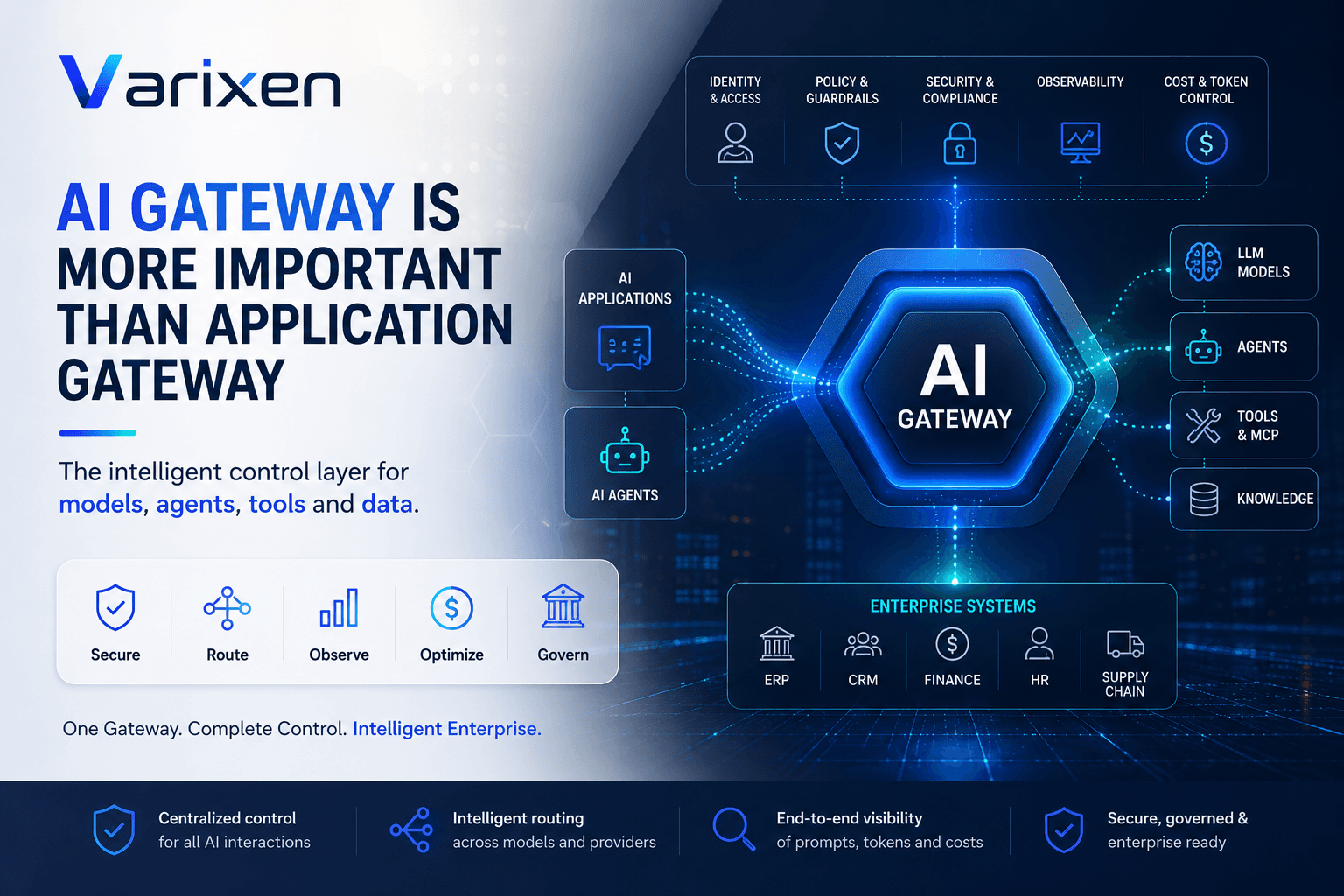
An AI Gateway does not replace the Application or API Gateway. Instead, it adds an AI-aware control layer capable of managing models, tokens, prompts, agents, tools, policies, costs, security, and AI observability.
For enterprises moving toward agentic AI, multi-model architectures, and AI-native applications, this layer is becoming strategically important.
Table of Contents
- 1Introduction
- 2The Evolution of Enterprise Gateways
- 3Why Traditional Application Gateways Are Not Enough
- 4What Is an AI Gateway?
- 5AI Gateway vs Application Gateway
- 6Why AI Gateway Matters at Enterprise Scale
- 7Technical Deep Dive
- 8Enterprise Architecture
- 9AI Gateway Security
- 10Intelligent Model Routing
- 11AI Observability and Cost Management
- 12AI Agents and Tool Governance
- 13Real-World Case Study
- 14Business Benefits
- 15Implementation Roadmap
- 16Common Mistakes
- 17Best Practices
- 18Future Trends
- 19Key Takeaways
- 20Frequently Asked Questions
- 21Conclusion
- 22About Varixen
- 23Call to Action
Introduction
For more than a decade, the enterprise application stack has been built around APIs.
A typical architecture looked like:
Users
   ↓
Application
   ↓
API Gateway
   ↓
Microservices
   ↓
Databases
The API Gateway became a central control point for authentication, authorization, routing, rate limiting, security, and observability.
But enterprise AI is changing the traffic pattern.
A modern AI application may look more like:
User
 ↓
AI Application
 ↓
AI Agent
 ↓
AI Gateway
 ↓
Model
 ↓
Knowledge / Tools / APIs
 ↓
Enterprise Systems
The AI workload is no longer simply requesting a predictable backend service.
It may be:
- Selecting between multiple models
- Retrieving enterprise knowledge
- Calling external tools
- Executing business APIs
- Processing sensitive information
- Generating large volumes of tokens
- Invoking other agents
- Making decisions
- Triggering downstream actions
This introduces a new architectural challenge.
Who controls the intelligence layer?
The Evolution of Enterprise Gateways
Enterprise gateways evolved alongside application architectures.
Traditional Application Architecture
Client
  ↓
Application Gateway
  ↓
API Gateway
  ↓
Services
  ↓
Database
The primary concern was controlling application traffic.
Cloud-Native Architecture
As enterprises adopted microservices, Kubernetes, and distributed systems, gateways became responsible for:
- Service routing
- Authentication
- Authorization
- Traffic management
- Rate limiting
- TLS termination
- API security
- Observability
AI-Native Architecture
AI introduces another dimension:
Applications
     ↓
AI Agents
     ↓
AI Gateway
     ↓
Models / Tools / Knowledge
     ↓
Enterprise APIs
     ↓
Business Systems
The gateway now needs to understand more than HTTP requests.
It needs to understand AI workloads.
Why Traditional Application Gateways Are Not Enough
Application gateways remain essential.
However, they typically operate at the application and API layer.
Consider a request:
POST /customer/profileA conventional gateway can determine:
- Who sent the request
- Whether they are authenticated
- Whether they are authorized
- Where the request should go
- Whether the request exceeds its rate limit
Now consider an AI request:
"Analyze this supplier's financial history
and recommend whether we should renew the contract."
The AI system might:
- 1Retrieve supplier information.
- 2Search financial records.
- 3Call an ERP API.
- 4Query a procurement database.
- 5Invoke an LLM.
- 6Compare historical contracts.
- 7Generate a recommendation.
- 8Trigger an approval workflow.
The architectural problem is much broader.
The enterprise needs to understand:
Which model was used?
How much data was sent?
How much did the request cost?
Which agent initiated the action?
Which tools were accessed?
Was sensitive data exposed?
What policies were applied?
What decision did the AI system make?
These are AI-specific governance requirements.
What Is an AI Gateway?
An AI Gateway is a centralized infrastructure layer that manages and governs interactions between enterprise AI applications and the AI models, agents, tools, data sources, and providers they use.
A mature AI Gateway can provide:
- Model routing
- Provider abstraction
- Authentication
- Authorization
- AI-specific policies
- Token management
- Cost controls
- Prompt and response filtering
- Security controls
- Observability
- Model failover
- Rate limiting
- Data protection
- Agent and tool governance
Conceptually:
AI Applications
      ↓
┌─────────────────────────┐
│       AI Gateway        │
│                         │
│ Identity                │
│ Policy                  │
│ Model Routing           │
│ Security                │
│ Cost Management         │
│ Observability           │
│ Governance              │
└────────────┬────────────┘
             ↓
      AI Infrastructure
AI Gateway vs Application Gateway
The two layers solve different problems.
| Capability | Application Gateway | AI Gateway |
|---|---|---|
| HTTP routing | ✓ | ✓ |
| API authentication | ✓ | ✓ |
| API authorization | ✓ | ✓ |
| Load balancing | ✓ | ✓ |
| Rate limiting | ✓ | ✓ |
| Model routing | — | ✓ |
| Multi-model management | — | ✓ |
| Token monitoring | — | ✓ |
| AI cost tracking | — | ✓ |
| Prompt governance | — | ✓ |
| Model security policies | — | ✓ |
| AI observability | Limited | ✓ |
| Agent governance | — | ✓ |
| Tool/MCP governance | — | ✓ |
| Model failover | Limited | ✓ |
| AI-specific guardrails | — | ✓ |
The conclusion is not that enterprises should abandon application gateways.
Instead:
Application gateways control application traffic. AI gateways control AI traffic and intelligence.
Why AI Gateway Matters at Enterprise Scale
A small AI application may work perfectly with a direct model API call.
For example:
const response = await openai.responses.create({
    model: "gpt-5",
    input: userPrompt
});
That can work for a prototype.
But imagine an enterprise with:
- 300 AI applications
- 500 AI agents
- Multiple model providers
- Private models
- Open-source models
- Thousands of employees
- Sensitive enterprise data
- Hundreds of internal APIs
Direct model integrations quickly become difficult to govern.
You may end up with:
Application A → Provider A
Application B → Provider B
Application C → Provider A
Agent D → Provider C
Agent E → Private Model
Agent F → Open Model
Every application starts managing:
- API credentials
- Model selection
- Cost limits
- Security policies
- Logging
- Provider integrations
- Failover
This creates AI infrastructure fragmentation.
A centralized AI Gateway provides a common control layer.
Technical Deep Dive
1. Model Routing
Different workloads require different models.
For example:
Simple classification
        ↓
Small / low-cost model
Document extraction ↓ Specialized model
Complex reasoning ↓ Frontier model
Sensitive workload
↓
Private model
`
The AI Gateway can evaluate:
- Task
- Model capability
- Cost
- Latency
- Context requirements
- Availability
- Data sensitivity
and select an appropriate model.
This allows enterprises to implement model routing policies rather than hardcoding model choices into applications.
2. Provider Abstraction
An enterprise should ideally avoid tightly coupling every application to one AI provider.
Instead:
Application
     ↓
AI Gateway
     ↓
┌──────────┬──────────┬──────────┐
│ Provider │ Provider │ Private  │
│    A     │    B     │  Model   │
└──────────┴──────────┴──────────┘
This can provide:
- Provider flexibility
- Failover
- Negotiated pricing flexibility
- Workload optimization
- Reduced vendor dependency
3. Token and Cost Management
AI introduces a new infrastructure metric:
Tokens.
Traditional API monitoring may track:
Requests
Latency
Errors
Throughput
AI infrastructure needs to additionally track:
Input tokens
Output tokens
Context size
Model
Cost
Latency
User
Application
Agent
This enables organizations to calculate:
Cost per request
Cost per user
Cost per workflow
Cost per business outcome
For CFOs and CIOs, this can become critical to understanding AI ROI.
AI Security
Security becomes significantly more complex when AI systems can access enterprise tools.
An AI Gateway can become an enforcement point for:
Identity
Who is using the AI system?
Authorization
What can the user or agent access?
Data Protection
Can sensitive information be sent to a particular model?
Tool Authorization
Can the agent call the ERP, CRM or payment system?
Content Security
Should a request or response be blocked?
Auditability
What happened during the AI interaction?
This is particularly important for agentic AI.
A chatbot may generate an answer.
An agent can potentially take an action.
That difference changes the security model.
Intelligent Model Routing
Consider an enterprise procurement assistant.
A user asks:
"Analyze these 10,000 supplier invoices and identify potential anomalies."
Sending every request to the most expensive frontier model may be unnecessary.
The gateway could implement:
Request
   ↓
Classification
   ↓
Workload Analysis
   ↓
Model Selection
   ↓
Execution
   ↓
Quality Validation
For example:
Low complexity → Model A
Medium complexity → Model B
High complexity → Model C
Sensitive data → Private Model
This allows enterprises to optimize the balance between:
Quality + Cost + Latency + Security
AI Observability
Traditional observability tells engineering teams whether a service is healthy.
AI observability must go further.
A mature AI observability layer should answer:
- Which models are being used?
- Which applications are using them?
- Which agents are generating traffic?
- How many tokens are being consumed?
- What is the cost?
- What is the latency?
- Which prompts are failing?
- Which providers are experiencing failures?
- Which workflows require human intervention?
An enterprise AI Gateway can centralize these signals.
Enterprise Architecture
A practical enterprise architecture can look like this:
USERS
                           │
                           ▼
                 ┌──────────────────┐
                 │ Application/API  │
                 │     Gateway      │
                 └────────┬─────────┘
                          │
                          ▼
              ┌────────────────────────┐
              │ AI Applications /      │
              │ Copilots / AI Agents   │
              └───────────┬────────────┘
                          │
                          ▼
              ┌────────────────────────┐
              │      AI GATEWAY        │
              │                        │
              │ Identity               │
              │ Authorization          │
              │ Model Routing           │
              │ Security               │
              │ Guardrails              │
              │ Cost Management         │
              │ Observability            │
              │ Governance               │
              └───────────┬────────────┘
                          │
          ┌───────────────┼────────────────┐
          │               │                │
          ▼               ▼                ▼
     AI Models       MCP / Tools      Knowledge
          │               │                │
          └───────────────┼────────────────┘
                          ▼
                 ┌────────────────┐
                 │ API Gateway    │
                 └───────┬────────┘
                         ▼
              Enterprise Applications
                         │
                         ▼
                     Data Layer
Core Components
AI Applications
User-facing copilots, AI assistants and enterprise applications.
AI Gateway
The central intelligence control layer.
Model Layer
External providers, private models and specialized models.
Agent Layer
Autonomous or semi-autonomous business agents.
Tool Layer
MCP servers, APIs, databases and enterprise services.
Application/API Gateway
Protects and routes conventional application traffic.
Enterprise Systems
ERP, CRM, HRMS, finance, supply chain and other business platforms.
Security Architecture
The gateway should integrate with the enterprise security stack.
A mature architecture may include:
Identity Provider
      ↓
IAM / RBAC / ABAC
      ↓
AI Gateway
      ↓
Policy Engine
      ↓
AI Models / Agents / Tools
      ↓
SIEM / SOC / Audit
For highly regulated organizations, every AI interaction should be traceable.
The organization should be able to answer:
Who initiated the request?
Which model processed it?
What data was accessed?
Which tools were called?
What decision was generated?
What action was taken?
Was human approval required?
This is the foundation of enterprise AI governance.
Real-World Case Study
Problem
A global manufacturing organization deployed multiple AI solutions across procurement, operations, customer support and engineering.
Different teams selected different models and providers.
Within 12 months, the organization had:
- Multiple model providers
- Hundreds of AI workflows
- Distributed API credentials
- Inconsistent security policies
- Limited AI cost visibility
- No centralized model routing
- Inconsistent logging
The organization could see application traffic.
It could not clearly see enterprise AI traffic.
Solution
The company introduced a centralized AI Gateway between AI applications and the model/tool ecosystem.
The architecture introduced:
- Centralized authentication
- Model routing
- Token tracking
- AI cost monitoring
- Data protection policies
- Model allowlists
- Agent permissions
- Centralized observability
- Provider failover
The existing API Gateway remained in place.
The AI Gateway became the dedicated control layer for AI workloads.
Implementation
The implementation was delivered in four stages.
Stage 1 — Inventory
The enterprise mapped:
- AI applications
- Models
- Providers
- Agents
- APIs
- Data sources
- Tools
Stage 2 — Gateway Deployment
AI traffic was routed through the new gateway.
Stage 3 — Governance
Policies were introduced for:
- Model selection
- Data sensitivity
- Agent permissions
- Token budgets
- Tool access
Stage 4 — Optimization
The organization introduced model routing based on:
- Cost
- Quality
- Latency
- Security requirements
Business Results
After stabilization, the organization achieved illustrative improvements such as:
| Metric | Result |
|---|---|
| AI infrastructure visibility | 100% centralized |
| Model provider failover | Enabled |
| AI cost visibility | Real-time |
| Low-value model workloads | 30%+ optimized |
| AI policy enforcement | Centralized |
| Agent/tool auditability | Significantly improved |
The most important outcome was not simply cost reduction.
It was control.
The organization could now understand how AI was being used across the enterprise.
Business Benefits
| Benefit | Business Impact | Expected ROI |
|---|---|---|
| Model routing | Reduces unnecessary model expenditure | High |
| Cost visibility | Improves AI budget management | High |
| Centralized security | Reduces AI-related risk | High |
| Provider abstraction | Reduces dependency | Medium–High |
| Observability | Improves operational reliability | High |
| Governance | Supports compliance and accountability | High |
| Agent governance | Controls autonomous actions | Very High |
| Performance optimization | Improves latency and user experience | Medium–High |
Actual ROI depends on AI workload volume, architecture, model mix, governance requirements, and existing infrastructure.
Implementation Roadmap
Phase 1 — Assessment
Inventory:
- AI applications
- Models
- Agents
- Providers
- APIs
- Data sources
- AI costs
Phase 2 — Architecture
Define:
- AI Gateway architecture
- Security model
- Identity strategy
- Model routing policies
- Observability architecture
- Integration with existing API gateways
Phase 3 — Pilot
Start with one high-value workload.
Examples:
- Enterprise chatbot
- Procurement assistant
- Document intelligence
- Customer service agent
Measure:
- Cost
- Latency
- Reliability
- Security
- Quality
Phase 4 — Production
Expand the gateway across:
- AI applications
- Agents
- Departments
- Model providers
- Enterprise tools
Phase 5 — Optimization
Introduce:
- Intelligent model routing
- Dynamic cost controls
- Advanced observability
- Agent governance
- Automated policy enforcement
Common Mistakes
1. Treating the AI Gateway as Just Another Proxy
An AI Gateway should provide AI-specific capabilities.
Simply forwarding requests to an LLM provider does not create an enterprise AI architecture.
2. Replacing the API Gateway
AI Gateway and API Gateway have different responsibilities.
Enterprises should integrate them rather than unnecessarily replace one with the other.
3. Hardcoding Model Providers
Applications tightly coupled to individual providers become difficult to optimize and migrate.
Use abstraction where it creates genuine business value.
4. Ignoring Cost
AI costs can scale rapidly with:
- Token consumption
- Context size
- Agent loops
- Tool calls
- High-volume workloads
Cost should be observable from the beginning.
5. Ignoring Agent Permissions
An AI agent should not automatically inherit unrestricted access to enterprise systems.
Use least privilege.
6. Deploying Without Observability
If the enterprise cannot determine:
who → used what → model → tool → data → action
then it does not have sufficient AI operational visibility.
Best Practices
1. Design the AI Gateway as a Platform
Treat it as shared enterprise infrastructure rather than an application-specific component.
2. Centralize AI Policies
Maintain consistent policies for:
- Models
- Data
- Agents
- Tools
- Costs
- Security
3. Implement Least Privilege
Agents should receive only the permissions required for their specific workflows.
4. Track AI Economics
Measure:
Cost per request → Cost per workflow → Cost per business outcome
5. Maintain Provider Flexibility
Avoid unnecessary vendor lock-in while recognizing that abstraction can introduce complexity.
6. Integrate With Existing Security
Connect AI observability and security events with existing:
- IAM
- SIEM
- SOC
- DLP
- Audit systems
7. Keep Human Oversight for High-Risk Actions
Financial transactions, production changes, sensitive data operations and other high-impact decisions may require explicit approval.
Future Trends
AI Gateways Will Become More Intelligent
Future gateways will increasingly make decisions dynamically.
Instead of:
Request → Modelthe architecture may become:
Request
   ↓
Classify
   ↓
Evaluate Risk
   ↓
Select Model
   ↓
Select Agent
   ↓
Authorize Tools
   ↓
Execute
   ↓
Validate
   ↓
Audit
AI Gateways Will Become Part of the Enterprise Control Plane
As enterprises deploy large numbers of AI agents, the gateway will increasingly become connected with:
- Identity
- Security
- Governance
- Observability
- FinOps
- Compliance
- Data governance
The gateway becomes more than infrastructure.
It becomes an enterprise AI control point.
Multi-Agent Systems Will Increase the Need
When agents begin interacting with other agents, enterprises will need visibility into:
Agent A
   ↓
Agent B
   ↓
Tool
   ↓
API
   ↓
Database
This creates a much more complex security and observability problem.
The AI Gateway can become one of the layers through which those interactions are governed.
Key Takeaways
- AI Gateway does not replace the Application/API Gateway.
- Application gateways manage application traffic; AI gateways manage AI-specific workloads.
- AI introduces new concerns around models, tokens, agents, tools, prompts, cost and autonomous actions.
- Centralized model routing can improve cost, latency and resilience.
- AI security requires visibility into data, models, agents and tool usage.
- Enterprise AI requires centralized observability and governance.
- Agentic AI makes these requirements increasingly important.
- Enterprises should treat the AI Gateway as strategic AI infrastructure rather than simply another proxy.
- The future enterprise stack will likely contain both application gateways and AI gateways working together.
Frequently Asked Questions
1. What is an AI Gateway?
An AI Gateway is an infrastructure layer that manages interactions between AI applications and models, agents, tools, APIs, and AI providers.
2. Is an AI Gateway the same as an API Gateway?
No. API gateways primarily manage application and API traffic. AI gateways add capabilities specifically designed for AI workloads such as model routing, token tracking, AI observability, AI security, and model governance.
3. Does an AI Gateway replace an API Gateway?
Generally, no. A mature enterprise architecture can use both. The API Gateway manages application/API traffic while the AI Gateway manages AI workloads.
4. Why do enterprises need an AI Gateway?
As AI deployments scale, enterprises need centralized control over models, costs, security, agents, tools, data access, observability, and governance.
5. Can an AI Gateway support multiple AI providers?
Yes. Provider abstraction and multi-model routing are common capabilities of AI gateway architectures.
6. Can AI Gateways reduce AI costs?
They can. Intelligent model routing, token controls, workload optimization and cost visibility can help enterprises avoid unnecessarily expensive model usage.
7. Can an AI Gateway secure AI agents?
An AI Gateway can provide policy enforcement around agent identity, permissions, tool access, model usage, data handling and auditability. It should be part of a broader enterprise security architecture.
8. Is an AI Gateway necessary for every AI application?
Not necessarily. A small application may not require a dedicated gateway. The value becomes increasingly significant as AI workloads, users, models, agents, providers and governance requirements scale.
9. How does an AI Gateway work with MCP?
An AI Gateway can provide policy and security controls around AI applications or agents interacting with MCP servers and tools, depending on the implementation architecture.
10. What should enterprises evaluate before selecting an AI Gateway?
Organizations should evaluate:
- Model/provider support
- Security
- Identity integration
- Model routing
- Observability
- Cost management
- Agent governance
- Tool governance
- Performance
- Cloud compatibility
- Extensibility
- Compliance requirements
Conclusion
The enterprise gateway architecture is entering another transition.
Application gateways solved the problems created by APIs and distributed applications.
AI is creating a new class of workload.
Models, agents, tools, knowledge systems, and autonomous workflows introduce requirements that traditional application infrastructure was not designed to handle independently.
That does not make the Application Gateway obsolete.
It makes the AI Gateway complementary—and increasingly strategic.
The enterprise architecture of the future may not be defined simply by how applications communicate with services.
It will also be defined by how intelligence is routed, governed, secured, observed, and allowed to act.
For organizations moving toward agentic AI and AI-native operations, the question is no longer whether AI needs infrastructure.
The question is:
Are you building the control layer before your AI ecosystem becomes too complex to control?
About Varixen
Varixen is an Enterprise AI and Software Engineering company helping organizations build and scale intelligent digital systems.
Our capabilities span Enterprise AI, Agentic AI, AI Security, AI Governance, Intelligent Automation, Cloud Engineering, Data Engineering, Enterprise Software, and Digital Transformation.
Varixen helps enterprises move from AI experimentation to production-grade systems through practical architecture, secure engineering, scalable infrastructure, and measurable business outcomes.
Call to Action
Building Your Enterprise AI Architecture?
Whether you're evaluating AI Gateways, multi-model infrastructure, AI agents, governance, or enterprise AI modernization, Varixen can help you design the architecture around your business requirements.
Talk to Varixen about your Enterprise AI strategy and architecture.
Explore Enterprise AI Solutions → Schedule a Consultation →
Internal Linking Suggestions
- 1Enterprise AI Architecture: Designing AI Systems for Production at Scale
- 2AI Governance in the Enterprise: Building Secure and Responsible AI Systems
- 3AI Agents in Enterprise: Architecture, Security and Governance
- 4LLMOps: Building Reliable and Observable Enterprise AI Infrastructure
- 5Multi-Model AI Architecture: Building Flexible Enterprise AI Systems