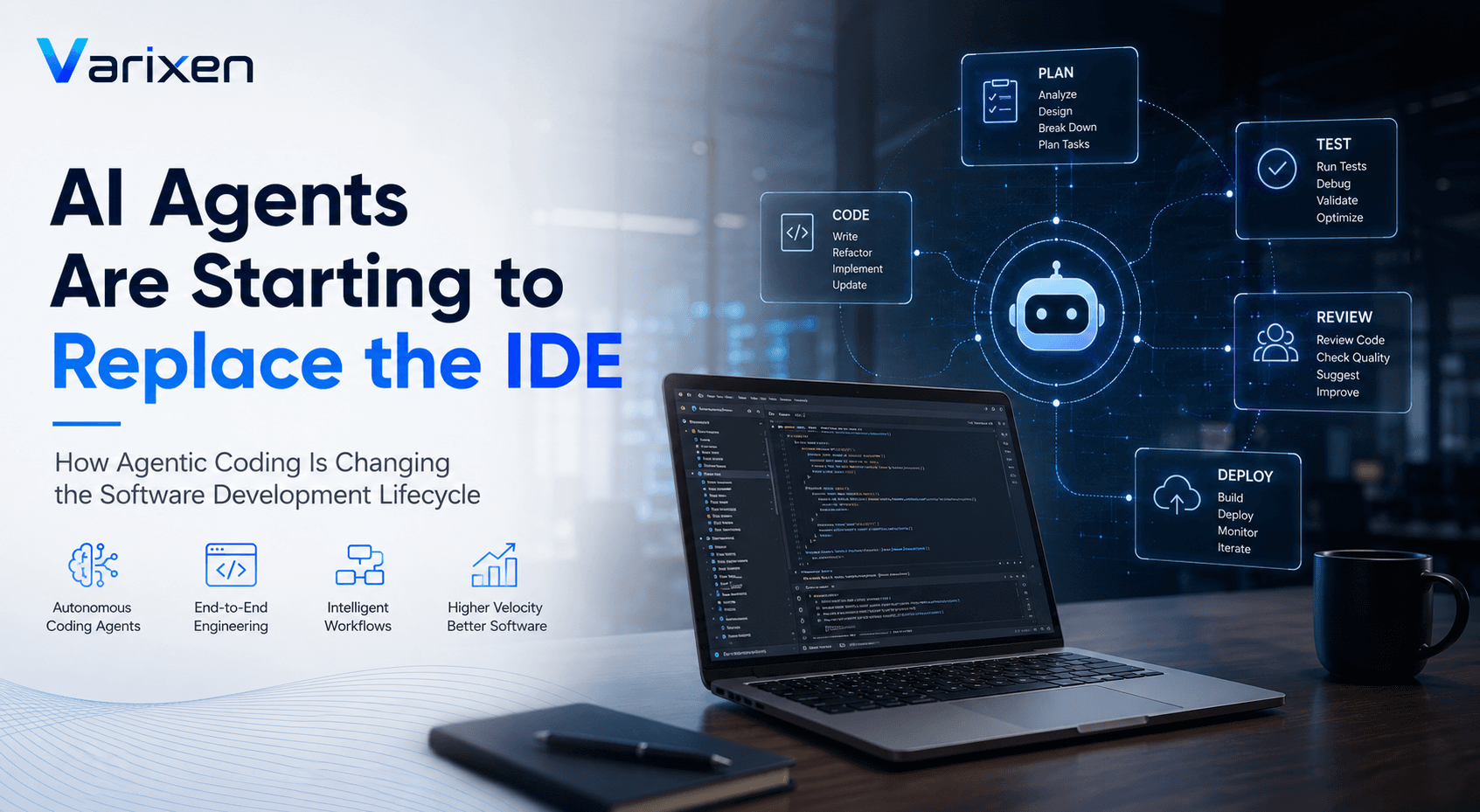
AI Agents Are Starting to Replace the IDE: How Agentic Coding Is Changing the Software Development Lifecycle
Software development is moving from writing code inside an IDE to directing autonomous agents across the entire engineering lifecycle.
Varixen Editorial Team
Enterprise Architecture & AI Advisory
Executive Summary
The traditional software development workflow is built around a developer sitting inside an IDE, writing code, running tests, committing changes, and opening pull requests.
That workflow is beginning to change.
Modern coding agents can work across repositories, execute multi-step tasks, modify code, run tests, perform reviews, and operate for extended periods. OpenAI says Codex usage has expanded from individual coding tasks toward parallel, long-running engineering work, while Anthropic's research shows growing adoption of end-to-end agentic coding workflows.
The important question isn't whether AI will eliminate the IDE.
It is whether the IDE remains the primary place where software engineering happens.
Table of Contents
- 1Introduction
- 2What Changed in AI Coding?
- 3Why the IDE-Centered Workflow Is Being Challenged
- 4How Agentic Coding Works
- 5The New Software Development Lifecycle
- 6Enterprise Architecture
- 7Real-World Engineering Scenario
- 8Business Benefits
- 9Implementation Roadmap
- 10Common Mistakes
- 11Best Practices
- 12Future Trends
- 13Key Takeaways
- 14Frequently Asked Questions
- 15Conclusion
Introduction
For decades, software development followed a familiar pattern:
Open IDE → write code → compile → test → commit → review → deploy.
AI initially entered this workflow as autocomplete.
Then came conversational coding assistants.
Now a third phase is emerging:
Give an agent a software problem and let it plan, execute, test, and iterate on the work.
OpenAI's Codex app describes this shift explicitly: developers are moving from working with one coding agent on targeted edits toward orchestrating multiple agents across designing, building, shipping, and maintaining software.
Google is pursuing a similar direction with Antigravity, positioning agentic development around moving from prompts to action and coordinating autonomous agents.
This changes the fundamental unit of software development.
Instead of:
Developer writes code
the emerging model is:
Engineer defines intent → AI agent executes → engineering system verifies → human approves
Current Industry Challenges
The shift is happening quickly.
Anthropic's analysis of roughly 400,000 Claude Code sessions found that agentic coding has expanded significantly, with coding-agent activity across GitHub projects more than doubling since late 2025. It also found that users are increasingly using agents for deployment, data analysis, debugging, and other end-to-end work rather than only code generation.
OpenAI reported that by May 2026, more than 70% of Codex users were asking it to complete tasks estimated to take a human more than one hour, while the share of longer-horizon tasks continued to increase.
Meanwhile, Google launched Gemini 3.7 Flash in August 2026 with an emphasis on coding and agent workflows, showing that competition is moving toward models optimized not only for generating code but for executing software-engineering tasks.
The market is therefore moving from:
AI-assisted coding → AI-agentic engineering.
Why This Problem Matters
This is not simply a developer-tool upgrade.
It changes how engineering organizations think about:
- Developer productivity
- Team structure
- Code review
- Testing
- CI/CD
- Technical debt
- Software architecture
- Engineering management
- Security
- Cost of software delivery
Consider a conventional feature request.
Traditional workflow
Product Requirement
        ↓
Engineer understands requirement
        ↓
Engineer designs solution
        ↓
Engineer writes code
        ↓
Engineer writes tests
        ↓
Pull Request
        ↓
Code Review
        ↓
CI/CD
        ↓
Deployment
Agentic workflow
Business Requirement
        ↓
Engineer defines intent + constraints
        ↓
AI Agent plans implementation
        ↓
Agent modifies code
        ↓
Agent runs tests
        ↓
Agent analyzes failures
        ↓
Agent iterates
        ↓
Automated Review / CI
        ↓
Human Approval
        ↓
Deployment
The engineer's role moves up the abstraction layer.
Less time can be spent typing implementation code.
More time is spent defining architecture, constraints, acceptance criteria, security requirements, and validation.
Technical Deep Dive
What Makes a Coding Agent Different From an AI Coding Assistant?
A traditional coding assistant typically responds to an interaction:
"Complete this function."
A coding agent can receive a higher-level objective:
"Add OAuth authentication to this application, update the database schema, implement tests, update the API documentation, and prepare the pull request."
The agent can then:
- 1Inspect the repository
- 2Understand the architecture
- 3Identify relevant files
- 4Create a plan
- 5Modify multiple files
- 6Run commands
- 7Execute tests
- 8Investigate failures
- 9Iterate
- 10Produce a diff
- 11Prepare a pull request
That is fundamentally different from autocomplete.
The Agentic Coding Loop
┌──────────────┐
             │    Intent    │
             └──────┬───────┘
                    ↓
             ┌──────────────┐
             │    Plan      │
             └──────┬───────┘
                    ↓
             ┌──────────────┐
             │    Execute   │
             └──────┬───────┘
                    ↓
             ┌──────────────┐
             │    Test      │
             └──────┬───────┘
                    ↓
             ┌──────────────┐
             │   Evaluate   │
             └──────┬───────┘
                    │
              Failed? ── Yes ──→ Execute
                    │
                    No
                    ↓
             ┌──────────────┐
             │ Human Review │
             └──────────────┘
The key capability is not code generation.
It is the feedback loop.
An agent that can generate code but cannot test, inspect, correct, and validate its work remains a sophisticated autocomplete system.
Enterprise Architecture
A production-grade agentic coding platform should not simply give an LLM access to the company's Git repositories.
It needs an engineering control plane.
┌─────────────────────────────────────────────┐
│              Engineering Team               │
│       Developer • Architect • Manager       │
└──────────────────────┬──────────────────────┘
                       ↓
┌─────────────────────────────────────────────┐
│             Agent Control Plane              │
│ Planning • Tasks • Context • Permissions    │
└──────────────────────┬──────────────────────┘
                       ↓
┌─────────────────────────────────────────────┐
│             Coding Agent Runtime             │
│ Repository • Terminal • Tools • Browser      │
└──────────────┬───────────────┬──────────────┘
               ↓               ↓
        ┌─────────────┐  ┌──────────────┐
        │ Git / Repos │  │ CI / Testing │
        └─────────────┘  └──────────────┘
               │               │
               └───────┬───────┘
                       ↓
              ┌──────────────────┐
              │ Quality & Security│
              │ Review • SAST     │
              │ Tests • Policies  │
              └────────┬─────────┘
                       ↓
                 Human Approval
                       ↓
                  Production
Core components
Agent runtime
Provides the execution environment for the coding agent.
Repository access
Allows controlled interaction with Git repositories and worktrees.
Tool layer
Provides terminal, testing, documentation, browser, database, and cloud capabilities.
CI/CD
Validates generated changes automatically.
Security controls
Restrict what agents can access and execute.
Observability
Tracks agent actions, failures, cost, latency, and outcomes.
Human approval
Remains critical for sensitive production changes.
The goal is not unrestricted autonomy.
It is controlled autonomy.
Real-World Case Study
Illustrative Scenario: Enterprise Legacy API Modernization
This is an illustrative scenario, not a claim about a Varixen client.
A large enterprise has a 10-year-old Node.js API platform containing hundreds of endpoints.
The organization wants to:
- migrate selected services to a newer architecture
- improve test coverage
- identify deprecated APIs
- update documentation
- reduce technical debt
A conventional approach requires engineers to manually inspect services, write migration code, create tests, update documentation, and review changes.
An agentic engineering approach changes the workflow.
Problem
The engineering team has limited capacity.
The modernization backlog contains hundreds of technical tasks that compete with new product development.
Solution
A controlled coding-agent environment is introduced.
Engineers provide:
- repository context
- architecture standards
- coding conventions
- security policies
- testing requirements
- acceptance criteria
Agents then work on isolated branches or worktrees.
Workflow
Backlog
   ↓
AI Agent
   ↓
Repository Analysis
   ↓
Implementation Plan
   ↓
Code Changes
   ↓
Automated Tests
   ↓
Security Checks
   ↓
Code Review
   ↓
Human Approval
   ↓
Merge
Business Results
Rather than claiming arbitrary percentage improvements, the organization should measure:
| Metric | Measurement |
|---|---|
| Engineering cycle time | Time from task assignment to merged PR |
| Test coverage | Before vs after |
| Review effort | Human review hours |
| Defect rate | Defects introduced by AI-generated changes |
| Technical debt | Number/value of prioritized debt items completed |
| Developer throughput | Completed engineering work per sprint |
| AI cost | Model/tooling cost per completed task |
The important insight is that AI productivity must be measured at the engineering-system level, not by lines of generated code.
Business Benefits
| Benefit | Business Impact | Expected ROI |
|---|---|---|
| Faster implementation | Shorter development cycles | High |
| Automated testing | Earlier defect detection | High |
| Technical debt reduction | More engineering capacity for product work | Medium–High |
| Parallel execution | Multiple tasks can progress simultaneously | High |
| Better documentation | Lower maintenance and onboarding cost | Medium |
| Engineering scalability | More work without proportional headcount growth | High |
| Faster modernization | Legacy systems can be addressed incrementally | High |
The ROI depends heavily on the quality of the engineering environment, task selection, supervision model, and verification system.
Implementation Roadmap
Phase 1 — Assessment
Identify suitable workloads:
- repetitive engineering tasks
- migrations
- test generation
- documentation
- bug fixing
- dependency upgrades
- code review
Avoid starting with unrestricted production access.
Phase 2 — Engineering Foundation
Establish:
- repository standards
- coding conventions
- test automation
- CI/CD
- security policies
- agent permissions
- observability
Phase 3 — Controlled Pilot
Start with low-risk tasks.
Measure:
Time saved + quality + review effort + failure rate + cost
Phase 4 — Production Integration
Connect agents to:
- Git
- CI/CD
- issue trackers
- testing infrastructure
- documentation
- cloud development environments
Maintain human approval for sensitive actions.
Phase 5 — Agentic Engineering Platform
Move from individual tools toward a reusable internal platform where multiple agents can operate under standardized organizational rules.
Common Mistakes
Treating agents as smarter autocomplete
The biggest mistake is using agents only for small code snippets.
Fix: Give agents well-defined engineering tasks with acceptance criteria.
Giving agents excessive permissions
An agent with unrestricted production credentials creates unnecessary risk.
Fix: Use least privilege, isolated environments, scoped credentials, and approval gates.
Removing code review
Generated code still needs verification.
Fix: Increase automated testing and maintain human review for high-risk changes.
Measuring lines of code
More generated code does not equal more business value.
Fix: Measure cycle time, quality, defects, throughput, and business outcomes.
Ignoring repository quality
Agents perform better when repositories have clear architecture, tests, documentation, and conventions.
Fix: Treat the codebase itself as an engineering interface for agents.
Best Practices
- 1Give agents objectives, not vague prompts.
- 2Provide repository-level instructions and architectural context.
- 3Keep agents inside isolated execution environments.
- 4Use worktrees or equivalent isolation for parallel tasks.
- 5Require automated tests before accepting changes.
- 6Integrate security scanning into CI/CD.
- 7Keep production credentials behind approval boundaries.
- 8Track every significant agent action.
- 9Measure completed engineering outcomes rather than generated code volume.
- 10Make architecture and engineering standards machine-readable wherever practical.
One of the more important emerging ideas is "harness engineering": rather than merely improving the model, organizations improve the environment in which agents operate—tools, instructions, feedback loops, tests, and constraints. OpenAI describes an internal experiment in which an application was built with zero manually written code, emphasizing that humans increasingly focused on specifying intent, designing environments, and creating feedback mechanisms.
Future Trends
The next phase of software engineering is likely to be less IDE-centric and more agent-centric.
Several developments point in that direction.
Multi-agent engineering
Instead of one agent handling everything:
Architect Agent
      ↓
Coding Agent
      ↓
Testing Agent
      ↓
Security Agent
      ↓
Review Agent
Each agent can specialize while an orchestration layer manages the overall task.
OpenAI's Codex app already supports multiple agents working in parallel, including isolated worktrees.
Always-on engineering agents
Agents can increasingly work in the background on:
- issue triage
- dependency updates
- test failures
- documentation
- code review
- monitoring
- routine maintenance
Codex already supports background-oriented workflows, while Google is positioning agentic development around autonomous agents capable of taking action rather than merely suggesting code.
The rise of the AI-native engineering organization
The most significant change may not be the disappearance of the IDE.
It may be the disappearance of manual implementation as the default unit of engineering work.
The engineer increasingly becomes responsible for:
Intent + Architecture + Constraints + Verification
while agents increasingly handle:
Implementation + Iteration + Testing + Routine Maintenance
Key Takeaways
- AI coding is moving beyond autocomplete toward autonomous engineering tasks.
- The IDE may become one interface to software development rather than the central workspace.
- Coding agents can increasingly plan, implement, test, review, and iterate.
- The biggest productivity opportunity comes from delegating complete engineering tasks, not individual lines of code.
- Enterprise adoption requires strong permissions, testing, CI/CD, observability, and governance.
- Engineers remain essential for architecture, product judgment, security, system design, and verification.
- Multi-agent workflows will increasingly enable parallel engineering work.
- The winning enterprise strategy is not "AI writes our code."
- It is "AI agents execute engineering work inside a controlled software delivery system."
Frequently Asked Questions
1. Are AI agents actually replacing IDEs?
Not completely. IDEs remain valuable for interactive development, debugging, inspection, and human review. The more important change is that IDEs may no longer be the primary interface for every engineering task.
2. What is agentic coding?
Agentic coding is the use of AI systems that can independently plan and execute multi-step software engineering tasks using tools such as repositories, terminals, test runners, and development environments.
3. How is an AI coding agent different from GitHub Copilot-style autocomplete?
Autocomplete predicts code while you type. An agent can operate across multiple files and tools, execute commands, run tests, inspect failures, and iterate toward a defined objective.
4. Will AI agents replace software engineers?
The more likely near-term change is role transformation. Engineers spend less time on routine implementation and more time on architecture, requirements, verification, security, and system-level decisions.
5. Are coding agents safe for enterprise environments?
They can be, when deployed with appropriate isolation, least-privilege permissions, secure credentials, testing, monitoring, and human approval.
6. What tasks are best suited for coding agents?
Good starting points include testing, documentation, bug fixes, migrations, dependency upgrades, refactoring, code review, and well-defined feature implementation.
7. Should AI-generated code still be reviewed by humans?
Yes. The required level of human review should depend on the risk of the change. Security-sensitive, financial, infrastructure, and production-critical changes warrant stronger controls.
8. How should enterprises measure AI coding ROI?
Measure engineering outcomes such as cycle time, developer throughput, defect rates, review effort, technical-debt reduction, deployment frequency, and cost per completed task.
9. What infrastructure does enterprise agentic coding require?
Depending on the organization, it may include Git repositories, isolated development environments, CI/CD, test infrastructure, secrets management, cloud compute, observability, security scanning, and an agent orchestration layer.
Conclusion
The interesting shift in software engineering is not simply that AI can write code.
AI can increasingly work on software.
It can inspect repositories, plan changes, modify multiple files, run tests, investigate failures, review its own work, and continue operating while engineers focus elsewhere. OpenAI, Google, and Anthropic are all building toward this more agentic software-development model, while enterprise adoption is increasingly moving beyond simple code completion.
The IDE is therefore unlikely to disappear overnight.
But its role is changing.
The future engineering environment may look less like:
Developer → IDE → Code
and more like:
Engineer → Agent → Engineering Environment → Verification → Production
For enterprises, the competitive advantage will not come from giving developers the most powerful model.
It will come from building the best system around those agents.
About Varixen
Varixen is an Enterprise AI and Software Engineering company helping organizations apply AI, cloud engineering, automation, data engineering, enterprise software, and intelligent technologies to real-world business problems.
Its engineering capabilities include AI agents, generative AI, multi-agent systems, enterprise software development, cloud architecture, DevOps, CI/CD, data engineering, AI security, and enterprise automation.
Varixen focuses on building production-ready technology systems where AI, software engineering, cloud infrastructure, data, and business workflows work together.
Call To Action
Exploring Agentic Software Engineering?
If your engineering organization is evaluating AI coding agents, legacy modernization, AI-native development, or automated software delivery, Varixen can help assess the architecture, security model, engineering workflow, and path to production.
Explore Enterprise AI and Software Engineering with Varixen: https://www.varixen.com
Internal Linking Suggestions
- 1AI ROI: Stop Measuring Tokens and Start Measuring Business Outcomes
- 2Why Your Enterprise AI Pilot Isn't Reaching Production: 7 Real-World Problems and How to Fix Them
- 3Enterprise AI Architecture: Building Production-Ready AI Systems
- 4LLMOps: How Enterprises Deploy and Monitor AI Applications
- 5AI Agent Security: How Enterprises Can Safely Deploy Autonomous AI