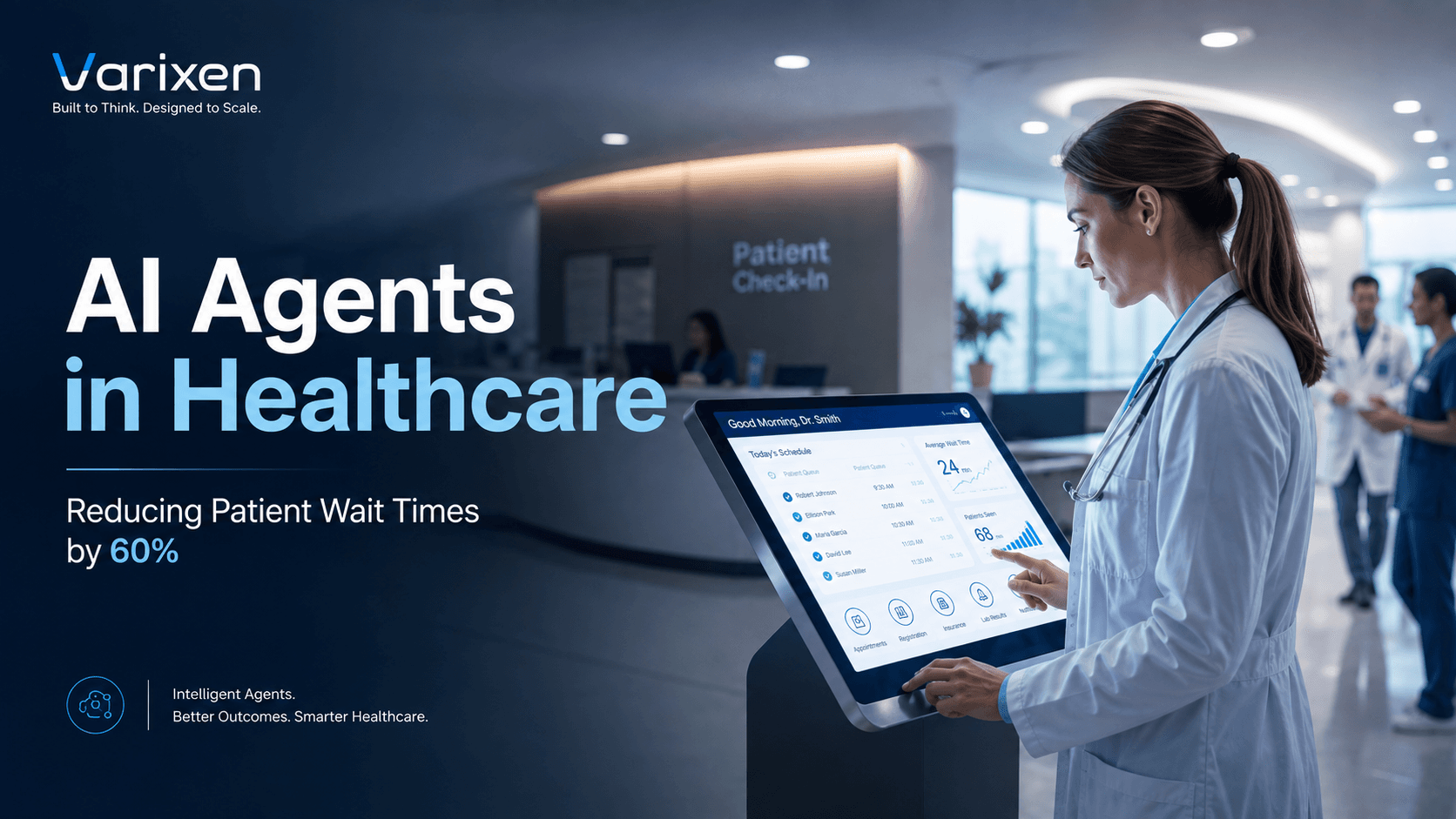
AI Agents in Healthcare: Reducing Patient Wait Times by 60% Through Intelligent Workflow Automation
How enterprise AI agents are transforming hospital operations, improving patient experiences, and enabling scalable digital healthcare delivery.
Varixen Editorial Team
Enterprise Architecture & AI Advisory
AI Agents in Healthcare: Reducing Patient Wait Times by 60% Through Intelligent Workflow Automation
Executive Summary
Healthcare systems across the globe are experiencing unprecedented operational challenges. Rising patient volumes, workforce shortages, increasing administrative complexity, and fragmented digital ecosystems have significantly impacted the quality and speed of care delivery.
While hospitals continue investing in Electronic Health Records (EHR), Hospital Information Systems (HIS), and telemedicine platforms, many organizations still rely heavily on manual coordination across departments. Administrative processes—from appointment scheduling and insurance verification to patient registration and discharge planning—often consume more time than direct clinical care.
Enterprise AI Agents represent a new generation of intelligent automation capable of orchestrating these workflows end-to-end. Unlike traditional chatbots or rule-based automation, AI agents can understand context, reason across multiple systems, collaborate with other specialized agents, and continuously optimize healthcare operations.
Organizations implementing AI-driven workflow automation have reported measurable improvements, including significant reductions in patient waiting times, faster administrative processing, improved staff productivity, and higher patient satisfaction scores.
This article explores the enterprise architecture, implementation strategies, business benefits, and real-world applications of AI agents in modern healthcare environments.
Table of Contents
- 1Introduction
- 2Current Industry Challenges
- 3Why Patient Wait Times Matter
- 4Understanding Enterprise AI Agents
- 5Technical Deep Dive
- 6Enterprise Architecture
- 7Multi-Agent Healthcare Workflow
- 8Real-World Case Study
- 9Business Benefits
- 10Implementation Roadmap
- 11Common Implementation Mistakes
- 12Best Practices
- 13Future Trends
- 14Key Takeaways
- 15Frequently Asked Questions
- 16Conclusion
- 17About Varixen
- 18Call to Action
Introduction
Healthcare has entered an era where operational efficiency directly influences clinical outcomes.
Patients increasingly expect healthcare experiences comparable to modern digital services—fast appointments, minimal paperwork, real-time updates, and seamless communication. However, many hospitals continue operating with disconnected systems and manual workflows that create delays throughout the patient journey.
Common bottlenecks include:
- Appointment scheduling conflicts
- Lengthy registration processes
- Manual insurance verification
- Delayed diagnostic coordination
- Slow laboratory result routing
- Administrative overload for healthcare staff
These inefficiencies affect not only patient satisfaction but also financial performance, resource utilization, and workforce productivity.
Enterprise AI agents offer a practical solution by acting as intelligent coordinators capable of automating routine tasks while enabling clinicians to focus on patient care.
Current Industry Challenges
Healthcare organizations operate within one of the most complex operational environments across all industries.
Several interconnected factors contribute to increasing patient wait times and operational inefficiencies.
Administrative Burden
Healthcare professionals spend a significant portion of their working hours performing administrative activities rather than delivering direct patient care.
Common examples include:
- Data entry
- Appointment coordination
- Insurance verification
- Medical record retrieval
- Documentation
- Referral processing
These repetitive tasks create delays that compound across the patient journey.
Fragmented Healthcare Systems
Modern hospitals rely on dozens of enterprise applications, including:
- Electronic Health Records (EHR)
- Laboratory Information Systems (LIS)
- Radiology Information Systems (RIS)
- Pharmacy Systems
- Billing Platforms
- Insurance Portals
- Telemedicine Platforms
- Patient Portals
These systems often operate in isolation, requiring staff to manually transfer information between platforms.
Workforce Shortages
Healthcare providers worldwide continue facing shortages of:
- Physicians
- Nurses
- Administrative staff
- Specialists
- Medical coders
As patient demand increases, existing staff are expected to manage growing workloads without proportional increases in resources.
Increasing Patient Expectations
Patients increasingly expect:
- Online appointment booking
- Instant notifications
- Digital registration
- Personalized communication
- Transparent wait times
- Virtual consultations
Organizations unable to meet these expectations risk declining patient satisfaction and competitive disadvantage.
Why This Problem Matters
Reducing patient wait times is far more than a customer experience initiative—it is a strategic business objective with measurable financial and operational implications.
Revenue Growth
Shorter wait times enable hospitals to:
- Increase patient throughput
- Reduce appointment cancellations
- Improve operating room utilization
- Optimize physician schedules
- Serve more patients without expanding infrastructure
Cost Reduction
Administrative automation significantly reduces:
- Manual processing costs
- Overtime expenses
- Duplicate work
- Documentation errors
- Claims processing delays
Operational Efficiency
AI agents improve workflow coordination across departments by reducing handoff delays and automating routine decisions.
Benefits include:
- Faster patient movement
- Improved resource utilization
- Reduced bottlenecks
- Better scheduling accuracy
Patient Satisfaction
Healthcare organizations increasingly measure patient experience through metrics such as:
- Waiting time
- Communication quality
- Appointment availability
- Service responsiveness
AI-driven workflow automation directly improves these indicators while reducing frustration throughout the care journey.
Technical Deep Dive
Unlike conventional automation tools that execute predefined rules, enterprise AI agents combine reasoning, contextual understanding, and autonomous decision-making capabilities.
A modern healthcare AI platform typically consists of multiple specialized agents collaborating to complete complex workflows.
Appointment Scheduling Agent
Responsibilities include:
- Managing clinician calendars
- Resolving scheduling conflicts
- Prioritizing urgent cases
- Sending reminders
- Rescheduling appointments dynamically
Insurance Verification Agent
This agent automatically:
- Validates patient insurance
- Checks eligibility
- Retrieves policy information
- Identifies authorization requirements
- Flags incomplete documentation
Clinical Documentation Agent
Capabilities include:
- Summarizing consultation notes
- Organizing patient histories
- Drafting structured clinical documentation
- Assisting physicians with medical record updates
Laboratory Coordination Agent
Coordinates:
- Test requests
- Sample tracking
- Result notifications
- Physician alerts
- Patient communications
Patient Communication Agent
Provides:
- Appointment confirmations
- Wait-time updates
- Medication reminders
- Follow-up instructions
- Personalized healthcare notifications
Enterprise Architecture
A scalable AI healthcare platform integrates securely with existing enterprise infrastructure rather than replacing it.
Patient Portal
                        │
                        ▼
               API Gateway / IAM
                        │
                        ▼
            Enterprise AI Agent Platform
────────────────────────────────────────────────────
 Scheduling Agent
 Insurance Agent
 Registration Agent
 Clinical Agent
 Laboratory Agent
 Communication Agent
────────────────────────────────────────────────────
                        │
        ┌───────────────┼────────────────┐
        ▼               ▼                ▼
     EHR System      HIS System      Billing
        │               │                │
        └───────────────┼────────────────┘
                        ▼
               Enterprise Data Platform
                        │
                        ▼
             Analytics & BI Dashboards
Core Components
- AI Agent Orchestrator
- Enterprise API Gateway
- Identity and Access Management (IAM)
- Electronic Health Records
- HL7/FHIR Integration Layer
- Cloud-based Data Platform
- Audit Logging
- Monitoring and Observability
- Security Operations Center (SOC)
Security Considerations
Healthcare AI systems must incorporate:
- Role-Based Access Control (RBAC)
- Encryption at rest and in transit
- Zero Trust Architecture
- Audit logging
- Data masking
- Compliance with HIPAA, GDPR, and regional healthcare regulations
- Secure API authentication
- Model governance and monitoring