How AI Agents Are Transforming Cancer Care: Inside a Multi-Agent Healthcare Architecture
How multimodal AI agents can coordinate clinical data, specialized reasoning, and human expertise to support faster, more connected cancer-care workflows.
Varixen Editorial Team
Enterprise Architecture & AI Advisory
Executive Summary
Cancer care is one of the most information-intensive workflows in healthcare.
A single treatment decision can require clinicians to synthesize electronic health records, medical imaging, pathology, genomics, previous treatments, clinical guidelines, research literature, and clinical-trial eligibility. The challenge is not simply generating another AI-generated summary. It is coordinating multiple specialized forms of reasoning while keeping clinicians in control.
This is where multi-agent AI architecture becomes strategically important.
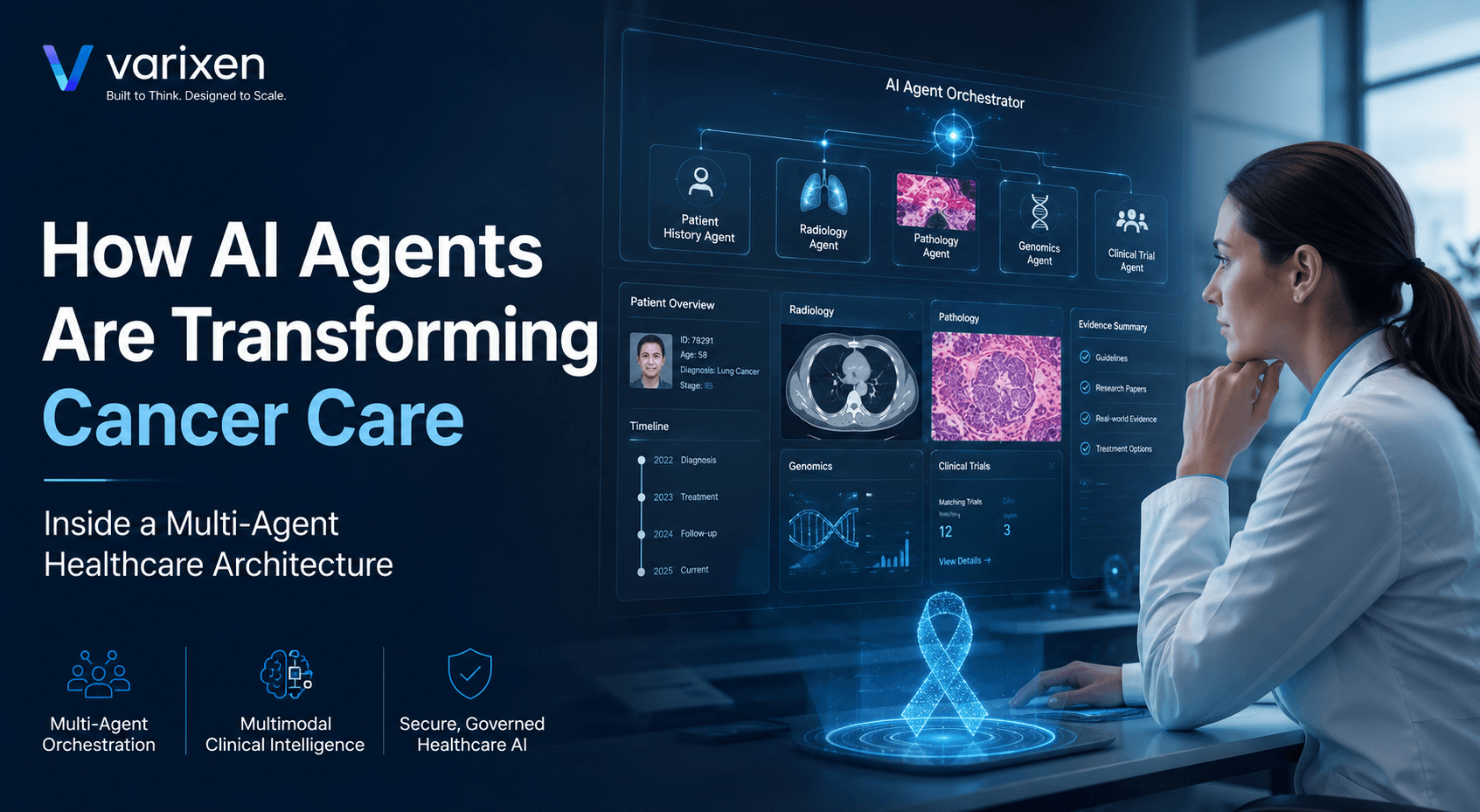
In May 2025, Microsoft described a healthcare agent orchestrator designed to coordinate specialized AI agents across complex multidisciplinary workflows such as tumor boards. The system can work across multimodal healthcare information, including DICOM imaging, whole-slide pathology images, genomics data, and clinical notes. Microsoft reported that institutions including Stanford Medicine, Johns Hopkins, Providence Genomics, Mass General Brigham, and the University of Wisconsin School of Medicine and Public Health were exploring the technology. ([Microsoft][1])
The architecture is significant because it demonstrates a broader enterprise AI pattern:
Instead of asking one general-purpose model to solve an entire business problem, enterprises can orchestrate multiple specialized agents around a governed workflow.
For healthcare organizations, this can mean better information retrieval, reduced administrative friction, more consistent preparation for multidisciplinary discussions, and faster access to relevant evidence—while keeping final clinical decisions with qualified healthcare professionals.
This article examines the architecture behind this approach, the engineering challenges involved, and what healthcare enterprises can learn when designing their own agentic AI platforms.
Table of Contents
- 1Executive Summary
- 2Introduction
- 3Current Industry Challenges
- 4Why This Problem Matters
- 5From Generative AI to Multi-Agent Healthcare
- 6Technical Deep Dive
- 7Enterprise Architecture
- 8Multi-Agent Cancer-Care Workflow
- 9Real-World Case Study: Microsoft's Healthcare Agent Orchestrator
- 10Business Benefits
- 11Implementation Roadmap
- 12Common Mistakes
- 13Best Practices
- 14Future Trends
- 15Key Takeaways
- 16Frequently Asked Questions
- 17Conclusion
- 18About Varixen
- 19Call to Action
- 20Internal Linking Suggestions
- 21External References
- 22Image Recommendations
- 23SEO Quality Checklist
Introduction
Healthcare organizations have invested heavily in digital infrastructure over the past two decades.
Electronic health records have digitized clinical documentation. Imaging systems have moved medical images into digital repositories. Laboratory systems have automated diagnostic workflows. Genomics platforms have created new sources of molecular information.
Yet digitization has not eliminated one of healthcare's fundamental challenges:
Clinicians still have to bring fragmented information together before making complex decisions.
Cancer care makes this challenge particularly visible.
A patient's treatment strategy can involve information from:
- Electronic health records
- Radiology
- Pathology
- Genomics
- Previous treatment history
- Laboratory results
- Clinical guidelines
- Research publications
- Clinical trials
- Real-world evidence
- Patient characteristics
- Multidisciplinary specialist opinions
The data may exist digitally, but digital availability does not automatically mean contextual availability.
A physician may have access to thousands of records but still need to spend substantial time finding the few pieces of information that matter for a specific clinical discussion.
Microsoft's 2025 research and product work around a healthcare agent orchestrator illustrates one possible architectural response. Its system coordinates specialized agents across clinical modalities and workflows, with the objective of assisting multidisciplinary teams rather than replacing them. ([Microsoft][1])
The significance extends beyond healthcare.
The same architectural principle applies to enterprise environments where decisions depend on multiple data sources, specialized models, business rules, and human approval.
Current Industry Challenges
1. Clinical Information Is Fragmented
Healthcare data is rarely stored in one homogeneous system.
A simplified enterprise environment may look like:
EHR
 │
 ├── Clinical Notes
 ├── Medications
 ├── Diagnoses
 └── Patient History
PACS │ └── Medical Imaging
Pathology │ └── Whole-Slide Images
Genomics │ └── Molecular Data
External Knowledge
│
├── Guidelines
├── Research
└── Clinical Trials
`
Each source may use different data models, APIs, identifiers, security controls, and update cycles.
FHIR provides a standardized framework for exchanging healthcare information electronically and includes resources covering clinical, diagnostic, medication, workflow, financial, and other healthcare domains. ([HL7][2])
However, interoperability at the data-exchange layer does not automatically solve higher-level reasoning and workflow orchestration.
2. Cancer Care Is Multidisciplinary
Complex oncology decisions often involve multiple specialists.
A multidisciplinary tumor board may involve:
- Medical oncologists
- Radiation oncologists
- Surgical oncologists
- Radiologists
- Pathologists
- Genetic specialists
- Clinical researchers
- Oncology nurses
- Pharmacists
Each specialist evaluates a different portion of the patient's information.
The operational challenge is coordinating those perspectives into one coherent workflow.
3. Multimodal Data Creates a Different AI Problem
Traditional enterprise AI applications often operate primarily on structured or textual data.
Healthcare introduces multiple modalities:
| Data Type | Example |
|---|---|
| Structured | Diagnoses, medications, laboratory values |
| Text | Clinical notes |
| Imaging | CT, MRI, X-ray |
| Pathology | Whole-slide images |
| Genomics | Molecular sequencing |
| External knowledge | Guidelines and research |
| Workflow | Appointments, referrals, clinical trials |
An effective healthcare AI architecture therefore needs more than a single text-generation model.
It needs multimodal reasoning and specialized model orchestration.
4. High-Stakes Decisions Require Human Oversight
Healthcare is fundamentally different from low-risk enterprise automation.
An AI-generated answer about a marketing report and an AI-generated recommendation related to cancer treatment have dramatically different risk profiles.
Healthcare AI must therefore address:
- Accuracy
- Explainability
- Provenance
- Privacy
- Security
- Auditability
- Human oversight
- Regulatory requirements
- Model evaluation
- Operational monitoring
NIST's AI Risk Management Framework is designed to help organizations incorporate trustworthiness considerations into AI design, development, deployment, use, and evaluation. Its Generative AI Profile provides additional guidance for risks associated with generative AI systems. ([NIST][3])
Why This Problem Matters
Revenue and Capacity
Healthcare organizations operate expensive infrastructure and highly specialized workforces.
When clinicians spend significant time searching, consolidating, and preparing information, that time cannot be used for direct patient care.
Better information orchestration can potentially improve:
- Clinician productivity
- Patient throughput
- Specialist utilization
- Tumor-board preparation
- Clinical research operations
- Trial matching
- Care coordination
Cost
Administrative and information-management tasks can consume significant organizational resources.
An AI agent architecture can target repetitive activities such as:
- Patient-history summarization
- Information retrieval
- Document classification
- Trial discovery
- Evidence retrieval
- Report preparation
- Data reconciliation
The objective should not be to automate everything.
The objective should be to automate high-volume, low-value coordination work while preserving human control over high-impact decisions.
Productivity
Consider the difference between these two workflows.
Traditional workflow
EHR Search
   ↓
Copy Notes
   ↓
Open Imaging System
   ↓
Review Reports
   ↓
Search Pathology
   ↓
Review Genomics
   ↓
Search Clinical Trials
   ↓
Search Guidelines
   ↓
Prepare Presentation
   ↓
Tumor Board
Agentic workflow
Patient Context
      ↓
Agent Orchestrator
      ↓
┌─────────┬──────────┬──────────┬────────────┐
│ History │ Radiology│ Pathology│ Genomics   │
│ Agent   │ Agent    │ Agent    │ Agent      │
└─────────┴──────────┴──────────┴────────────┘
      ↓
Guideline / Trial / Research Agents
      ↓
Evidence-Grounded Synthesis
      ↓
Clinician Review
      ↓
Tumor Board
The second architecture does not eliminate clinical expertise.
It attempts to compress the information-preparation layer around that expertise.
From Generative AI to Multi-Agent Healthcare
The distinction between a chatbot and an agentic system is important.
A conventional chatbot might answer:
"Summarize this patient's clinical history."
An AI agent can potentially:
- 1Retrieve authorized patient records.
- 2Identify relevant clinical events.
- 3Structure the patient's timeline.
- 4Invoke a radiology model.
- 5Invoke a pathology model.
- 6Search relevant guidelines.
- 7Search clinical trials.
- 8Collect evidence.
- 9Produce a structured synthesis.
- 10Present the result for human validation.
A multi-agent architecture extends this further by assigning different responsibilities to specialized agents.
Technical Deep Dive
The Agent Orchestrator
At the center of the architecture is an orchestrator.
Its responsibility is not necessarily to perform every reasoning task itself.
Instead, it manages:
- Task decomposition
- Agent selection
- Workflow execution
- Shared context
- State management
- Tool invocation
- Error handling
- Human interaction
- Result aggregation
Microsoft describes its healthcare agent orchestrator as coordinating specialized agents using Semantic Kernel and Magentic-One patterns, including shared memory and human-in-the-loop interaction. ([Microsoft][1])
A generalized architecture looks like:
User / Clinician
                           │
                           ▼
                  ┌─────────────────┐
                  │ Agent Interface  │
                  └────────┬────────┘
                           │
                           ▼
                  ┌─────────────────┐
                  │  Orchestrator   │
                  └────────┬────────┘
                           │
       ┌───────────────────┼────────────────────┐
       │                   │                    │
       ▼                   ▼                    ▼
 History Agent       Imaging Agent       Pathology Agent
       │                   │                    │
       └───────────────────┼────────────────────┘
                           │
              ┌────────────┼────────────┐
              ▼            ▼            ▼
          Genomics     Trial Agent   Research Agent
              │            │            │
              └────────────┼────────────┘
                           ▼
                  Evidence Synthesis
                           │
                           ▼
                    Human Review
Specialized Agents
Patient History Agent
The patient-history agent transforms fragmented longitudinal information into a structured timeline.
Possible output:
2021
Initial diagnosis
2022 Surgical intervention
2023 Adjuvant therapy
2024 Recurrence detected
2025
Molecular testing performed
`
The key engineering challenge is maintaining temporal and clinical context.
A simple LLM summary is insufficient.
The system should preserve:
- Source references
- Dates
- Clinical entities
- Confidence
- Contradictions
- Missing information
Microsoft describes its patient-history agent as using Universal Medical Abstraction to organize patient information chronologically, with the stated goal of reducing work that can otherwise take hours. ([Microsoft][1])
Radiology Agent
Radiology data introduces multimodal processing.
A radiology agent may consume:
- DICOM metadata
- Imaging studies
- Existing radiology reports
- Prior scans
- Clinical context
The agent should not simply produce a free-form narrative.
Enterprise outputs should include:
Finding
Source
Confidence
Comparison
Clinical Context
Microsoft's example describes a radiology agent using models such as MAIRA-2 for radiology analysis and second-read workflows. ([Microsoft][1])
Pathology Agent
Pathology introduces another high-dimensional modality.
Whole-slide images can contain extremely large amounts of visual information.
A pathology agent may assist with:
- Tumor identification
- Morphology
- Biomarker analysis
- Slide interpretation
- Region-of-interest analysis
Microsoft's architecture describes integration with Paige's Alba pathology agent as an example of connecting an external specialized agent into the broader orchestrated workflow. ([Microsoft][1])
This illustrates an important enterprise principle:
An enterprise agent platform does not necessarily need to own every model. It needs a secure mechanism for orchestrating specialized capabilities.
Genomics Agent
A genomics agent could operate across:
- Molecular profiles
- Genetic variants
- Biomarkers
- Sequencing results
- Patient characteristics
The objective is to connect molecular information with the appropriate evidence and clinical workflow.
This is especially important for precision oncology, where treatment options may depend on specific molecular characteristics.
Clinical Trial Agent
A clinical-trial agent can search:
- Trial eligibility
- Disease characteristics
- Biomarkers
- Location
- Recruitment status
- Inclusion criteria
- Exclusion criteria
The agent should return evidence and eligibility reasoning, not simply recommend a trial.
For example:
Candidate Trial
      ↓
Eligibility Rules
      ↓
Patient Data
      ↓
Criteria Matching
      ↓
Matched / Unmatched
      ↓
Evidence + Source
      ↓
Clinician Review
Research and Guidelines Agents
A research agent can search relevant literature.
A guideline agent can retrieve applicable clinical guidance.
The architecture can then synthesize:
Patient Data
      +
Imaging
      +
Pathology
      +
Genomics
      +
Guidelines
      +
Clinical Trials
      +
Research
      ↓
Evidence-Grounded Synthesis
The important word is grounded.
For high-stakes applications, the system should expose the underlying evidence and provenance rather than asking clinicians to trust an unexplained model output.
Enterprise Architecture
A production-grade healthcare AI architecture should separate the experience, orchestration, AI, data, integration, and governance layers.
┌──────────────────────────────────────────────────────────────┐
│                    CLINICIAN EXPERIENCE                      │
│ Teams │ Web │ Mobile │ EHR Embedded UI │ Clinical Workspace │
└──────────────────────────────┬───────────────────────────────┘
                               │
                               ▼
┌──────────────────────────────────────────────────────────────┐
│                     API / SECURITY LAYER                     │
│ API Gateway │ IAM │ RBAC │ OAuth │ Consent │ Rate Limiting  │
└──────────────────────────────┬───────────────────────────────┘
                               │
                               ▼
┌──────────────────────────────────────────────────────────────┐
│                    AGENT ORCHESTRATION                       │
│ Planner │ Router │ State │ Memory │ Tool Registry │ HITL    │
└──────────────────────────────┬───────────────────────────────┘
                               │
          ┌────────────────────┼────────────────────┐
          ▼                    ▼                    ▼
┌─────────────────┐   ┌─────────────────┐   ┌─────────────────┐
│ Clinical Agents │   │ Modality Agents │   │ Knowledge Agents│
│                 │   │                 │   │                 │
│ History         │   │ Radiology       │   │ Guidelines      │
│ Trial Matching  │   │ Pathology       │   │ Research        │
│ Documentation   │   │ Genomics        │   │ Clinical Trials │
└────────┬────────┘   └────────┬────────┘   └────────┬────────┘
         │                     │                     │
         └─────────────────────┼─────────────────────┘
                               ▼
┌──────────────────────────────────────────────────────────────┐
│                     DATA / KNOWLEDGE                         │
│ EHR │ PACS │ LIS │ Genomics │ FHIR │ Vector DB │ Data Lake │
└──────────────────────────────┬───────────────────────────────┘
                               │
                               ▼
┌──────────────────────────────────────────────────────────────┐
│                   GOVERNANCE & OBSERVABILITY                  │
│ Audit │ Evaluation │ Monitoring │ Provenance │ Policy │ SIEM │
└──────────────────────────────────────────────────────────────┘
Components
API Gateway
The gateway provides controlled access to downstream services.
It can enforce:
- Authentication
- Authorization
- Rate limits
- Request validation
- API versioning
- Logging
Identity and Access Management
Healthcare AI should operate according to least privilege.
An agent that can retrieve pathology information should not automatically receive unrestricted access to billing records.
Access should be based on:
- User identity
- Agent identity
- Role
- Patient relationship
- Purpose
- Data classification
- Consent
- Workflow context
Healthcare Integration Layer
The integration layer can support:
- FHIR
- HL7
- DICOM
- REST APIs
- Event-driven integrations
- Legacy adapters
FHIR is specifically designed as a standard for exchanging healthcare information electronically and provides resources spanning clinical, diagnostic, medication, workflow, and financial domains. ([HL7][2])
Data Architecture
A modern architecture may include:
Operational Systems
- EHR
- PACS
- LIS
- Pharmacy
- Billing
- Scheduling
Analytical Systems
- Data warehouse
- Data lake
- Lakehouse
- Analytics platform
AI Knowledge Layer
- Document store
- Vector database
- Knowledge graph
- Embedding indexes
- Clinical terminology services
The key principle is:
Do not force the LLM to become the database.
Enterprise systems should remain the authoritative sources of record.
The AI layer should retrieve, reason over, and synthesize information from governed sources.
AI Model Layer
A multi-agent architecture can combine multiple model classes.
General Reasoning Model
          │
          ├── Planning
          ├── Coordination
          └── Synthesis
Vision Models │ ├── Radiology └── Pathology
Healthcare Language Models │ ├── Clinical Notes └── Medical Terminology
Embedding Models
│
└── Semantic Retrieval
`
This approach avoids forcing one model to perform every task.
Security Architecture
Healthcare AI introduces a particularly important security requirement:
The agent itself becomes a security principal.
Traditional application security asks:
"Which user is accessing this API?"
Agentic systems require additional questions:
"Which agent is acting?"
"Which tools can that agent invoke?"
"What data can it access?"
"Who authorized the action?"
"What evidence did the agent use?"
"What did the agent actually do?"
Security Controls
A production implementation should consider:
- Zero Trust principles
- Encryption
- RBAC/ABAC
- Agent identity
- OAuth/OIDC
- Secrets management
- Network segmentation
- Private endpoints
- Data-loss prevention
- Prompt-injection defenses
- Tool authorization
- Audit logs
- Immutable event trails
- Human approval gates
The HIPAA Security Rule establishes requirements for administrative, physical, and technical safeguards protecting electronic protected health information. ([HHS.gov][4])
Explainability and Provenance
A healthcare AI system should be able to answer:
Where did this information come from?
For every important output, the system should ideally maintain:
AI Output
   │
   ├── Source Document
   ├── Source System
   ├── Timestamp
   ├── Model
   ├── Agent
   ├── Retrieval Context
   ├── Confidence / Evaluation
   └── Human Review
Microsoft specifically highlights grounding AI-generated outputs to source EHR information as important for validation, trust, and adoption in high-stakes healthcare environments. ([Microsoft][1])
Real-World Case Study
Microsoft's Healthcare Agent Orchestrator
This is a documented real-world technology example, rather than an invented customer case study.
Microsoft announced its healthcare agent orchestrator in May 2025 as a system intended to coordinate specialized AI agents for complex clinical workflows, including multidisciplinary cancer-care workflows such as tumor boards. ([Microsoft][1])
Problem
Cancer-care teams need to synthesize information from multiple clinical specialties and data modalities.
Microsoft described the challenge as involving imaging, pathology, genomics, clinical notes, research, clinical trials, and guidelines.
The organization reported that clinicians can spend substantial time reviewing these sources before multidisciplinary discussions. Microsoft cited an ASCO study indicating clinicians spend approximately 1.5 to 2.5 hours per patient performing this type of review. ([Microsoft][1])
The underlying operational problem is therefore not simply a lack of AI.
It is information fragmentation and coordination complexity.
Solution
Microsoft's architecture uses multiple specialized agents coordinated by an orchestrator.
The documented architecture includes capabilities around:
- Patient history
- Radiology
- Pathology
- Genomics
- Clinical guidelines
- Clinical trials
- Medical research
The orchestrator coordinates these specialized components rather than relying on a single model to perform every task. ([Microsoft][1])
Implementation
Microsoft describes the orchestrator as leveraging:
- Azure AI Foundry
- Semantic Kernel
- Magentic-One
- Specialized multimodal models
- Healthcare data
- Human-in-the-loop workflows
The system can work with diverse data types including:
- DICOM imaging
- Whole-slide pathology images
- Genomics
- EHR clinical notes
It is also designed to integrate with familiar enterprise productivity environments such as Microsoft Teams and Word. ([Microsoft][1])
Researchers and developers at institutions including Stanford University, Johns Hopkins, Providence Genomics, Mass General Brigham, and the University of Wisconsin School of Medicine and Public Health were reported as exploring the orchestrator for complex healthcare tasks. ([Microsoft][1])
Stanford Medicine was specifically described as exploring how the orchestrator could streamline tumor-board workflows and surface information such as trial eligibility, treatment guidelines, and real-world evidence. ([Microsoft][5])
Business Results
The documented value proposition is primarily around workflow compression and information accessibility, rather than claiming autonomous clinical decision-making.
Microsoft's Healthcare Agent Orchestrator research describes workflows that can reduce tasks taking hours to minutes and improve access to information across multidisciplinary clinical workflows. ([Microsoft][6])
However, this distinction is critical:
The technology should not be interpreted as an autonomous cancer-treatment system.
Microsoft explicitly states that the healthcare agent orchestrator is intended for research and development and is not designed or intended to be deployed as-is for diagnosis or treatment. ([Agora Tech][7])
That limitation is an important enterprise lesson.
Lessons Learned
1. Start With Workflow, Not the Model
The most important architectural decision is identifying the workflow to improve.
2. Specialized Agents Can Outperform Monolithic Designs
Different clinical modalities require different capabilities.
3. Multimodal AI Is Essential
Healthcare information cannot be reduced to text.
4. Integration Is as Important as Intelligence
An excellent model that cannot securely access enterprise systems has limited operational value.
5. Human Oversight Is a Design Principle
For high-risk workflows, human review should be architected into the system rather than added after deployment.
6. Provenance Drives Trust
Clinicians need to understand where AI-generated information originated.
Business Benefits
| Benefit | Business Impact | Expected ROI |
|---|---|---|
| Reduced information-search time | More clinician capacity | High |
| Automated patient summarization | Lower administrative workload | High |
| Faster tumor-board preparation | More efficient multidisciplinary workflows | High |
| Clinical-trial discovery | Potentially faster research and enrollment workflows | Medium–High |
| Multimodal data synthesis | Better access to fragmented information | High |
| Evidence-grounded responses | Increased trust and auditability | Strategic |
| Workflow orchestration | Reduced manual coordination | High |
| Reusable agent platform | Lower marginal cost for additional AI workflows | Very High |
| Enterprise integration | Greater utilization of existing digital infrastructure | High |
| AI governance | Reduced operational and compliance risk | Strategic |
ROI should be measured against the organization's actual baseline rather than generic industry benchmarks.
A useful model is:
Annual AI Benefit
=
Hours Saved
×
Fully Loaded Labor Cost
+
Avoided Operational Cost
+
Incremental Capacity Value
-
AI Operating Cost
Implementation Roadmap
Phase 1 — Assessment
Identify high-value clinical and operational workflows.
Evaluate:
- Workflow complexity
- Data availability
- Existing APIs
- Security requirements
- Human decision points
- Regulatory requirements
- Baseline performance
Prioritize workflows based on:
Value × Feasibility × Risk
Phase 2 — Planning
Define:
- Agent responsibilities
- Orchestration model
- Data architecture
- Integration architecture
- Security model
- Evaluation framework
- Human-in-the-loop controls
Create an AI system architecture document before building agents.
Phase 3 — Pilot
Select one narrow workflow.
For example:
Automated preparation of a tumor-board patient summary.
Start with:
- Limited data sources
- Read-only access
- Strong source citations
- Human review
- Comprehensive logging
Do not begin with autonomous clinical actions.
Phase 4 — Production
Introduce:
- Enterprise identity
- Production APIs
- Monitoring
- Model evaluation
- Agent evaluation
- Security controls
- Incident response
- Data governance
- Disaster recovery
Production readiness should be treated as a software-engineering problem, not simply an AI-model deployment.
Phase 5 — Optimization
Once the first workflow is stable, expand into adjacent workflows.
For example:
Patient Summary Agent
        ↓
Trial Matching Agent
        ↓
Research Agent
        ↓
Guideline Agent
        ↓
Tumor Board Agent
        ↓
Care Coordination Agent
The organization gradually evolves from one AI use case into an enterprise healthcare agent platform.
Common Mistakes
1. Building a Generic Healthcare Chatbot
A chatbot may produce useful answers but does not necessarily improve enterprise workflows.
Better approach: identify a measurable workflow bottleneck first.
2. Giving Agents Excessive Access
An agent should not have unrestricted access to every healthcare system.
Better approach: use least-privilege permissions and tool-level authorization.
3. Treating the LLM as the Source of Truth
Language models should not become authoritative repositories for clinical records.
Better approach: retrieve authoritative information from governed systems and preserve source provenance.
4. Ignoring Legacy Systems
Many healthcare environments contain decades of technology.
Replacing everything before introducing AI is rarely practical.
Better approach: build an integration layer around existing systems.
5. Measuring Only Model Accuracy
An accurate model can still produce a poor enterprise system.
Measure:
- Workflow completion
- Latency
- Human escalation
- Retrieval quality
- Citation accuracy
- Tool-call accuracy
- Security events
- User adoption
- Cost per workflow
6. Removing Humans Too Early
Autonomous execution should be introduced based on risk.
Better approach:
AI Suggests
    ↓
Human Reviews
    ↓
AI Executes
before progressing toward more autonomous workflows where appropriate.
7. Ignoring Agent-Level Observability
Traditional application monitoring is insufficient.
Organizations need to know:
- Which agent executed?
- Which tools were called?
- Which documents were retrieved?
- Which model generated the response?
- What policies were applied?
- Where did the workflow fail?
Best Practices
Design Agents Around Capabilities
Do not create dozens of agents simply because multi-agent architecture is fashionable.
Each agent should have:
- Clearly defined responsibility
- Defined inputs
- Defined outputs
- Authorized tools
- Error-handling strategy
- Evaluation criteria
Keep Agents Stateless Where Possible
Persistent state should live in controlled enterprise systems.
This makes the architecture:
- Easier to audit
- Easier to scale
- Easier to test
- Easier to recover
Establish a Central Agent Registry
Enterprise organizations should maintain a catalog containing:
| Attribute | Example |
|---|---|
| Agent | Trial Matching Agent |
| Owner | Oncology AI Team |
| Version | 2.1 |
| Model | Approved model |
| Tools | Clinical trial API |
| Data Access | Trial + patient context |
| Risk Level | High |
| Human Approval | Required |
| Status | Production |
Implement Evaluation Before Production
Every agent should have automated evaluation.
Test:
- Correctness
- Grounding
- Hallucination
- Retrieval
- Tool selection
- Security
- Policy compliance
- Failure recovery
NIST's AI RMF provides a useful framework for managing AI risks across design, development, deployment, and evaluation. ([NIST][8])
Future Trends
1. Agent-to-Agent Collaboration
The next generation of healthcare AI will increasingly involve specialized agents communicating through controlled protocols.
History Agent
      ↕
Radiology Agent
      ↕
Pathology Agent
      ↕
Genomics Agent
      ↕
Trial Agent
The orchestration layer becomes the coordination fabric.
2. Multimodal Healthcare Agents
Healthcare agents will increasingly combine:
- Text
- Images
- Genomics
- Structured records
- Voice
- Video
- Sensor data
This will expand AI beyond document-based workflows.
3. AI Embedded Into Existing Clinical Workflows
The most successful enterprise AI systems are unlikely to require clinicians to constantly switch between applications.
AI will increasingly appear inside:
- EHR interfaces
- Clinical workspaces
- Collaboration tools
- Mobile applications
- Hospital operations dashboards
4. Agent Governance Will Become a Core Enterprise Capability
As organizations deploy hundreds or thousands of agents, traditional application governance will not be sufficient.
Enterprises will need:
AgentOps
covering:
- Agent lifecycle management
- Evaluation
- Observability
- Security
- Cost management
- Version control
- Policy enforcement
5. Healthcare AI Will Move From Assistance to Orchestration
The larger shift is:
AI Answers Questions
        ↓
AI Assists Tasks
        ↓
AI Completes Workflows
        ↓
AI Coordinates Specialized Agents
        ↓
Human + AI Operational System
The final stage does not imply removing human expertise.
It means building an operating model in which AI manages information complexity while humans retain appropriate authority over high-impact decisions.
Key Takeaways
- AI agents in healthcare are moving beyond conversational interfaces toward workflow orchestration.
- Cancer care is particularly suited to multi-agent architecture because it requires multiple clinical specialties and data modalities.
- A healthcare agent platform can coordinate specialized agents for patient history, radiology, pathology, genomics, research, guidelines, and clinical trials.
- FHIR provides an important interoperability foundation for healthcare data exchange. ([HL7][2])
- Enterprise AI should retrieve authoritative data rather than treating the LLM as the system of record.
- Security must apply to both users and agents.
- Human-in-the-loop controls are essential for high-risk clinical workflows.
- Provenance and explainability are critical to adoption.
- AI evaluation must measure the complete workflow, not only model performance.
- Microsoft's healthcare agent orchestrator demonstrates how multi-agent architecture can be applied to complex cancer-care workflows. ([Microsoft][1])
- The long-term opportunity is an enterprise AI orchestration platform, not a collection of disconnected healthcare chatbots.
Frequently Asked Questions
1. What are AI agents in healthcare?
AI agents are software systems capable of interpreting context, retrieving information, using authorized tools, reasoning over tasks, and executing defined workflows. In healthcare, they can assist with activities such as documentation, information retrieval, scheduling, research, and clinical workflow coordination.
2. How are AI agents different from healthcare chatbots?
A chatbot primarily responds to user input.
An AI agent can interact with enterprise systems, call tools, retrieve information, perform multiple steps, maintain workflow state, and coordinate with other agents.
3. What is a multi-agent healthcare system?
A multi-agent healthcare system consists of multiple specialized AI agents coordinated by an orchestration layer.
For example, one agent may analyze patient history while another processes radiology information and another searches clinical trials.
4. How can AI agents support cancer care?
Potential applications include:
- Patient-history synthesis
- Radiology assistance
- Pathology workflows
- Genomics analysis
- Clinical-trial matching
- Research retrieval
- Guideline retrieval
- Tumor-board preparation
These systems should support qualified clinicians rather than independently making treatment decisions.
5. What is a healthcare agent orchestrator?
An agent orchestrator coordinates multiple AI agents and determines how they collaborate to complete a larger workflow.
Microsoft's Healthcare Agent Orchestrator is an example designed around complex healthcare workflows such as multidisciplinary cancer-care analysis. ([Microsoft][1])
6. What data can healthcare AI agents process?
Depending on authorization and system design, healthcare AI platforms may process:
- Clinical notes
- EHR data
- Medical images
- Pathology slides
- Genomic information
- Laboratory results
- Clinical-trial information
- Research literature
FHIR supports standardized healthcare information exchange, while specialized systems such as DICOM handle medical imaging workflows. ([HL7][2])
7. Are AI agents safe for clinical decision-making?
Safety depends on the specific system, workflow, model, controls, validation, and regulatory context.
High-risk clinical workflows require rigorous evaluation, security, governance, human oversight, and appropriate regulatory compliance.
AI-generated information should not automatically be treated as clinical truth.
8. How should enterprises secure healthcare AI agents?
Organizations should implement:
- Strong identity
- Least-privilege access
- RBAC/ABAC
- Encryption
- Secure APIs
- Audit logging
- Data-loss prevention
- Agent authorization
- Tool restrictions
- Human approval
- Continuous monitoring
Healthcare organizations must also address applicable privacy and security requirements. The HIPAA Security Rule, for example, establishes safeguards for electronic protected health information in covered environments. ([HHS.gov][4])
9. Should healthcare organizations build or buy AI agents?
There is no universal answer.
Buy can make sense for standardized capabilities.
Build may be appropriate where workflows, integrations, or intellectual property are strategic.
A hybrid architecture is often attractive for enterprises that need proprietary orchestration while leveraging specialized third-party models or services.
10. What is the biggest challenge in implementing healthcare AI agents?
The biggest challenge is rarely the LLM itself.
The harder problems are:
- Data integration
- Security
- Governance
- Workflow redesign
- Evaluation
- Legacy systems
- Human adoption
- Regulatory compliance
- Observability
Enterprise AI succeeds when these engineering and organizational components are designed together.
Conclusion
The most important development in healthcare AI is not simply that language models are becoming more capable.
It is that AI systems are beginning to evolve from isolated assistants into coordinated systems of specialized agents.
Cancer care illustrates why this matters.
A multidisciplinary oncology workflow can require information from clinical records, radiology, pathology, genomics, research, guidelines, and clinical-trial databases. Asking one general-purpose model to solve that entire problem is neither the most reliable nor necessarily the most scalable architecture.
A better enterprise pattern is to decompose the workflow.
Specialized agents perform specialized tasks. An orchestration layer coordinates them. Enterprise systems remain the sources of record. Security and governance control access. Provenance makes outputs auditable. Human experts remain responsible for decisions where clinical judgment is required.
Microsoft's healthcare agent orchestrator provides a valuable real-world reference architecture for this direction, with institutions such as Stanford Medicine, Johns Hopkins, Providence Genomics, Mass General Brigham, and UW Health exploring applications in complex healthcare workflows. ([Microsoft][1])
For healthcare executives, the strategic question is therefore changing.
It is no longer simply:
"Where can we add a chatbot?"
The more important question is:
"Which complex workflows can we redesign around secure, governed AI agents while keeping humans in control of consequential decisions?"
That is where the enterprise opportunity lies.
About Varixen
Varixen is an Enterprise AI and Software Engineering company helping organizations accelerate digital transformation through Artificial Intelligence, Automation, Cloud Engineering, Data Engineering, Enterprise Software, and intelligent business solutions.
Its capabilities span Enterprise AI, Agentic AI, AI Agents, Multi-Agent Systems, Generative AI, Enterprise LLM solutions, AI Security and Governance, Computer Vision, Intelligent Document Processing, Enterprise Software Engineering, Cloud Engineering, Data Engineering, Enterprise Architecture, and Digital Transformation.
For healthcare organizations, this technology foundation can support the development of secure AI platforms, intelligent workflow automation, enterprise integrations, multimodal AI systems, and governed agentic architectures.
Call To Action
Healthcare organizations evaluating AI agents should begin with the workflow—not the model.
Identify a high-value process, establish measurable operational objectives, assess the underlying data and integration landscape, and design governance and security into the architecture from the beginning.
Varixen helps enterprises evaluate, architect, build, integrate, and scale AI-powered solutions across complex business environments.
If your organization is exploring AI agents, multi-agent systems, healthcare automation, enterprise AI, or broader digital transformation, connect with Varixen to discuss an enterprise AI strategy and implementation roadmap.
Internal Linking Suggestions
- 1Enterprise AI Agents: Architecture, Security, Governance and ROI
- 2Multi-Agent Systems in Enterprise AI: Architecture and Design Patterns
- 3AI Agent Security: How Enterprises Can Secure Autonomous AI Systems
- 4Enterprise RAG Architecture: Building Secure AI Knowledge Systems
- 5AI Governance Framework for Enterprises: From AI Pilots to Production
External References
- 1Microsoft — Developing next-generation cancer care management with multi-agent orchestration
- 2Microsoft's primary documentation of the healthcare agent orchestrator, its multi-agent architecture, multimodal data processing, participating institutions, and cancer-care workflow applications. ([Microsoft][1])
- 2Microsoft Research — Healthcare Agent Orchestrator
- 2Provides technical background on Microsoft's Healthcare Agent Orchestrator, including multimodal healthcare workflows and participating research institutions. ([Microsoft][6])
- 3HL7 — FHIR Overview
- 2Official FHIR specification and overview for healthcare information exchange and interoperability. ([HL7][2])
- 4NIST — AI Risk Management Framework
- 2Official framework for managing AI risks throughout the AI lifecycle. ([NIST][8])
- 5NIST — Artificial Intelligence Risk Management Framework: Generative AI Profile
- 2Guidance addressing risks associated with generative AI systems. ([NIST][3])
- 6U.S. Department of Health & Human Services — HIPAA Security Rule
- 2Official information on safeguards protecting electronic protected health information. ([HHS.gov][4])
- 7Microsoft — AI and Healthcare Research
- 2Additional Microsoft research and healthcare AI resources covering agentic systems and healthcare transformation. ([Microsoft][9])
Image Recommendations
1. Hero Banner
Concept: Premium enterprise healthcare environment.
Show:
- Oncologist reviewing a digital patient workspace
- Modern hospital environment
- Subtle AI visualization
- Multiple clinical data streams represented on screens
- Imaging, pathology, genomics, and patient timeline elements
- Minimal enterprise aesthetic
- Varixen branding
- Large title:
AI Agents in Cancer Care
Small subtitle:
Inside a Multi-Agent Healthcare Architecture
Avoid futuristic holograms and exaggerated "AI brain" imagery.
2. Inline Image — Multidisciplinary Tumor Board
Show:
- Oncologists
- Radiologist
- Pathologist
- Surgeon
- Clinical researcher
around a large digital display showing a unified patient view.
The visual should communicate:
Multiple specialists + multiple data sources + one coordinated workflow.
3. Inline Image — Multimodal Healthcare AI
Illustrate:
Clinical Notes
      +
Radiology
      +
Pathology
      +
Genomics
      ↓
AI Orchestrator
      ↓
Clinical Team
Use recognizable healthcare data representations rather than abstract AI graphics.
4. Inline Image — Human-in-the-Loop
Show the workflow:
AI Agents
    ↓
Evidence
    ↓
AI Synthesis
    ↓
Clinician Review
    ↓
Clinical Decision
Emphasize that AI augments clinical expertise.
5. Infographic — Single Agent vs Multi-Agent AI
Create a comparison:
| Traditional AI Assistant | Multi-Agent Architecture |
|---|---|
| One general model | Specialized agents |
| Limited tools | Tool orchestration |
| Single workflow | Complex workflows |
| Primarily conversational | Workflow-oriented |
| Limited specialization | Domain-specific capabilities |
| Manual coordination | Automated coordination |
6. Infographic — Cancer Care AI Workflow
Visualize:
Patient → EHR → Orchestrator → History Agent → Radiology Agent → Pathology Agent → Genomics Agent → Trial Agent → Evidence Synthesis → Clinician
Use a clean horizontal enterprise architecture.
7. Architecture Diagram
Create a detailed technical architecture showing:
- Clinician interface
- API gateway
- Identity and access management
- Agent orchestrator
- Specialized agents
- Model layer
- FHIR integration
- EHR
- PACS
- LIS
- Genomics systems
- Vector database
- Knowledge base
- Audit logging
- Observability
- Governance
This should be the primary technical diagram in the article.
8. Security Architecture Diagram
Show:
User Identity
      ↓
IAM
      ↓
Agent Identity
      ↓
Policy Engine
      ↓
Authorized Tools
      ↓
Healthcare Data
      ↓
Audit + Monitoring
Include:
- RBAC
- Consent
- Encryption
- Audit
- Data governance
- Human approval
9. Comparison Table
Include a visual comparison of:
Chatbot vs Copilot vs AI Agent vs Multi-Agent System
| Capability | Chatbot | Copilot | AI Agent | Multi-Agent |
|---|---|---|---|---|
| Conversational | ✓ | ✓ | ✓ | ✓ |
| Tool usage | Limited | ✓ | ✓ | ✓ |
| Workflow execution | Limited | Limited | ✓ | ✓ |
| Specialization | Low | Medium | High | Very High |
| Agent collaboration | No | No | Sometimes | ✓ |
| Complex orchestration | No | Limited | ✓ | ✓ |